


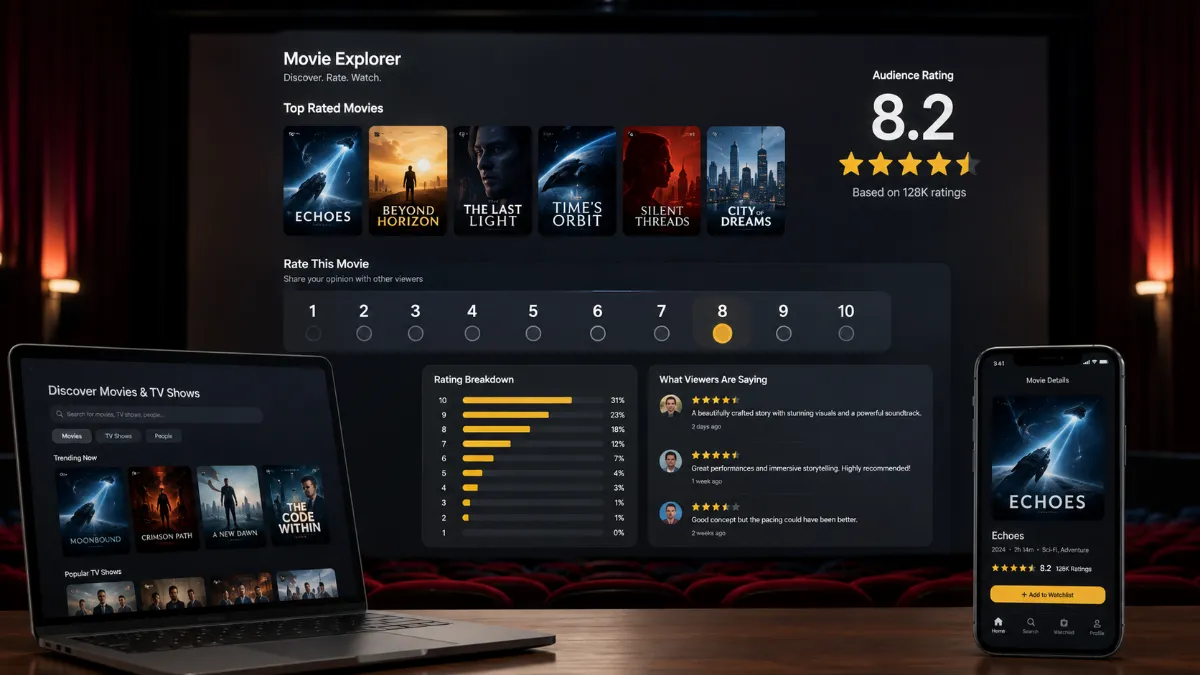
When you are deciding whether a movie is worth watching, one of the first things you may check is its IMDb score. But what is IMDb, who gives those ratings, and why can the number on the page differ from a simple average? Understanding how the system works makes the score much easier to interpret.
What Is IMDb?
Table of Contents
IMDb stands for Internet Movie Database. It is an online entertainment database covering movies, TV shows, cast and crew members, and other information about the entertainment industry. IMDb was launched online in 1990 and has been a subsidiary of Amazon since 1998.
IMDb is more than a rating website. Its services include title and name information, user ratings and reviews, watchlists, trailers, showtimes, entertainment news and other tools that help people discover what to watch.
The platform grew from a personal movie database created by Col Needham and developed into a community-driven entertainment information service. Amazon announced its acquisition of Internet Movie Database Ltd. in April 1998. The announcement said the three acquisitions in that transaction carried total charges of about $55 million, so the often-repeated claim that Amazon paid $55 million for IMDb alone is not precise.
Who Gives IMDb Ratings?
IMDb ratings come from registered IMDb users, not from a single professional critic or a panel of movie reviewers. A registered user can rate a released title from 1 to 10.
On IMDb, 1 represents a very negative opinion and 10 represents an excellent opinion. Users can change their rating, but a user has one rating for a particular title at a time; a new rating replaces the previous one.
This means the IMDb score is best understood as a summary of the opinions expressed by IMDb users. It is not the personal verdict of IMDb’s editors or a professional critics’ score.
How Does the IMDb Rating Work?
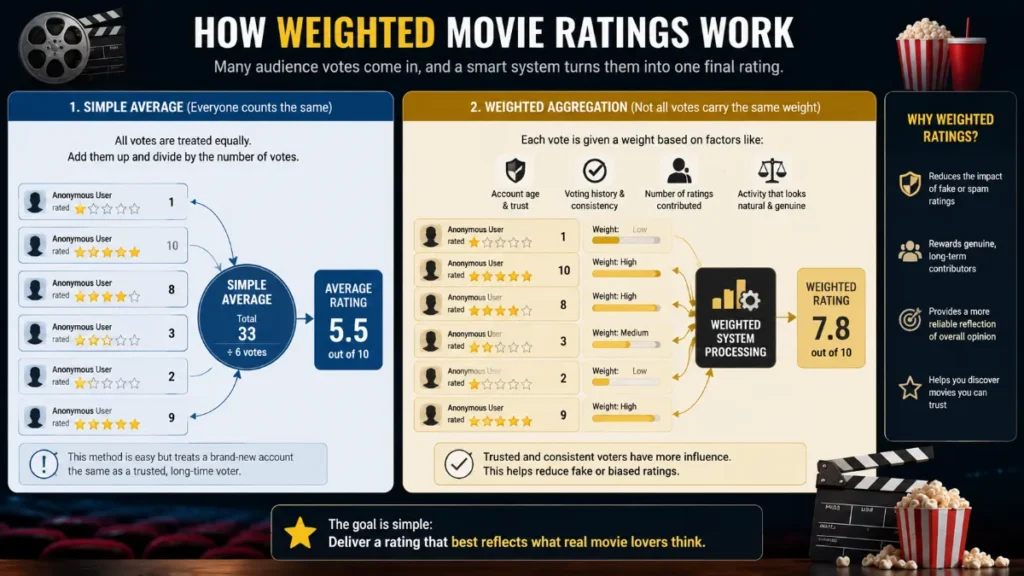
The most important point is that the IMDb score shown on a title page is not simply the arithmetic mean of all submitted ratings. IMDb uses a weighted average.
In a normal arithmetic average, every vote has exactly the same effect. For example, if 100 people gave a movie 10 and another 100 people gave it 1, the simple average would be 5.5. IMDb’s displayed rating can differ because its system gives ratings different weights.
IMDb says the exact weighting method is not publicly disclosed. When unusual voting activity is detected, IMDb can apply a different weighting calculation to protect the reliability of the rating and reduce attempts to manipulate it.
This is why the number of votes matters, but simply counting votes does not tell you exactly how much each vote contributes to the displayed score.
Why Doesn’t IMDb Publish the Exact Formula?
IMDb deliberately keeps the detailed weighting method private. The reason is straightforward: publishing every rule would make it easier for organized groups, bots or other bad actors to design voting activity specifically to influence the score.
IMDb describes its system as a set of safeguards intended to reduce ballot stuffing and unusual voting patterns. The platform says these calculations are applied automatically rather than being manually adjusted by someone deciding which movie deserves a higher or lower rating.
Importantly, this does not mean that IMDb can prove every voter has watched a title. IMDb says there is no foolproof way to verify that every person has actually seen what they rate. Instead, the system uses safeguards to reduce the impact of attempts to distort the aggregate result.
Why Can a Movie’s Rating Change Even When the Vote Count Barely Changes?
IMDb ratings can move for several reasons. Users can delete or change their ratings, the weight assigned to some ratings can change, and IMDb can periodically adjust the formulas used to calculate weighted ratings and counter manipulation.
Movies with relatively few ratings can be especially volatile. When the total number of ratings is small, a comparatively small number of additional votes can have a noticeable effect on the displayed score.
As a result, an early IMDb rating should not automatically be treated as a permanent measure of a movie’s quality. A score can settle as more people rate the title.
Does the Number of Ratings Matter?
Yes. The rating itself tells only part of the story. A score supported by a large number of ratings generally gives you more information about the broader IMDb voting population than a very high or low score based on only a handful of votes.
IMDb also withholds the displayed user rating until a released title has received enough ratings to calculate a weighted score; IMDb’s current help documentation says the minimum is five ratings.
For that reason, it is useful to look at both the score and the number of ratings rather than treating a single decimal number as a complete review.
Can Fans or Haters Manipulate an IMDb Rating?
IMDb is aware of attempts to inflate or deflate title ratings. Its weighting system is specifically designed to reduce the effect of unusual activity and organized ballot stuffing.
That does not mean manipulation attempts never happen. It means IMDb uses safeguards intended to limit their influence on the displayed weighted rating. The exact signals and weighting rules are not publicly disclosed.
This is also why a sudden burst of ratings should not automatically be interpreted as proof that a movie has genuinely become much more popular or unpopular.
IMDb Rating vs. Other Movie Rating Platforms
Different platforms answer slightly different questions, so their scores should not be treated as interchangeable.
| Platform | Main rating source | What it helps you understand |
| IMDb | IMDb user ratings | Audience sentiment on a 1–10 scale, using a weighted aggregate |
| Rotten Tomatoes | Tomatometer: approved critics; Popcornmeter: audience ratings | Separates professional critical response from audience response |
| Metacritic | Critic reviews for Metascore; also has user ratings | A critic-focused score on a 0–100 scale, alongside a separate user score |
| BookMyShow | Registered-user movie ratings | Viewer ratings within a ticketing and entertainment platform |
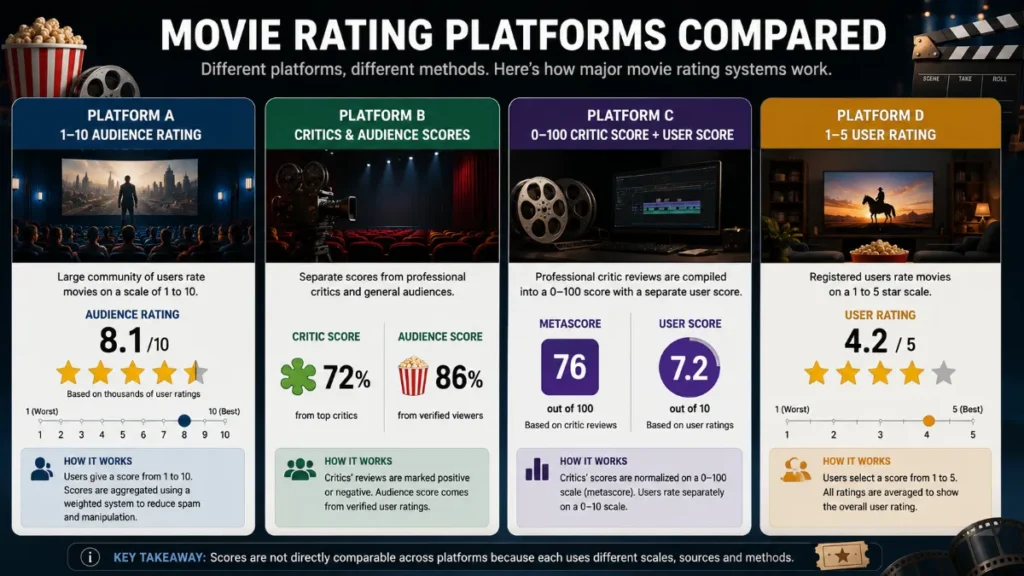
For Rotten Tomatoes, the Tomatometer represents the percentage of positive reviews from approved critics, while the Popcornmeter represents audience sentiment. Metacritic’s Metascore is based on professional critics, while the service also provides a separate user score. These differences explain why the same movie can receive very different numbers across platforms.
Is IMDb a Reliable Way to Decide Whether to Watch a Movie?
IMDb can be a useful starting point, but it should not be treated as an objective measurement of a movie’s quality.
A rating is a snapshot of what a particular community of viewers thinks. Your preferences may be very different from the average IMDb user. Genre, language, age, expectations, fandom, cultural context and the type of audience attracted to a particular title can all influence how you respond to it.
A practical approach is to use the IMDb score as one signal, then look at the number of ratings, read a few user reviews, check professional reviews when relevant, and consider whether the movie matches your own interests.
What About IMDb Top 250?
The IMDb Top 250 uses a different calculation from the ordinary title-page rating. IMDb says the Top 250 calculation is a Bayesian estimate that takes into account the number of ratings, a minimum number of ratings required for the chart, and the mean rating across titles.
IMDb also says only votes from regular IMDb voters are considered for the Top 250 charts, and the criteria for being classified as a regular voter are deliberately not disclosed.
So a movie can have a very high average user rating and still not appear on the Top 250. The chart is not simply a list sorted by the raw average shown in the ratings breakdown.
Can a Producer Sue IMDb Because a Movie Has a Low Rating?
A low rating by itself is not the same thing as a defamatory statement. A viewer expressing an honest opinion such as ‘I did not enjoy this movie’ is different from publishing a false factual allegation about a person or company.
The legal position is more complicated than saying that IMDb can never be sued. In India, Section 79 of the Information Technology Act, 2000 provides certain exemptions from intermediary liability subject to statutory conditions. Whether a particular platform receives protection depends on the facts and applicable law; Section 79 should not be treated as blanket immunity.
Because defamation and intermediary-liability questions can depend on the exact statement, platform conduct and jurisdiction, anyone involved in an actual dispute should obtain advice from a qualified lawyer rather than relying on a general explanation of Section 79.
IMDb’s Former Message Boards
IMDb once had message boards where users could discuss movies and other topics. IMDb permanently closed the message boards and private messaging system on February 20, 2017.
IMDb said the boards were no longer providing a positive, useful experience for the vast majority of its users and that the decision followed a review based on data and traffic. The boards are therefore not part of today’s IMDb experience, although users can still rate titles, write reviews and use other community features.
What Is an IMDb Account Used For?
An IMDb account lets users interact with many of the platform’s personalized features. Depending on the feature, you can use an account to:
- Rate movies and TV shows you have seen.
- Maintain a Watchlist.
- Create and share lists.
- Check in and share what you are watching.
- Receive personalized recommendations and notifications.
- Contribute information and reviews to the IMDb community.
Is There an IMDb App?
Yes. IMDb offers mobile apps for Android and iOS. The apps provide access to title and name information, ratings and reviews, watchlists and other entertainment features. IMDb’s current Android documentation says the app is free and available internationally.
What Is the IMDb Dataset?
IMDb also provides structured entertainment data for developers and businesses through its data products. Its developer documentation covers information such as titles, names, credits, ratings and other metadata. IMDb also provides bulk datasets and API-related documentation for supported data products.
The dataset is therefore different from the consumer-facing IMDb website: it is structured data that can be used for technical and analytical purposes under the applicable IMDb terms and licensing conditions.
What Does an IMDb Credit Mean?
An IMDb credit identifies a person’s credited involvement with a title, such as an actor, director, writer or another cast or crew role. IMDb’s database contains title and name information and uses unique identifiers for titles and people, making it possible to distinguish individual entries in its data.
How to Read an IMDb Score More Sensibly
If you are checking a movie before deciding whether to watch it, use this simple checklist:
- Look at the IMDb score.
- Check how many users have rated the title.
- Remember that the displayed score is weighted, not a simple arithmetic mean.
- Read a few user reviews to understand why people liked or disliked it.
- Compare critic and audience reactions when the distinction matters.
- Consider your own tastes instead of assuming a high score guarantees that you will enjoy the movie.
Frequently Asked Questions
What is IMDb rating?
An IMDb rating is a 1–10 user rating aggregated into a single title score. IMDb uses a weighted average rather than a simple arithmetic mean, and it keeps the detailed weighting method private.
What does IMDb stand for?
IMDb stands for Internet Movie Database.
What is IMDb score?
The IMDb score is the weighted aggregate user rating displayed for a movie, TV series or other released title on IMDb.
What is IMDb app?
The IMDb app is IMDb’s mobile application for Android and iOS, providing access to entertainment information, ratings, reviews, watchlists and other features.
What is an IMDb account?
An IMDb account is a user account that enables features such as rating titles, maintaining a Watchlist, creating lists and using personalized IMDb services.
What is IMDb dataset?
IMDb datasets are structured collections of IMDb entertainment data made available for supported technical and data-use purposes. IMDb’s developer documentation describes title, name, credit, rating and other data products.
What is an IMDb credit?
An IMDb credit records a person’s credited role or involvement in a movie, TV show or other title, such as acting, directing or writing.
Conclusion
IMDb is a large entertainment information platform, but its rating system is what makes it especially useful when people are deciding what to watch. The key point is that the displayed IMDb score is a weighted aggregate of user ratings, not a simple average and not the verdict of a professional critic.
Because IMDb keeps its detailed weighting rules private and uses safeguards against unusual voting activity, the score should be read as a broad signal of user opinion rather than an absolute judgment of quality. Looking at the rating together with the number of votes, reviews and your own preferences gives you a much more useful picture.
Want to understand a movie before watching it? Check its IMDb score, read a few reviews, and then decide whether it matches your taste.
Further Reading
IMDb: Ratings FAQ
IMDb: What is IMDb?
IMDb Developer: Data and API documentation
India Code: Information Technology Act, 2000
Rotten Tomatoes: About the Tomatometer and Popcornmeter
Read more about Entertainment –Entertainment – A1-InfoHub

