


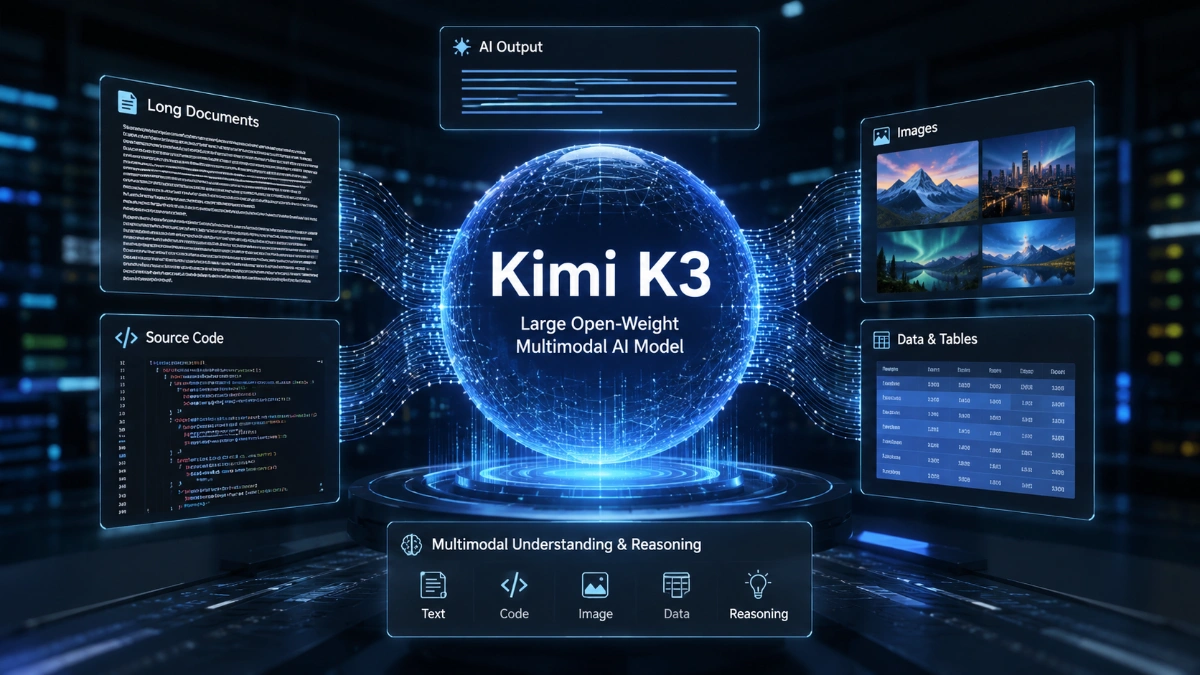
Kimi K3 is Moonshot AI’s 2.8-trillion-parameter, open-weight multimodal AI model, designed for long-context reasoning, coding, knowledge work and agentic tasks. It supports a 1-million-token context window and activates about 104 billion parameters per token through a sparse Mixture-of-Experts architecture. Moonshot AI released Kimi K3 on July 16, 2026, and released its full model weights on July 27, 2026.
What Is Kimi K3?
Kimi K3 is the flagship AI model developed by Moonshot AI, the company behind the Kimi family of AI products. It is an open-weight, native multimodal model built for demanding tasks such as software engineering, long-form reasoning, research and other workflows where an AI system needs to work through large amounts of information.
The model has 2.8 trillion total parameters, making it a 3-trillion-parameter-class model. Unlike a conventional dense model that uses the full network for every token, Kimi K3 uses a sparse Mixture-of-Experts (MoE) design. Its architecture selects a small group of experts for each token, with 16 of 896 routed experts selected per token and about 104 billion parameters activated.
Table of Contents
When Did Kimi K3 Come Out?
Moonshot AI announced and released Kimi K3 on July 16, 2026. At launch, the model was available through Kimi products and the Kimi API. The company subsequently published the full model weights and technical report on July 27, 2026.
This distinction matters because the model’s initial product/API availability and the later public release of its weights were separate milestones. As of the July 27 release, developers can access the published open-weight model rather than relying only on a hosted API.
Key Features of Kimi K3
2.8 Trillion Parameters
Kimi K3 contains 2.8 trillion total parameters. Parameters are learned values inside an AI model that help it represent patterns and relationships in its training data. A large parameter count does not automatically mean a model is better, but it indicates the scale of the model.
Sparse Mixture-of-Experts Architecture
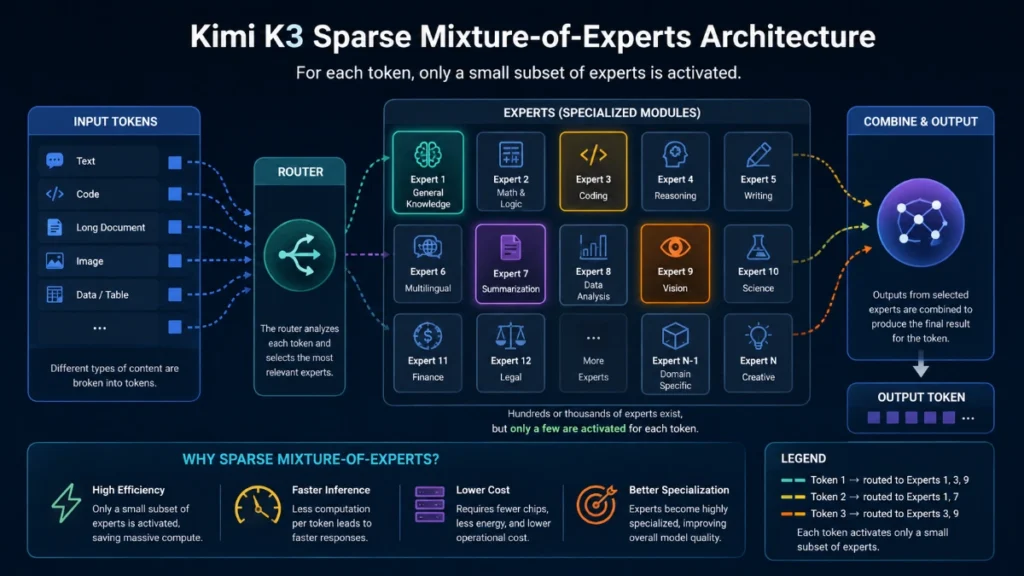
Kimi K3 uses a sparse Mixture-of-Experts architecture. It has 896 routed experts, while 16 experts are selected for each token. This means the model can have a very large overall capacity without activating every parameter for every piece of input.
In practical terms, this is similar to having a large organization with many specialist teams but assigning only the teams relevant to a particular task. The approach is intended to improve computational efficiency while preserving a large model capacity.
1-Million-Token Context Window
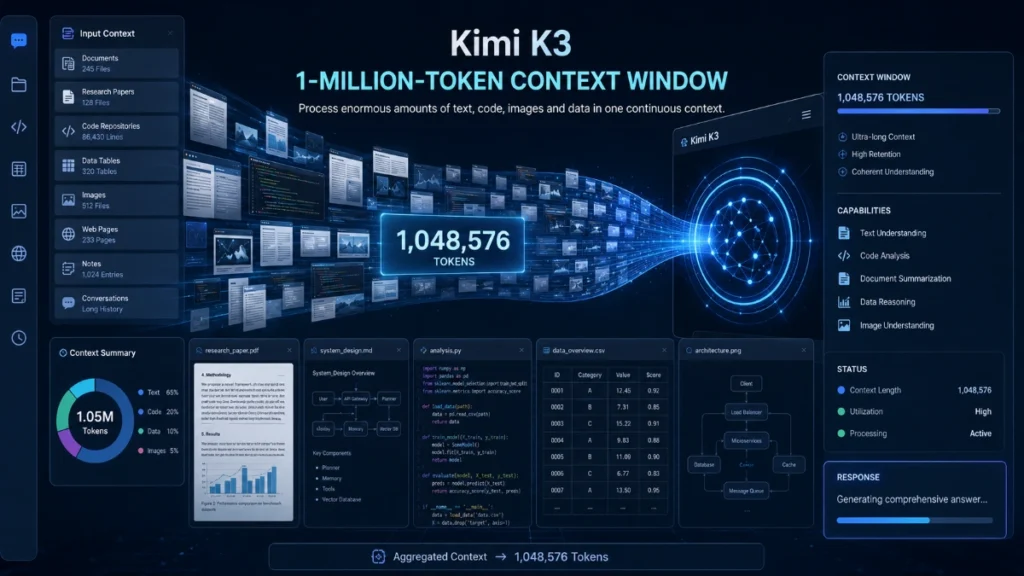
Kimi K3 supports a context length of 1,048,576 tokens. A large context window allows the model to work with unusually large amounts of information in a single task, which can be useful for large codebases, lengthy documents and extended research workflows.
A 1-million-token limit should not be interpreted as a guarantee that every million-token task will produce equally strong results. Performance can depend on the task, the information provided and how the context is organized.
Native Multimodal Capabilities
Kimi K3 is a native multimodal model with vision capabilities. Its published model information identifies text and image input support, while Moonshot describes K3 as capable of working across multimodal knowledge-work and agentic scenarios.
Kimi Delta Attention and Attention Residuals
The architecture incorporates Kimi Delta Attention (KDA) and Attention Residuals (AttnRes). Moonshot says these architectural changes, together with its sparse MoE design and training improvements, provide substantially better scaling efficiency than Kimi K2.
These techniques are important because increasing model size can make training and inference increasingly expensive. K3’s design attempts to improve the amount of useful model capability obtained from available computing resources.
What Can Kimi K3 Be Used For?
Kimi K3 is positioned for tasks that go beyond ordinary question answering. Its published capabilities include long-horizon coding, knowledge work, reasoning and agentic workflows.
- Software development, code generation, code review and work across large repositories
- Long-form research and analysis involving large amounts of information
- Reasoning and problem-solving tasks
- Working with images alongside text
- Agentic workflows that involve tools and multiple steps
- Generating and transforming complex knowledge-work outputs
Is Kimi K3 Open Source or Open Weight?
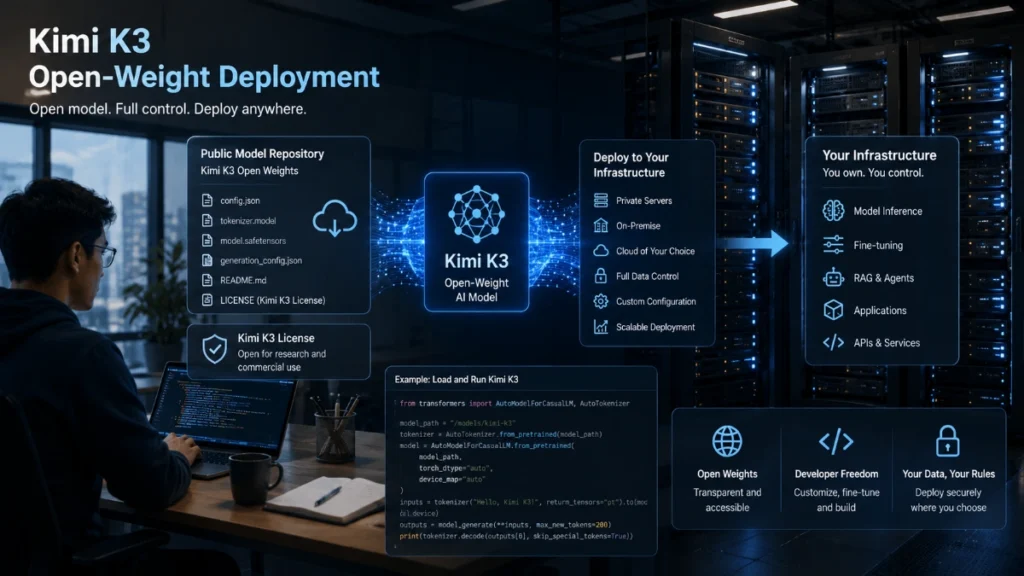
Kimi K3 is more accurately described as an open-weight model. Moonshot AI released the model weights publicly on July 27, 2026 under the Kimi K3 License. The official model repository is available through Hugging Face, and the model can also be deployed using supported inference software.
The terms “open source” and “open weight” are sometimes used interchangeably in AI discussions, but they are not identical. For Kimi K3, the safest description is open-weight, with the specific license governing how the released model can be used and redistributed.
Kimi K3 Pricing: How Much Does It Cost?
Kimi K3’s API uses usage-based pricing rather than a single flat price. The current Kimi API pricing page lists the following rates per 1 million tokens:
| Usage | Price per 1M tokens | What it means |
| Cached input | $0.30 | Previously cached input tokens |
| Input | $3.00 | New input tokens sent to the model |
| Output | $15.00 | Tokens generated by the model |
These are API rates and should not be confused with the cost of running the open-weight model yourself. Self-hosting involves hardware, memory, electricity, software and operational costs, and the published model files are very large.
Why Did Kimi K3 Affect AI and Chip Stocks?

Kimi K3 also attracted attention beyond the AI-model market because its launch revived a question that emerged during the DeepSeek episode: if powerful AI systems can be built and served more efficiently, could the industry need less expensive computing infrastructure than investors had expected?
The concern was reflected in semiconductor-market trading around the launch. Reuters reported that Asian semiconductor shares fell sharply on July 28 amid a combination of concerns about AI infrastructure financing and growing Chinese competition, with Kimi K3 among the developments affecting sentiment.
However, it would be misleading to say that Kimi K3 alone determines the future demand for AI chips. K3 itself is a large model, and its popularity can also create additional demand for computing capacity. Moonshot temporarily paused new subscriptions after demand for K3 strained its computing capacity, illustrating that efficient models can still require substantial infrastructure at scale.
Why Kimi K3 Matters
The significance of Kimi K3 is not simply its parameter count. Its combination of very large total capacity, sparse expert activation, long context, native multimodality and open weights shows how frontier-level AI development is increasingly focusing on efficiency and deployability as well as raw scale.
For developers and organizations, open weights can provide more control over deployment and experimentation than a hosted-only model. At the same time, the size and operational requirements of K3 mean that self-hosting is not a lightweight undertaking.
Frequently Asked Questions About Kimi K3
What is Kimi K3?
Kimi K3 is Moonshot AI’s 2.8-trillion-parameter open-weight, native multimodal AI model. It uses a sparse Mixture-of-Experts architecture, supports a 1-million-token context window and is designed for reasoning, coding, knowledge work and agentic tasks.
When will Kimi K3 model weights be released?
The full Kimi K3 model weights were released on July 27, 2026. Moonshot AI announced the model on July 16 and subsequently published the weights and technical report on July 27.
When did Kimi K3 come out?
Kimi K3 was released on July 16, 2026. Its full open-weight release followed on July 27, 2026.
How does Kimi K3 pricing work?
Kimi K3 uses usage-based API pricing. The current Kimi API page lists $0.30 per 1 million cached input tokens, $3.00 per 1 million input tokens and $15.00 per 1 million output tokens. Self-hosting is a separate cost because it requires suitable hardware and infrastructure.
Conclusion
Kimi K3 is a major open-weight AI release from Moonshot AI, combining a 2.8-trillion-parameter sparse MoE architecture with a 1-million-token context window, native multimodal capabilities and a focus on long-horizon reasoning and agentic work. Its July 2026 release also highlighted a broader shift in AI: the competition is increasingly about how efficiently powerful models can be trained, served and deployed—not only how large they are.
Sources: Moonshot AI/Kimi official materials, Kimi API pricing, and the official Kimi K3 model repository.
Official references: Kimi K3 technical announcement · Kimi API pricing · Kimi K3 model repository
read more about Technology:Technology – A1-InfoHub

