


Geothermal Energy in India
Imagine generating electricity without relying directly on sunlight, wind, or burning coal. Instead, the energy comes from the natural heat stored deep beneath the Earth’s surface.
That is the basic idea behind geothermal energy.
India is now exploring this energy source through a major project in Puga Valley, Ladakh, where ONGC has drilled two geothermal wells. The project is planned initially as a 1 MW pilot, with much larger expansion discussed for the future.
But what exactly is geothermal energy, how does it generate electricity, and why is India’s Puga Valley important?
Table of Contents
What Is Geothermal Energy?
The word geothermal comes from two ideas: geo, meaning Earth, and thermal, meaning heat.
In simple terms, geothermal energy means using the natural heat stored inside the Earth.
Deep underground, temperatures can become extremely high. In areas where underground heat is accessible, this heat can warm groundwater and produce hot water or steam. That heat can then be used to drive equipment such as turbines and generate electricity.
Unlike solar power, which depends on sunlight, or wind power, which depends on wind conditions, geothermal energy can provide a more continuous source of power when suitable underground resources are available.
ONGC’s Geothermal Project in Puga Valley, Ladakh
One of India’s important geothermal developments is taking place in Puga Valley in Ladakh.
According to the source, the geothermal wells are located at an altitude of around 14,000 feet above sea level. Working at such a high altitude creates difficult conditions, including very cold temperatures and reduced oxygen availability.
Despite these challenges, ONGC engineers drilled two geothermal wells, each reaching approximately 1,000 metres, or about one kilometre, in depth.
The project initially targets approximately 1 MW of electricity generation.
Two Geothermal Wells Have Been Drilled
The project experienced a period of interruption after the agreement between the Ladakh administration and ONGC expired. The source says that the agreement was subsequently renewed for five years, after which work progressed more quickly.
The first well was completed on May 22, while the second was completed around July 8. The two wells were officially inaugurated on July 17, according to the transcript.
The project is therefore being presented as an important early step in India’s attempt to develop geothermal energy.
What Temperatures Were Found Underground?
One of the most significant findings mentioned in the source is the temperature detected underground.
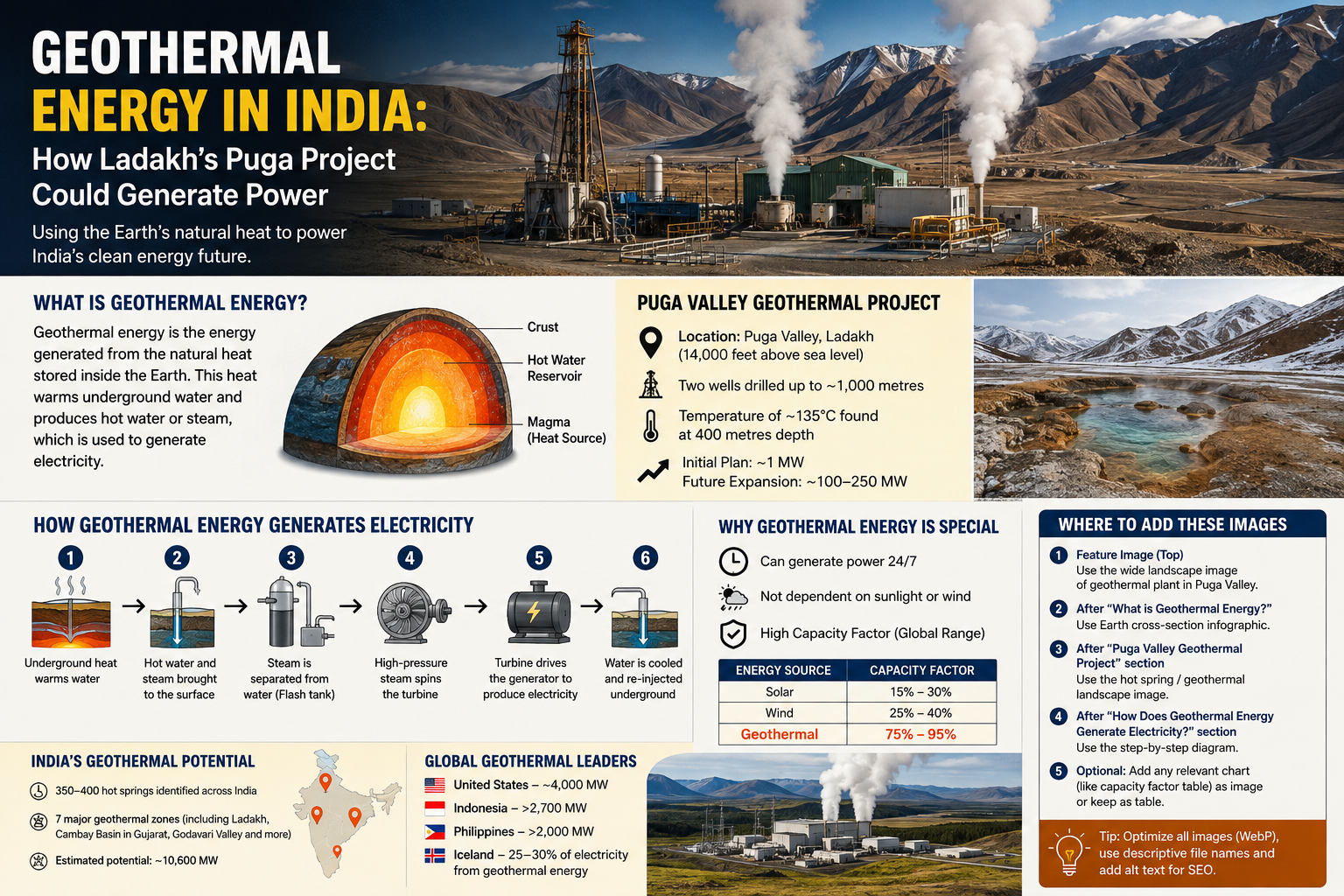
At a depth of approximately 400 metres, temperatures of around 135°C were reported.
The source notes that water boils at 100°C under normal conditions, making the reported underground temperature particularly significant for geothermal applications.
It also states that engineers expect temperatures to exceed 240°C if the well reaches a depth of approximately one kilometre.
The initial project is planned at around 1 MW, while a future expansion to approximately 100–250 MW is discussed in the source.
How Does Geothermal Energy Generate Electricity?
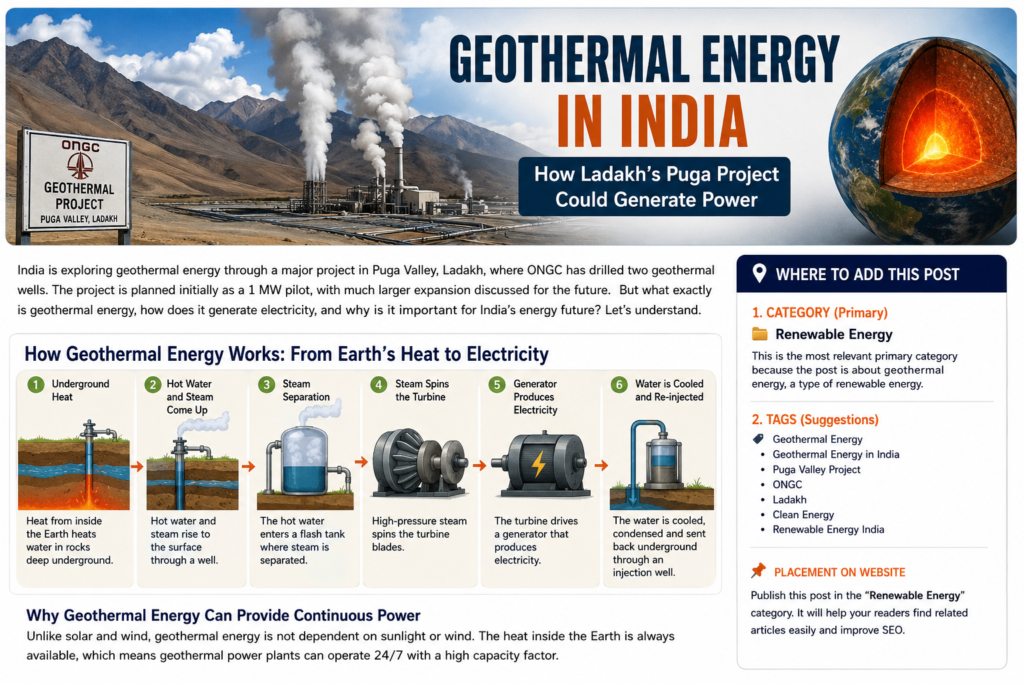
The basic process can be understood in several stages.
1. Underground Heat Warms Water
Heat stored beneath the Earth’s surface heats groundwater.
In geothermal regions, this can create extremely hot water and steam.
Puga Valley is described in the source as an area with hot-water springs, indicating the presence of significant underground thermal activity.
2. Hot Water and Steam Are Brought to the Surface
Geothermal wells provide a pathway for hot water and steam to reach the surface.
The source describes bringing hot water and steam upward through wells under pressure.
3. Steam Is Separated From Water
The hot fluid can be sent into a flash tank, where the water and steam are separated.
The high-pressure steam can then be directed toward a turbine.
4. Steam Spins a Turbine
High-pressure steam moves rapidly through the turbine.
The force of the steam causes the turbine to rotate.
This principle is similar to the basic turbine-generator process used in other electricity-generation systems where heat is used to produce steam.
5. The Generator Produces Electricity
The turbine is connected to a generator.
As the turbine rotates, mechanical energy is converted into electrical energy.
The generated electricity can then be supplied to the power grid.
6. Water Is Cooled and Re-injected
After passing through the turbine system, the steam can be cooled through a condenser and converted back into water.
The source describes returning this water underground through another well known as an injection well.
This helps maintain the underground water system rather than simply removing the water from the geothermal reservoir.
Where Does Earth’s Underground Heat Come From?
The Earth’s interior contains enormous amounts of heat.
The source explains that temperatures toward Earth’s central region can reach approximately 5,200–6,000°C.
It attributes Earth’s internal heat partly to the enormous heat generated during Earth’s formation billions of years ago and retained within the planet.
Another source of heat mentioned is radioactive decay involving elements such as uranium, thorium and potassium.
This underground heat can warm groundwater. In suitable geological areas, the heated water can rise or move through fractures and eventually appear at the surface as hot-water springs.
This natural process is central to geothermal energy.
Why Can Geothermal Energy Provide Continuous Power?
One of the biggest advantages highlighted in the source is that geothermal energy is not directly dependent on daylight or wind.
Solar power depends on sunlight. Electricity generation from solar panels decreases or stops when sunlight is unavailable.
Wind power, meanwhile, depends on sufficient wind speed.
Geothermal heat underground can remain available regardless of whether it is day or night or whether weather conditions change at the surface.
This makes geothermal energy particularly interesting for applications that require continuous electricity, such as:
- Hospitals
- Railway systems
- Airports
- Data centres
- Other systems that need reliable electricity around the clock
Geothermal Capacity Factor
The source also highlights capacity factor, which describes how much electricity a power plant generates compared with what it could produce if it operated at full capacity continuously.
The transcript gives the following approximate figures:
| Energy Source | Capacity Factor Mentioned |
|---|---|
| Solar | 15–30% |
| Wind | 25–40% |
| Geothermal | 75–95% |
These figures are presented in the source as global ranges.
The key point is that geothermal plants can potentially operate for long periods without the same direct dependence on sunlight or wind.
Geothermal Energy vs Solar and Wind Energy
India already uses large amounts of solar and wind power, and both are important renewable-energy sources.
However, their output can vary depending on environmental conditions.
Solar generation changes with the availability of sunlight. Clouds and nighttime conditions can reduce solar output.
Wind generation similarly depends on wind speed.
Geothermal energy works differently because the source of the energy is underground heat.
This means geothermal power can potentially complement variable renewable sources by providing electricity more continuously.
Rather than relying on a single energy source, a country can use multiple sources to create a more diversified electricity system.
Which Countries Already Use Geothermal Energy?
Geothermal power is not a completely new technology globally.
The source states that approximately 17,173 MW of geothermal electricity is being generated worldwide.
It identifies the following countries as major geothermal-power producers:
United States
The United States is described as the world’s leading geothermal-power producer, with approximately 4,000 MW of geothermal electricity generation mentioned in the transcript.
Indonesia
Indonesia is identified as another major producer, with more than 2,700 MW of geothermal generation mentioned.
Philippines
The Philippines is described as producing more than 2,000 MW through geothermal energy.
Iceland
Iceland is another important example.
The source highlights the country’s extensive use of geothermal heat for heating and electricity. It states that around 90% of homes have heating systems supplied using this underground heat and that approximately 25–30% of the country’s electricity comes from geothermal energy.
These examples show that geothermal resources can be used not only for electricity but also for heating.
India’s Geothermal Energy Potential
India has geothermal resources in several parts of the country.
According to the source, the Geological Survey of India (GSI) has identified approximately 350–400 hot-water springs across the country.
The transcript also identifies seven major geothermal zones, including areas such as:
- Ladakh
- Cambay Basin in Gujarat
- Godavari Valley
The source estimates India’s geothermal electricity-generation potential at approximately 10,600 MW.
These figures suggest that the Puga Valley project is only one part of a potentially much larger geothermal opportunity.
India’s Geothermal Zones and Hot Springs
Hot-water springs are important indicators of underground geothermal activity.
The presence of these resources in different regions provides opportunities to investigate whether the underground heat can be used for electricity generation or other applications.
Puga Valley is therefore significant not simply because of its location in Ladakh, but because it represents an attempt to convert India’s geothermal resources into usable energy.
The Potential for Future Geothermal Power
The Puga project is described as an initial 1 MW pilot project.
The source discusses a possible future expansion to approximately 100–250 MW.
If such expansion becomes technically and economically viable, the project could become much larger than its initial pilot stage.
The transcript presents the development as an early step toward establishing Ladakh as a clean-energy region.
What Could Geothermal Energy Mean for India’s Energy Future?
India’s energy system uses multiple sources, including fossil fuels and renewable energy.
Geothermal energy could add another option to this mix.
Its most important characteristic is its potential for continuous generation, which can complement renewable sources whose output changes with weather or time of day.
The Puga Valley project therefore represents more than simply the drilling of two wells. It is an attempt to explore whether India’s underground heat can become a practical source of electricity.
If geothermal resources can be developed successfully in suitable regions, they could become another component of India’s broader clean-energy strategy.
Conclusion
Geothermal energy in India is moving from resource exploration toward practical experimentation through projects such as the Puga Valley development in Ladakh.
The ONGC project has drilled two geothermal wells of approximately one kilometre depth, with the initial plan targeting around 1 MW of electricity generation. The source reports temperatures of about 135°C at around 400 metres and discusses the possibility of much higher temperatures at greater depths.
The technology itself is straightforward in principle: underground heat produces hot water and steam, the steam drives a turbine, the turbine powers a generator, and the resulting electricity can be supplied to the grid. Water can then be condensed and returned underground through an injection well.
The major attraction is the possibility of producing electricity continuously without depending directly on sunlight or wind.
For India, the Puga project could therefore serve as an important experiment in using a resource that already exists beneath the country’s surface.
As India explores multiple energy options, geothermal power could become another piece of the country’s evolving clean-energy puzzle.
Also Read:How Artificial Rain Is Created and Why It Cannot End a Drought

