


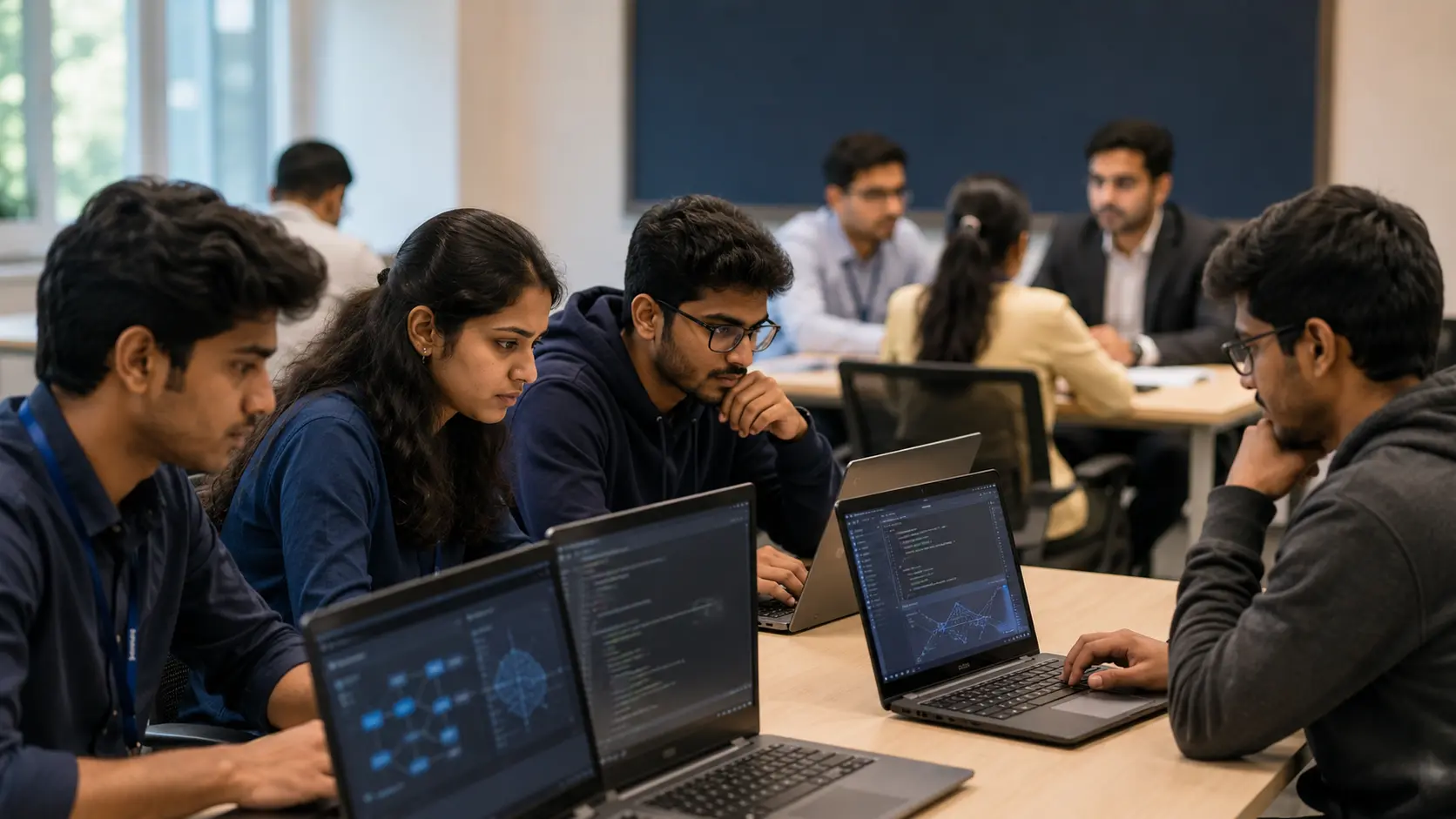
AI Skills in Campus Hiring– Instead of relying only on large-scale recruitment of graduates with basic programming knowledge, IT services companies are increasingly looking for freshers who can demonstrate specialised skills in AI, cybersecurity, cloud computing, data engineering and AI deployment.
A recent report from HirePro and industry reporting show that specialised hiring is becoming a larger part of campus recruitment. The shift does not mean traditional software skills are disappearing; it means the bar for entry-level candidates is moving toward practical, job-ready capabilities.
What is changing in IT campus hiring?
For years, large IT services companies built their entry-level workforce through high-volume campus recruitment. Graduates were often selected through academic records, aptitude tests and basic technical assessments, followed by company-specific training before moving into project work.
That model is not disappearing, but it is becoming more selective. According to Business Standard’s July 2026 reporting based on HirePro data, differential-salary hiring for specialised skills accounts for around 30% to 40% of overall campus hiring and is expected to rise to 45% to 55% in FY2026-27.
The important point is that this percentage refers to specialised or differential-salary hiring within campus recruitment. It should not be interpreted as meaning that 30% to 40% of all IT jobs are AI jobs.
Why AI skills are becoming more valuable
Generative AI is changing the type of work traditionally assigned to new software engineers. Routine coding, basic testing, documentation and other repetitive tasks can increasingly be supported or automated by AI tools.
At the same time, companies need engineers who can use AI systems in real business environments. That includes understanding model behaviour, evaluating outputs, building workflows, connecting AI systems to existing software and deploying solutions for customers.
This is why the market is moving from a simple question—’Can this graduate code?’—toward a broader question: ‘Can this graduate use technical and AI skills to solve a real problem?’
The rise of specialised freshers
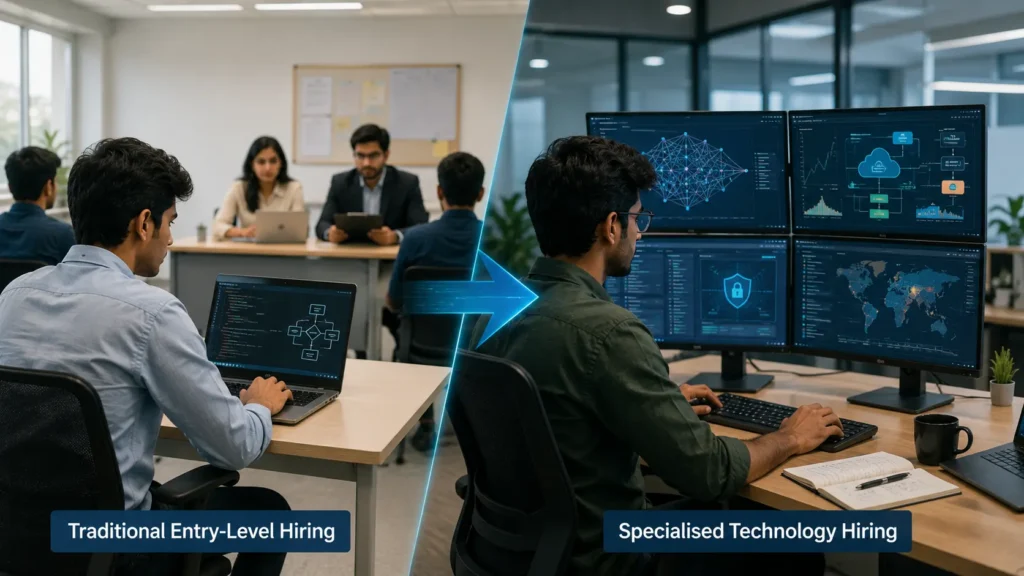
The premium is increasingly going to candidates with deeper technical capability rather than candidates who only have a degree and basic programming knowledge. HirePro’s data, reported by Business Standard, indicates that some specialised skill sets now attract salary packages as high as ₹15–16 lakh per year in certain cases.
The same report notes that differentiated pay is not entirely new. It began during the earlier shift toward cloud and digital skills, when companies started paying more for graduates with capabilities beyond traditional entry-level profiles.
| Hiring profile | Typical capability | What employers are signalling |
| Traditional fresher | Basic programming and core degree knowledge | Still relevant, but more competitive |
| Specialised fresher | AI, cloud, cybersecurity, data or other niche skills | Higher-value entry-level opportunities |
| AI deployment-oriented engineer | AI + software + business implementation | Strong demand for practical delivery skills |
Which skills are employers looking for?
The most useful approach for students is not to collect certificates randomly. Instead, build a combination of core software fundamentals and one or two specialised areas.
Artificial intelligence and machine learning fundamentals
Generative AI and practical AI application development
Prompt design and AI workflow automation
Model evaluation and AI-output quality assessment
Cloud computing and cloud-native development
Cybersecurity
Data engineering and data handling
API integration and deployment
Software engineering fundamentals
Business and communication skills for working with clients
The emphasis on practical capability is also consistent with Deloitte’s campus workforce research, which reported that 87% of engineers surveyed were pursuing AI/ML and data-science upskilling, while cybersecurity and robotics were among the skills associated with 10%–20% pay premiums in campus placements.
What are Forward Deployed Engineers?
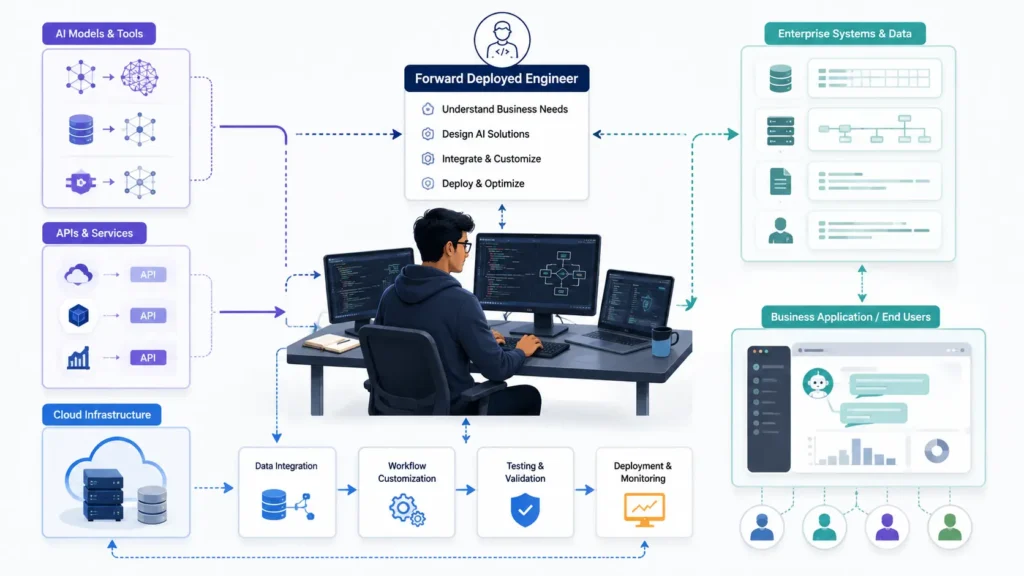
One of the clearest examples of the new hiring model is the Forward Deployed Engineer, or FDE. These engineers work close to enterprise customers and help deploy, customise and integrate AI solutions into real business workflows.
The role combines software engineering with AI knowledge, product thinking and customer-facing problem solving. A graduate targeting this kind of role therefore needs more than the ability to write code in isolation.
Recent industry reporting also shows that large Indian IT companies are building FDE capabilities. HCLTech, for example, has said it plans to focus on a smaller group of specialised freshers who can develop into FDEs over time.
What this means for college students
The biggest lesson is simple: a degree remains important, but it is increasingly only the starting point. Students who want stronger campus opportunities should demonstrate what they can actually build and deploy.
1. Strengthen programming fundamentals: Learn one main programming language properly and understand data structures, algorithms, APIs and software development basics.
2. Choose a specialisation: Pick a focused area such as AI/ML, cloud, cybersecurity, data engineering or AI application development.
3. Build practical projects: Create projects that solve realistic problems rather than relying only on course completion certificates.
4. Learn deployment: Understand how an application or AI workflow moves from development to a usable production environment.
5. Show your work: Maintain a clear GitHub portfolio, project documentation and a resume that explains your actual contribution.
6. Develop communication skills: Specialised roles often involve understanding business requirements and explaining technical solutions to other people.
Is a high salary guaranteed for AI-skilled freshers?
No. AI skills can improve a candidate’s competitiveness, but they do not guarantee a particular salary or job offer. Compensation depends on the employer, role, college, location, assessment performance, depth of skills, project quality and the company’s hiring needs.
The salary figures reported in the current campus-hiring coverage are best understood as examples of premium hiring for selected skill sets, not as standard salaries for every AI-trained graduate. Students should therefore avoid choosing a course solely because it advertises a high package.
A smarter way to prepare for the new hiring market
For a fresher, the strongest profile is usually a combination of fundamentals and specialisation. For example, a student could build solid Java or Python skills and then add cloud deployment, AI APIs, databases and a few practical AI projects.
This approach is more useful than trying to learn every trending AI tool. Tools change quickly, while programming fundamentals, problem solving, system understanding and the ability to learn new technologies remain valuable.
Final takeaway
AI skills in campus hiring are becoming a meaningful differentiator in India’s technology sector. HirePro data cited in 2026 industry reporting points to a continued rise in specialised hiring, while companies such as TCS and HCLTech are increasing their focus on higher-skilled entry-level talent.
For students, the message is not to abandon traditional software engineering. It is to build on it. Strong coding fundamentals plus practical AI, cloud, cybersecurity or data skills can create a much stronger profile for the changing campus market.
Sources & further reading
HirePro — The State of College Hiring in India 2026. Business Standard — Advanced skills dictate IT firms’ campus hiring as AI reshapes demand. Deloitte India — Campus Workforce Trends.
A1InfoHub note: Salary ranges and hiring trends vary by company and role. The figures in this article are reported industry figures or examples, not guaranteed offers.

