


Introduction
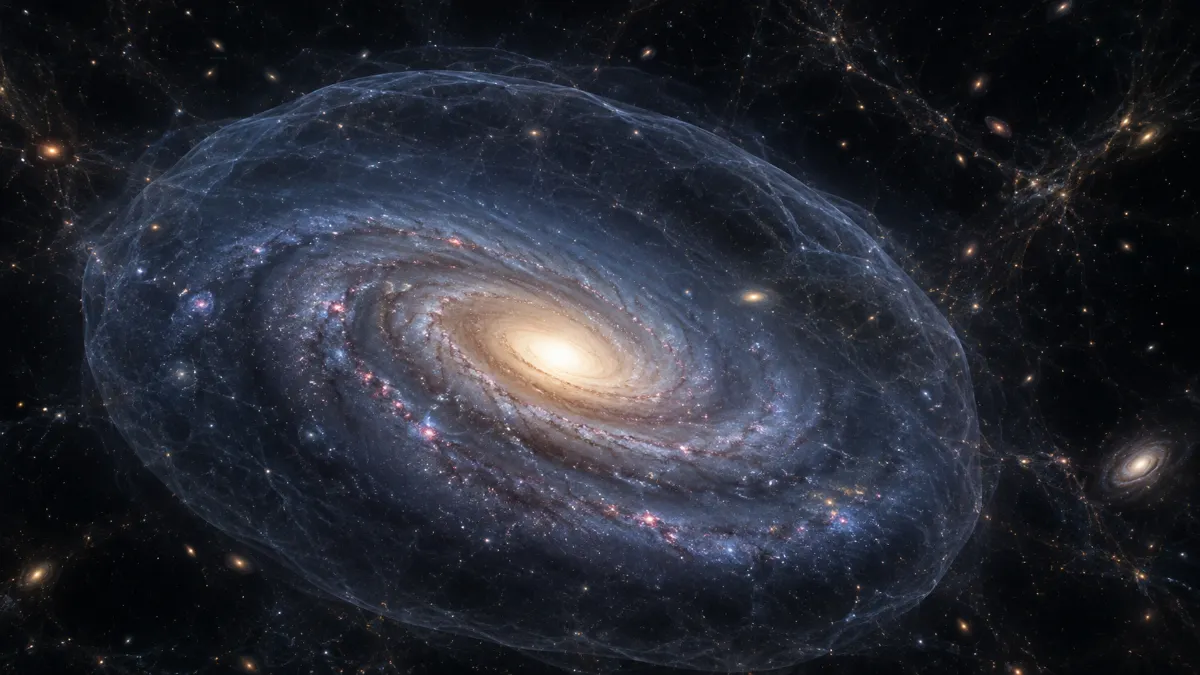
What is dark matter simplified? Dark matter is an invisible form of matter that does not emit, reflect, or absorb light in a way our telescopes can directly detect. Scientists know it is there mainly because its gravity affects stars, galaxies, galaxy clusters and even the path of light.
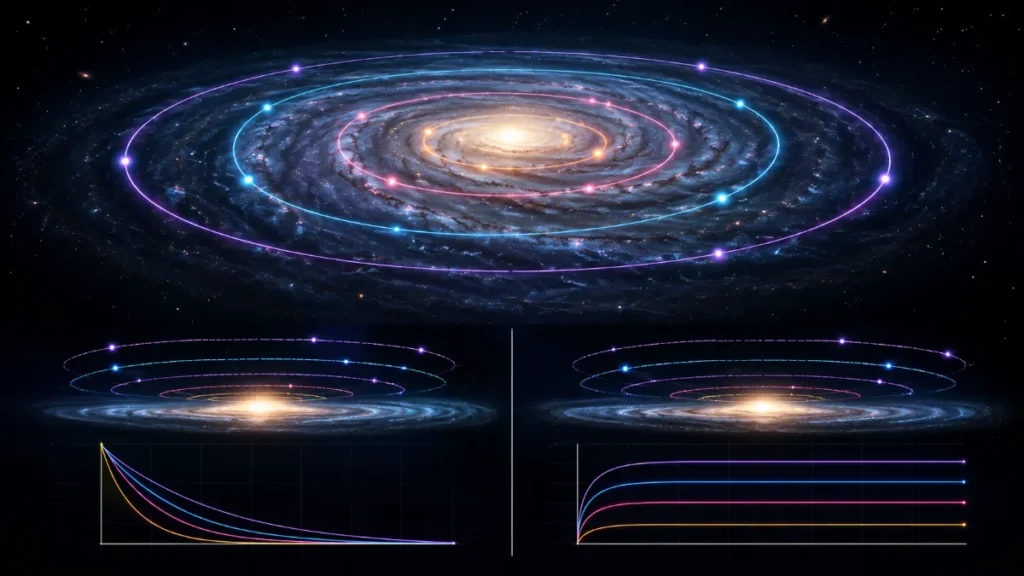
The mystery becomes easier to understand when you look at what galaxies are doing. Stars near the outer edges of many galaxies move much faster than the amount of visible matter alone seems able to explain. Something unseen appears to provide additional gravitational pull.
Dark matter is not simply black smoke or a dark cloud floating through space. It is a name for the unseen mass scientists infer from its gravitational effects. Current estimates put dark matter at about 27% of the universe, while ordinary matter makes up less than 5% and dark energy accounts for about 68%.
Table of Contents
What Is Dark Matter?
Dark matter is matter whose presence is inferred from gravity rather than from light. Unlike ordinary matter, it does not appear to interact strongly with electromagnetic radiation, so ordinary telescopes cannot directly see it.
A useful everyday analogy is wind. You cannot normally see wind itself, but you can see leaves moving because of it. In a similar way, astronomers cannot see dark matter directly, but they can measure how its gravity changes the motion and appearance of things they can see.
Scientists still do not know what dark matter is made of. Several possible particles and other explanations have been investigated, but no single candidate has been confirmed as the substance responsible for all of the observed effects.
Why Do Scientists Think Dark Matter Exists?
One of the clearest clues comes from the way stars move inside galaxies. If most of a galaxy’s mass were concentrated in the visible stars and gas, scientists would expect orbital speeds to decrease farther from the galactic centre. Instead, stars in the outer regions can continue moving at unexpectedly high speeds.
Astronomer Vera Rubin and her collaborators provided important evidence for this problem in the 1970s by studying the rotation of spiral galaxies. The observations showed that the visible material could not account for the observed motions without additional unseen mass.
This does not mean astronomers have photographed dark matter itself. The evidence is indirect but powerful: its gravitational influence shows up in several independent observations.
A simple example: the spinning galaxy
Imagine tying a stone to a string and swinging it around your hand. The tension in the string keeps the stone moving in a circle. If the string suddenly disappeared, the stone would fly away along its path.
A galaxy is not literally held together by a string, but the analogy helps explain the problem. The gravity produced by visible matter alone is often not enough to explain the observed motions of stars and gas. The additional gravity associated with dark matter helps account for why galaxies remain gravitationally bound.
How Can We Detect Something We Cannot See?
Astronomers detect dark matter by measuring its effects. Two especially important clues are the motion of matter and gravitational lensing.
1. The motion of stars and galaxies
The speeds and orbits of stars, gas and galaxies reveal how much gravitational mass is present. When the observed motion is stronger than visible matter can explain, scientists infer the presence of additional mass.
2. Gravitational lensing
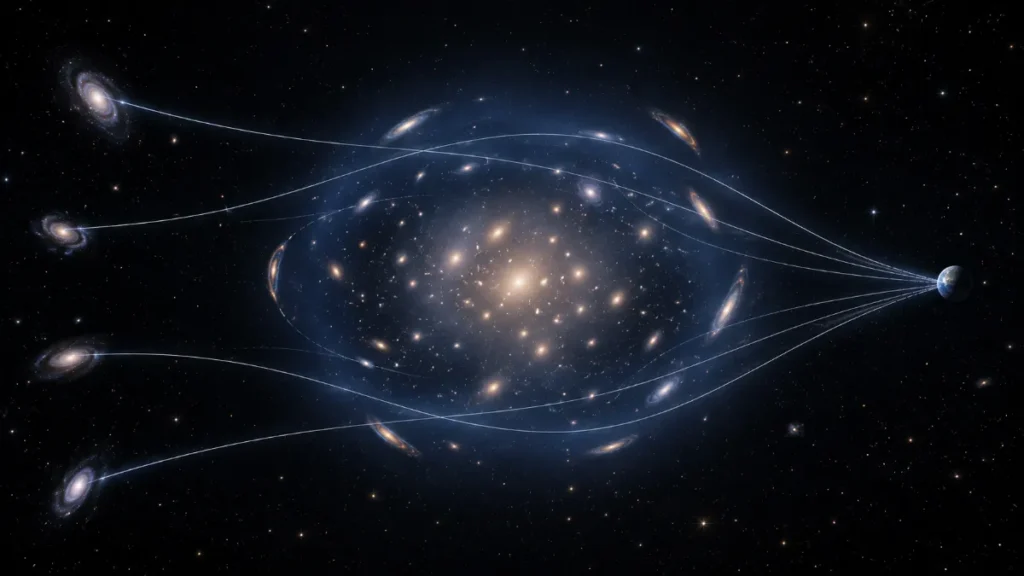
Gravity can bend the path of light. When light from a distant galaxy passes through a region containing a large amount of matter, the light can be distorted or magnified. Astronomers call this gravitational lensing.
Because dark matter contributes gravity even though it is not visible, lensing can help scientists map where unseen mass is located. In this sense, the shape of distant galaxies can act as a clue to the invisible mass between them and us.
Is Dark Matter the Same as Dark Energy?
No. Dark matter and dark energy are different ideas. Dark matter adds gravitational attraction and helps explain how galaxies and large-scale cosmic structures form and remain bound. Dark energy is the name given to whatever is driving the accelerating expansion of the universe.
A simple way to remember the difference is: dark matter helps pull structures together, while dark energy is associated with the accelerated expansion of space on the largest scales.
NASA estimates that dark matter makes up about 27% of the universe and dark energy about 68%, with ordinary matter accounting for less than 5%.
What Is the Cosmic Web?
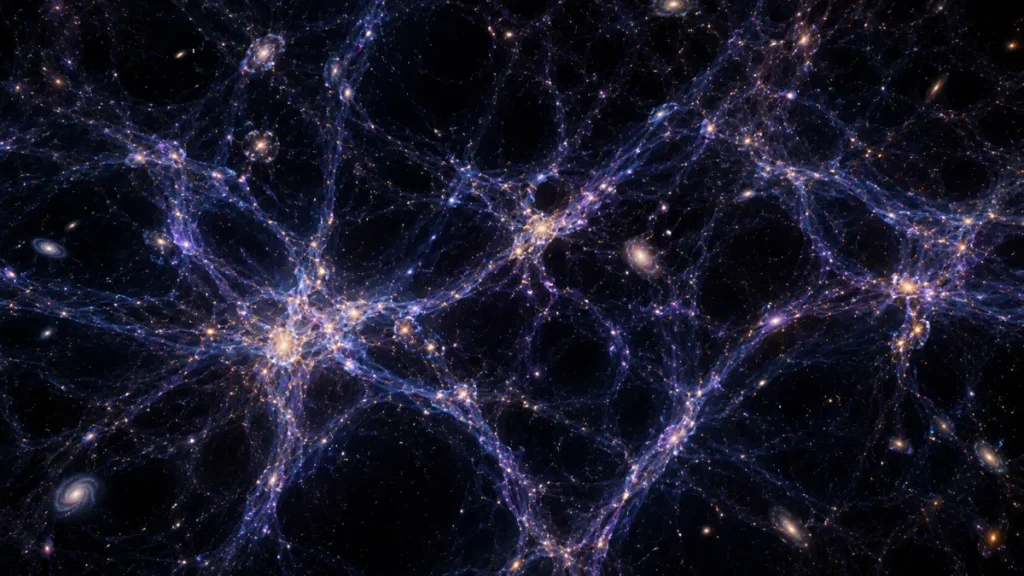
Dark matter is not thought to be spread uniformly through the universe. On very large scales, matter is organised into a network of filaments, knots and empty regions often described as the cosmic web.
Dark matter’s gravity helped create the gravitational framework in which galaxies could form and gather. The visible galaxies we see are therefore connected to a much larger structure that includes matter we cannot directly observe.
Why Is Dark Matter Important?
Dark matter matters because it is central to our explanation of how cosmic structures formed and evolved. Without an additional source of gravitational mass, many observations of galaxies and galaxy clusters would be difficult to reconcile with the amount of ordinary matter we can see.
Studying dark matter could also reveal new physics. If scientists eventually identify its particle or otherwise determine its true nature, they may learn that the current understanding of fundamental physics is incomplete.
What Can the Nancy Grace Roman Space Telescope Tell Us?
NASA’s Nancy Grace Roman Space Telescope is designed to study dark energy, dark matter, exoplanets and infrared astrophysics. It launched on August 30, 2026, aboard a SpaceX Falcon Heavy and is travelling toward the Sun-Earth L2 region, roughly one million miles from Earth.
Roman is especially useful for this research because its Wide Field Instrument can survey an area of sky at least 100 times larger than Hubble’s field of view while maintaining comparable image sharpness. NASA says the mission will measure light from about a billion galaxies over its lifetime.
For dark matter research, Roman will make large surveys that allow astronomers to study how galaxies are distributed and how their light is distorted by gravity. These measurements can help scientists build detailed maps of the distribution of unseen mass and test how cosmic structure has changed over time.
Roman will not photograph dark matter as if it were an ordinary object. Instead, its observations will help scientists infer dark matter’s distribution from its gravitational effects.
What We Still Do Not Know
The biggest unanswered question is simple: what is dark matter actually made of? Scientists have proposed several possibilities, but there is still no confirmed dark-matter particle.
It is also important not to confuse a strong scientific inference with a direct photograph or laboratory identification. The evidence for dark matter’s gravitational influence is extensive, while its microscopic nature remains unknown.
A Note About the End of the Universe
The transcript that inspired this article connects dark energy with possible long-term futures such as a Big Freeze or, under some models, a Big Rip. These are theoretical scenarios, not predictions with a settled outcome.
Current observations show that cosmic expansion is accelerating, but the ultimate fate of the universe depends on what dark energy is and whether its behaviour changes over time. Scientists are still investigating that question.
Frequently Asked Questions
What is dark matter?
Dark matter is invisible matter inferred from its gravitational effects on stars, galaxies, galaxy clusters and light. Scientists estimate it makes up about 27% of the universe.
Why is dark matter called dark?
It is called dark because it does not emit, reflect or absorb light in a way that lets ordinary telescopes detect it directly. The name does not mean that it is literally black.
How do scientists know dark matter exists?
Scientists infer dark matter from gravitational effects that visible matter alone cannot explain, including galaxy rotation and gravitational lensing.
Is dark matter the same as dark energy?
No. Dark matter is associated with additional gravitational mass, while dark energy is the name for the unknown cause of the universe’s accelerating expansion.
Can we see dark matter with a telescope?
Not directly. Telescopes can observe the gravitational effects of dark matter, such as changes in the motion of galaxies and distortions caused by gravitational lensing.
What will the Nancy Grace Roman Space Telescope do?
Roman will survey huge areas of the sky to study dark energy, dark matter, galaxies and exoplanets. Its wide field of view will let astronomers collect large amounts of data for mapping cosmic structure.
Conclusion
What is dark matter simplified? It is the name scientists give to an unseen source of mass whose gravity affects the visible universe. We cannot directly see it, but its influence appears in galaxy motions, gravitational lensing and the large-scale structure of the cosmos.
The mystery is far from solved. The Nancy Grace Roman Space Telescope and other surveys will provide new measurements that can test how dark matter is distributed and how it shaped the universe. Finding out what dark matter actually is could become one of the most important discoveries in modern physics.
Click here to read more A1-InfoHub.com

