


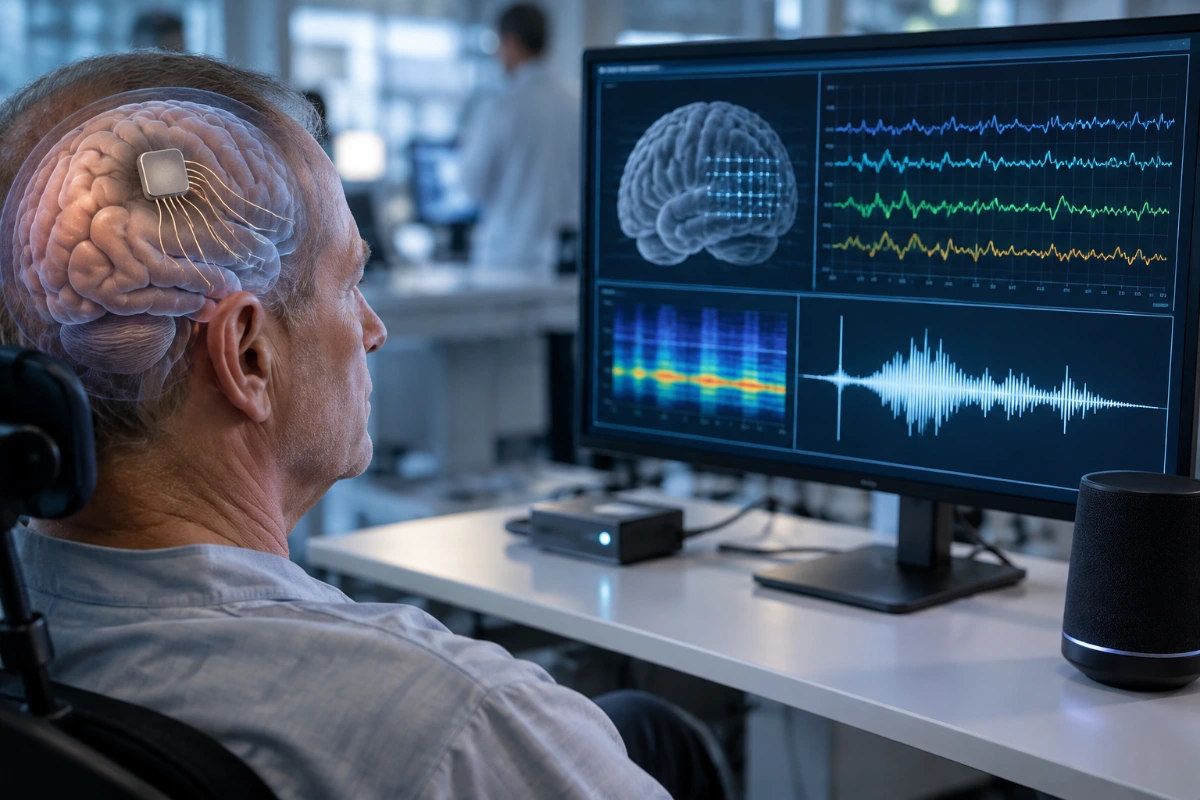
Neuralink is drawing renewed attention after a clinical-trial participant demonstrated thought-to-speech communication, including telling his partner “I love you” through an experimental brain-computer interface. The demonstration shows how a brain implant can record neural activity associated with intended speech and use software to turn that activity into audible communication.
What Happened in the Latest Neuralink Demonstration?
In September 2026, Neuralink shared a video of a participant in its VOICE clinical-trial program communicating through the company’s brain-computer interface. The participant did not produce the words through normal vocal speech. Instead, the system decoded neural signals associated with his intention to speak and produced audible speech through a computer.
The widely shared demonstration included the phrase “I love you,” which the participant used to communicate with his partner. Neuralink described its devices as investigational and not commercially available or FDA approved.
Some early reports used different descriptions of the participant, so it is important not to overstate details that were not consistently reported. Neuralink’s public material identifies its VOICE work with an ALS participant named Kenneth and describes the goal as restoring communication by decoding intended speech.
How Does Neuralink Turn Brain Signals Into Speech?
Speaking normally involves a sequence of brain signals that help coordinate the movements of the lips, tongue, jaw, vocal tract and other muscles involved in producing speech. Neurological diseases such as ALS can progressively disrupt the pathways needed to convert the intention to speak into understandable spoken output.
A brain-computer interface attempts to create another route. Neuralink’s N1 Implant records neural activity through 1,024 electrodes distributed across 64 flexible threads, according to the company’s PRIME study materials. The recorded signals are transmitted wirelessly to an external computer, where software can learn patterns associated with the participant’s intended actions or speech.
For speech restoration, the important distinction is that the system is not simply reading a person’s private thoughts in the general sense. It is trained to interpret neural activity linked to an intended communication task. The participant actively attempts or intends to produce speech, and the decoder maps the resulting neural patterns to language output.
Can Neuralink Recreate a Person’s Original Voice?
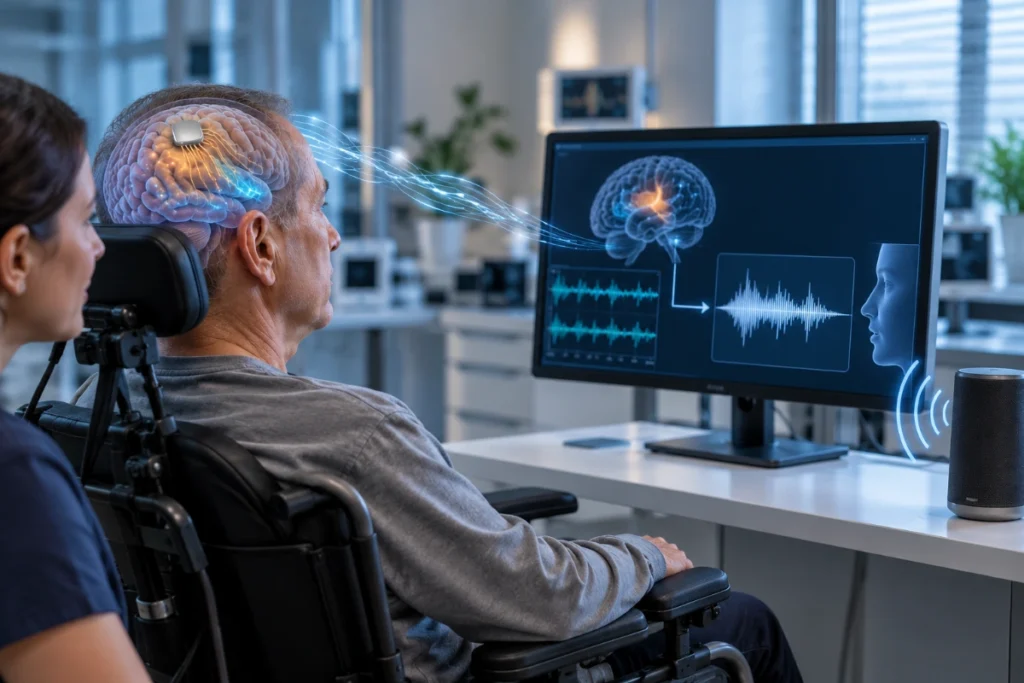
The goal of the VOICE work is not limited to displaying words on a screen. Neuralink has described its speech-restoration research as an effort to let people communicate through spoken output after losing the ability to speak normally.
In demonstrations involving participants with speech loss, a personalized or reconstructed voice can make the resulting communication sound more natural and personal than a generic computer voice. Neuralink’s public material has emphasized the human value of restoring a person’s ability to communicate in a familiar voice.
Why the Neuralink Speech Breakthrough Matters
Loss of speech can severely limit a person’s ability to communicate even when the person continues to understand language and knows what they want to say. A BCI that can translate intended speech into audible communication could therefore provide an alternative communication path for some people with severe neurological impairments.
The recent demonstration should still be viewed as a clinical-research result, not as proof that the technology is ready for every person with ALS, stroke, paralysis or another speech disorder. Neural interfaces can vary considerably between individuals, and clinical trials are needed to establish safety, reliability, performance and long-term usability.
How the N1 Implant Works
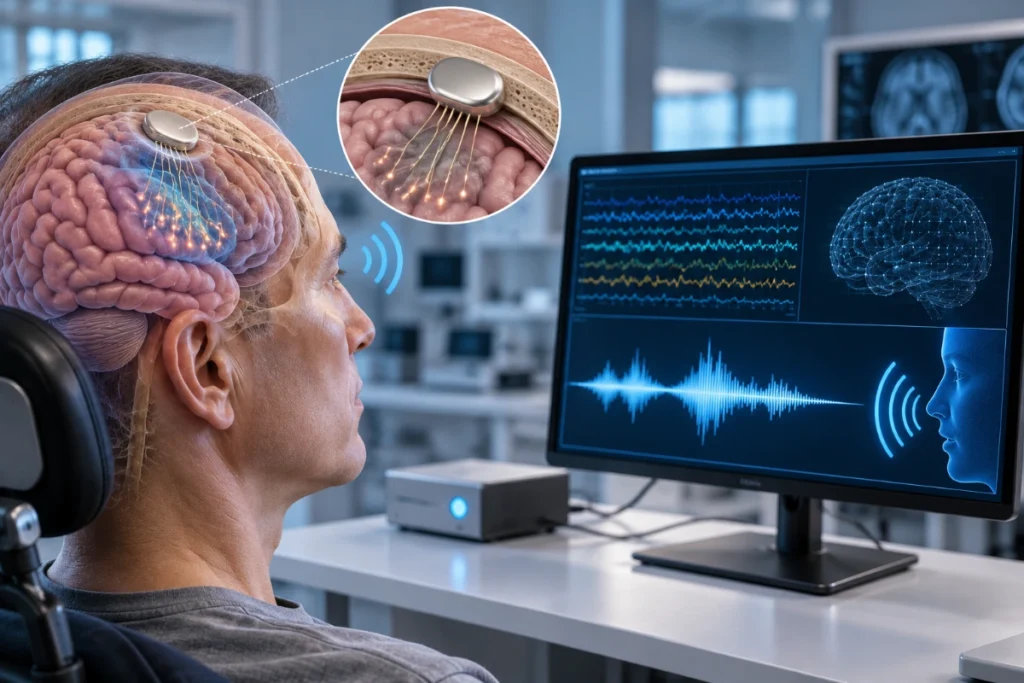
Neuralink’s N1 system is designed as an implanted brain-computer interface. Its publicly described architecture includes a small implant connected to 64 threads carrying a total of 1,024 electrodes. A surgical robot is used to place the flexible threads in the brain as part of the implantation procedure.
The implant records electrical activity from neurons near the electrodes. Those signals can then be processed by software to identify patterns associated with a participant’s intended movement or communication. The exact decoding process depends on the clinical application and the models trained for the participant.
Neuralink’s Earlier Human Demonstrations
Neuralink’s first human clinical work focused heavily on enabling people with paralysis to control computers using intended movement. The company’s PRIME study describes the N1 Implant as an investigational device intended to help people with paralysis control external devices.
The later VOICE program represents a different application: decoding intended speech. That distinction is important because controlling a computer cursor and generating spoken language require different neural signals, training procedures and output systems.
Is Neuralink FDA Approved?
No. Neuralink’s brain implants remain investigational rather than FDA-approved products for general commercial use. The company’s own clinical-trial materials state that the devices are investigational and not for sale.
The FDA explains that an Investigational Device Exemption, or IDE, can allow an investigational medical device to be used in a clinical study to collect safety and effectiveness data. An IDE does not mean that the device has received marketing approval. Commercial availability requires the appropriate regulatory pathway and evidence.
What Does Elon Musk Say About Neuralink?
Elon Musk has repeatedly described Neuralink as a company developing brain-computer interfaces with potential medical applications. He has publicly discussed goals such as helping people with paralysis communicate with computers and, in the longer term, restoring functions affected by neurological conditions.
After the September 2026 speech demonstration, Musk reshared the Neuralink video with the words “I love you.” His public statements about future Neuralink capabilities are company ambitions or predictions rather than evidence that those capabilities are already clinically available.
Will Neuralink Implant a Human Brain?
Yes. Neuralink has already implanted its N1 brain-computer interface in human clinical-trial participants. These procedures are part of investigational research and are not equivalent to a consumer product being available to the public.
Human implantation involves neurosurgery and therefore carries medical risks. Participation in a clinical trial is governed by research and regulatory requirements, and eligibility depends on the specific study.
What Are the Limitations Right Now?
The most important limitation is that the technology is still being evaluated. A successful demonstration from an individual participant does not establish that the same performance will occur for every patient.
Other issues include surgical risks, device reliability over time, training requirements, signal stability, decoding accuracy, privacy of neural data and the practical requirements of using an implanted system. These questions are part of the broader development of brain-computer interfaces and cannot be settled by a single demonstration.
What Could Neuralink Speech Technology Mean for the Future?
If future clinical studies establish that speech-decoding BCIs can operate safely and reliably, they could become an additional communication option for some people who cannot speak normally. The potential value is particularly significant for people whose ability to communicate has been limited by neurological disease or injury.
At the same time, the technology should be judged by clinical evidence rather than viral videos alone. Larger studies, longer follow-up and regulatory review will be needed before its real-world role can be understood.
Frequently Asked Questions
Will Elon Musk’s Neuralink implant a human brain?
It already has. Neuralink’s N1 Implant is being evaluated in human clinical trials. The device is investigational, and human implantation occurs under clinical-research protocols rather than as a general consumer procedure.
Is Neuralink Elon Musk’s brain chip company?
Neuralink is a brain-computer-interface company founded by Elon Musk and other co-founders. Its work focuses on implanted neural interfaces intended to connect brain activity with external devices and, initially, to address neurological and communication needs.
What does Elon Musk say about Neuralink?
Musk has described Neuralink as a technology platform with medical goals including helping people with paralysis communicate and interact with computers. He has also discussed more ambitious future applications, but those future capabilities remain goals or claims to be evaluated through research.
Does Elon Musk’s Neuralink have FDA approval?
No. Neuralink’s implants are investigational and are not FDA-approved for general commercial use. Clinical-trial authorization and investigational use should not be confused with FDA marketing approval.
Conclusion
The latest Neuralink demonstration shows a significant research direction for brain-computer interfaces: translating intended speech into audible communication for someone who has lost normal speech. The “I love you” demonstration is a powerful example of the human purpose behind the research, but it remains an experimental clinical result rather than a finished medical product.
Neuralink’s future will depend on evidence from clinical trials, long-term safety and reliability, and regulatory review. For now, the technology is best understood as an emerging investigational brain-computer interface with promising but still limited human evidence.

