


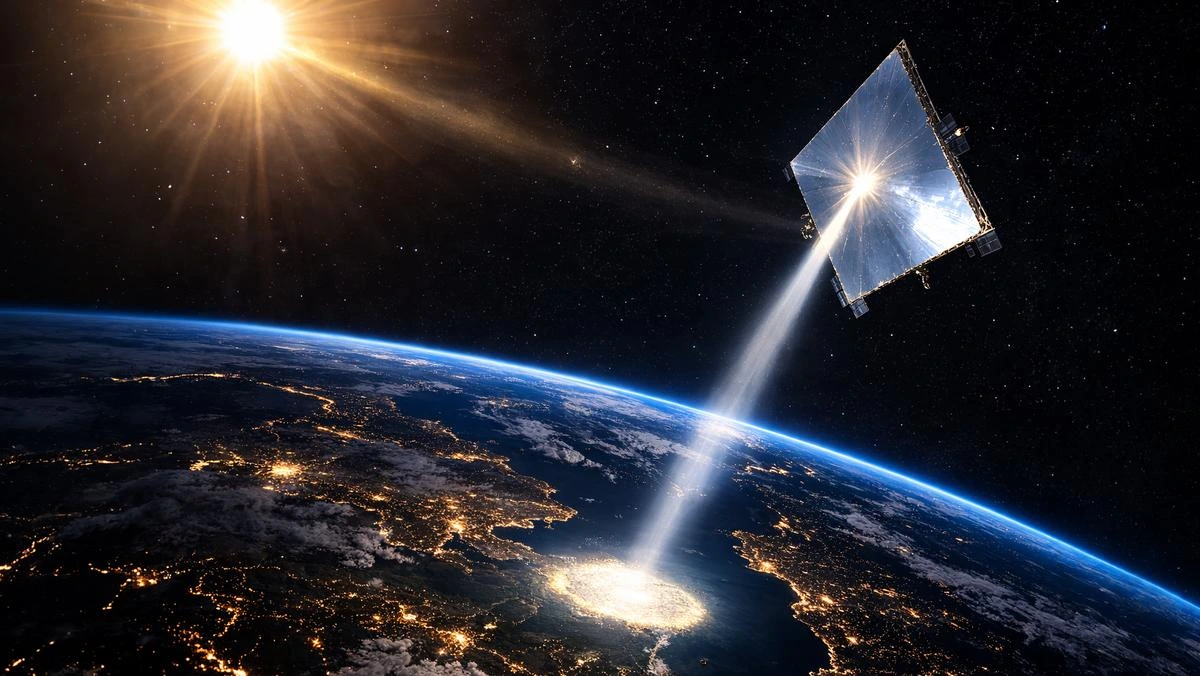
Space mirrors in orbit could one day reflect sunlight onto selected parts of Earth after sunset. The idea is being developed by the American startup Reflect Orbital, which wants to use satellites carrying large reflective surfaces to direct sunlight toward the ground at night. The concept could offer new lighting options for solar farms, construction sites and emergency operations, but it also raises important questions about cost, light pollution and the protection of the natural night sky.
Space mirrors in orbit are reflective structures carried by satellites that redirect sunlight toward selected areas on Earth’s surface.
Unlike ordinary mirrors used on the ground, these structures would operate in space, where satellites can receive sunlight even while parts of Earth are experiencing nighttime. By adjusting the mirror’s orientation, a satellite could direct reflected sunlight toward a target region.
Reflect Orbital calls its proposed service Sunlight on Demand. The company envisions providing illumination when and where it is needed rather than relying exclusively on conventional ground-based lighting.
However, the technology is still at an experimental stage. The proposed commercial benefits should not be confused with an established, widely available service.
Table of Contents
How Do Space Mirrors Work?
The basic principle is straightforward: a satellite collects sunlight using a reflective surface and directs some of that light toward a selected location on Earth.
1. A rocket carries the satellite into orbit

The satellite is launched into low Earth orbit. Reflect Orbital’s proposed demonstration spacecraft, Eärendil-1, is designed to test this approach.
2. A large reflective surface unfolds

Once deployed, the lightweight mirror-like structure provides a larger surface for reflecting sunlight. The company has described a prototype mirror approximately 18 metres across.
3. The satellite directs sunlight toward the ground

The spacecraft adjusts its orientation to redirect sunlight toward a selected region. The beam would illuminate a limited area rather than the entire planet.
4. The reflected light may support selected activities

Potential applications include site illumination, search-and-rescue support and experiments involving solar power generation. Their practical value will depend on the available light, operating costs and technical performance.
The satellite would not produce sunlight itself. It would redirect sunlight that already exists in space.
Also, a satellite in low Earth orbit moves quickly relative to a location on the ground. Providing illumination for longer periods would therefore require carefully coordinated satellite passes, rather than assuming that one satellite could light the same area throughout the night.
Why Is Reflect Orbital Developing This Technology?
The main idea is to make sunlight available at times when it would otherwise be unavailable to people on the ground.
Solar energy is an important renewable electricity source, but conventional solar panels generate little or no electricity at night. Space-based reflection is being explored as one possible way to direct additional sunlight onto solar installations after sunset.
Other proposed applications include:
- Solar farms: Testing whether reflected sunlight can contribute to electricity generation outside normal daylight hours.
- Construction projects: Providing additional illumination for selected sites that operate at night.
- Search-and-rescue operations: Helping illuminate a search area during certain emergencies.
- Remote industrial sites: Providing temporary lighting where conventional lighting infrastructure is difficult or expensive to install.
These are potential uses, not proof that orbital mirrors can already provide economical, reliable nighttime lighting at commercial scale.
Can Space Mirrors Generate Solar Power at Night?
This is one of the most interesting questions surrounding space mirrors in orbit.
Solar panels need incoming light to produce electricity. If a mirror redirects sunlight onto a solar farm after sunset, the panels may be able to generate some electricity while they are illuminated.
However, this does not mean that solar power becomes free or unlimited at night.
Several factors determine whether the approach is practical:
- Available light: Reflected sunlight is spread over a target area, reducing the amount of light received by each square metre.
- Mirror efficiency: Some incoming sunlight is lost because no reflective surface is perfect.
- Satellite availability: A satellite can illuminate a particular ground location only when its orbit, sunlight and pointing direction allow it to do so.
- Energy costs: Rockets, spacecraft manufacturing, control systems and operations all cost money.
- Electricity conversion: Solar panels can convert only a portion of incoming light into electricity.
Solar panels also perform differently under weak illumination than under direct daylight. Consequently, a useful nighttime electricity supply would need to be demonstrated through actual measurements, not assumed from the concept alone.
For many existing solar installations, batteries, grid connections and other energy-storage solutions remain important ways to manage the difference between daytime generation and nighttime demand.
How Much Light Can an Orbital Mirror Provide?
Reflect Orbital’s proposed technology uses large reflective structures to concentrate redirected sunlight onto a limited area.
Its initial demonstration design has been described as having an approximately 18-metre-wide mirror, with the company envisioning larger structures for future satellites. Published descriptions of the proposed system indicate that the illuminated area could be several kilometres across.
The brightness experienced on the ground would depend on the mirror’s size, its orientation, atmospheric conditions, the angle of the incoming sunlight and the size of the illuminated area.
It is important to distinguish the size of the mirror from the size of the illuminated region. A large mirror does not mean that the whole region would receive daylight-level illumination.
Researchers have also raised concerns that light can scatter through the atmosphere beyond the intended target area. This means the effects may extend beyond the location that the satellite is deliberately illuminating.
What Is India’s Skyroot Aerospace’s Role?
India’s private space industry is also connected to this developing technology.
Reporting on Reflect Orbital’s plans has identified Skyroot Aerospace, an Indian private launch company, as a launch partner for the proposed satellite missions. The company’s Vikram rocket family is intended to provide launch services for small satellites.
This is significant because commercial space projects increasingly depend on partnerships between spacecraft developers, launch providers and satellite operators in different countries.
However, a launch agreement should not be treated as proof that a satellite has already reached orbit or successfully demonstrated its intended function. Launch schedules, deployment and performance must be confirmed separately.
What Are the Main Challenges?
Although the concept is innovative, space mirrors in orbit face several technical, financial and environmental challenges.
1. High operating costs
Developing a satellite with a large deployable mirror requires specialised materials, engineering, launch capacity and orbital control.
The full cost includes more than launching the spacecraft. The company would also need to manage satellite operations, maintenance limitations, replacement missions and the economics of providing light to customers.
Whether the service can compete with conventional lighting and energy storage remains uncertain.
2. Light pollution
Light pollution is one of the most serious concerns.
Astronomers rely on dark skies to observe distant stars, galaxies, asteroids and other celestial objects. Artificially increasing nighttime brightness could make faint objects more difficult to study.
A 2026 study published in The Astrophysical Journal Letters examined the potential atmospheric light pollution from the proposed orbital mirrors. Its modelling found that the reflected beam could significantly brighten the surrounding night sky, including areas outside the directly illuminated region.
3. Effects on wildlife and natural darkness
Many animals depend on natural day-night cycles for feeding, migration, reproduction and navigation.
Artificial illumination could alter these behaviours, depending on its intensity, duration, timing and location. The potential effects would need to be assessed carefully before any large-scale deployment.
4. Human health and safety
Light exposure at night can affect sleep and circadian rhythms. The actual impact of orbital illumination would depend on exposure conditions and the brightness reaching people.
Bright reflected light could also create visibility concerns for drivers, pilots and people observing the sky. These risks require careful assessment and suitable operational controls.
5. Space debris and orbital management
Large satellite constellations introduce additional objects into an already busy orbital environment.
Operators would need reliable systems for tracking spacecraft, avoiding collisions and managing end-of-life disposal. A satellite that stops functioning should not become uncontrolled debris that creates hazards for other missions.
These concerns become more significant if a project grows from a single experimental spacecraft to thousands of satellites.
Sorce:research on atmospheric light pollution from space mirrors
What Do Scientists Say About Space Mirrors in Orbit?
Scientific criticism focuses on the cumulative effects of bright satellites, not simply on whether one prototype can reflect sunlight.
The European Southern Observatory reported in 2026 that proposals for large, bright satellite constellations could seriously damage astronomical observations. Its analysis included Reflect Orbital’s proposed expansion to tens of thousands of mirrors.
Researchers are concerned that such satellites could create bright trails in telescope images and increase overall sky brightness. These effects could interfere with observations that require very dark skies.
The findings are based on scientific analysis and modelling of proposed systems; they should not be mistaken for measurements of a fully deployed 50,000-satellite network.
The broader debate is about balancing potential commercial benefits with the protection of astronomy, wildlife, natural darkness and the shared orbital environment.
Is This Technology Ready for Everyday Use?
No. Space mirrors in orbit remain a developing technology, and their large-scale commercial usefulness has not yet been established.
A successful demonstration would need to show that a satellite can deploy its mirror reliably, direct light accurately, deliver useful illumination and operate safely.
A larger commercial network would face additional challenges, including launch costs, continuous service coverage, satellite coordination, environmental impacts and regulatory approval.
Even if the technology works as designed, customers would still need to compare its cost and performance with alternatives such as ground lighting, batteries and conventional power systems.
Frequently Asked Questions
1. What are space mirrors in orbit?
Space mirrors in orbit are reflective structures mounted on satellites that redirect sunlight toward selected areas on Earth’s surface. They are being developed as a possible way to provide illumination after sunset.
2. Which company is developing orbital sunlight technology?
Reflect Orbital, a US startup, is developing a proposed service called Sunlight on Demand. Its plans involve satellites carrying large reflective surfaces.
3. Can space mirrors make nighttime as bright as daytime?
Not automatically. Brightness depends on mirror size, distance, orientation and the area being illuminated. A proposed system’s performance must be measured rather than assumed to provide daylight-level illumination.
4. Can orbital mirrors replace solar batteries?
Not necessarily. Reflected sunlight might allow solar panels to generate some electricity after sunset, but the amount and cost of that electricity remain important uncertainties. Batteries and other energy-storage technologies would still have uses.
5. Is Skyroot Aerospace involved in this project?
Reporting has identified India’s Skyroot Aerospace as a launch partner for Reflect Orbital’s planned satellite missions. The partnership does not, by itself, establish that the satellites have launched or completed a successful demonstration.
6. Why are astronomers concerned about orbital mirrors?
Bright mirrors could interfere with telescope observations and increase artificial nighttime sky brightness. Scientific modelling suggests that atmospheric scattering could affect areas beyond the intended light beam.
7. Are space mirrors in orbit commercially available today?
The proposed system has not been established as a widely available commercial lighting service. Its technical performance, costs and environmental effects still need to be evaluated.
Conclusion
Space mirrors in orbit represent an ambitious attempt to redirect sunlight from space to places on Earth that need additional light. If the technology proves practical, it could support selected industrial, emergency and energy applications.
However, technical feasibility alone is not enough. The economics, reliability, effects on wildlife, risks to human safety and consequences for astronomy must all be considered.
The most important question is not simply whether satellites can reflect sunlight onto Earth at night. It is whether the benefits can justify the costs and environmental impacts of operating them at scale.
For now, space mirrors remain a promising but controversial concept whose future depends on reliable demonstrations, independent scientific assessment and responsible regulation.
Also Read:Google Project Suncatcher: Major AI Space Test Explained

