


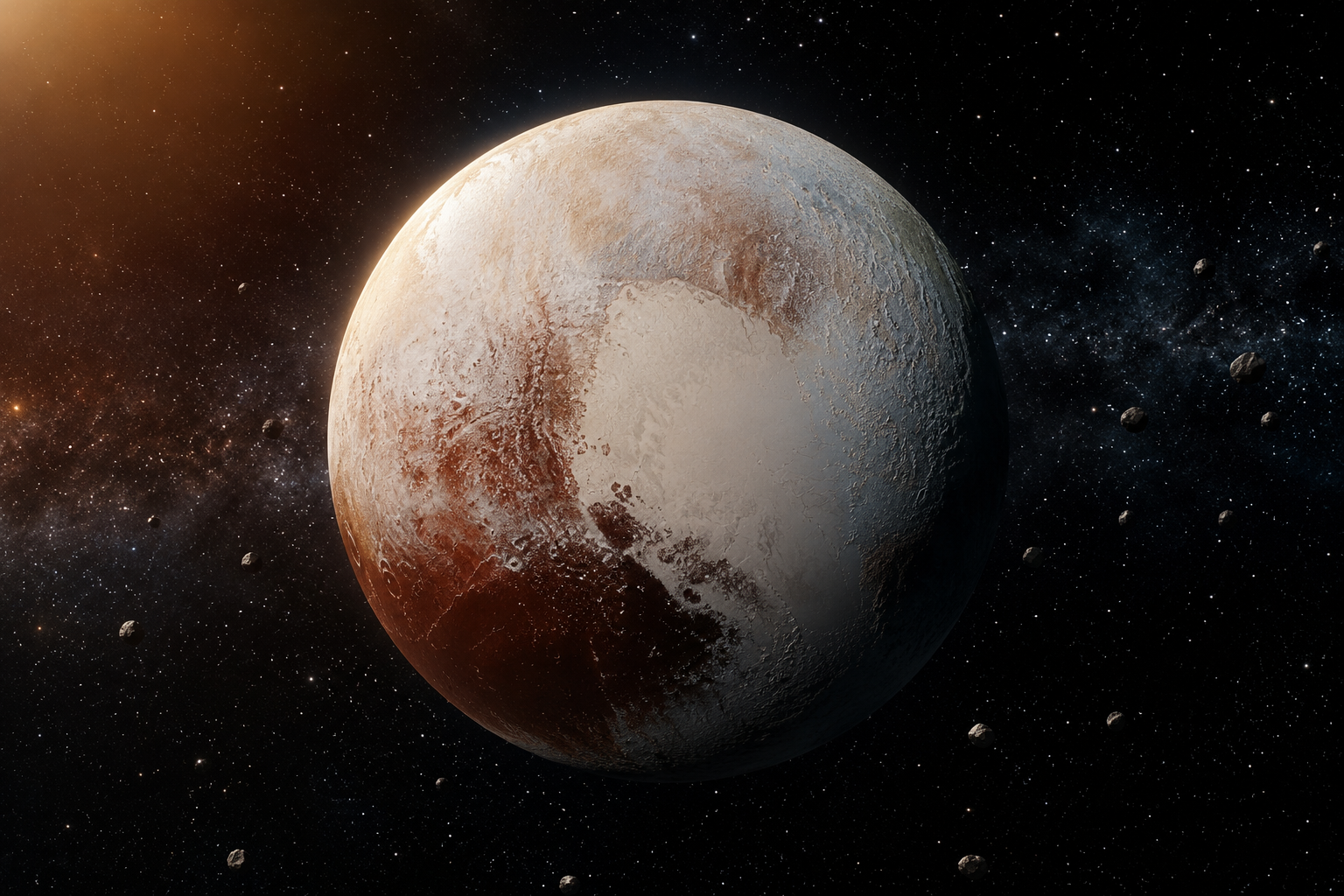
Pluto is back in the headlines. In April 2026, NASA Administrator Jared Isaacman said he supports the idea of making Pluto a planet again, reopening a debate that began when the International Astronomical Union (IAU) classified Pluto as a dwarf planet in 2006.
Why is Pluto a planet again a topic of discussion?
On April 28, 2026, during a U.S. Senate hearing about NASA’s fiscal 2027 budget request, Administrator Jared Isaacman said he was “very much in the camp” of making Pluto a planet again. He also said work was being done on papers intended to take the discussion back into the scientific community.
That statement does not mean Pluto has officially been restored to planet status. As of now, Pluto remains classified as a dwarf planet under the IAU’s 2006 definition. Changing that classification would require a new scientific and institutional process rather than a decision by NASA alone.
What happened to Pluto in 2006?
For decades, Pluto was taught as the ninth planet of the Solar System. Clyde Tombaugh discovered it at Lowell Observatory in 1930, and it remained a planet in the traditional Solar System lineup for 76 years.
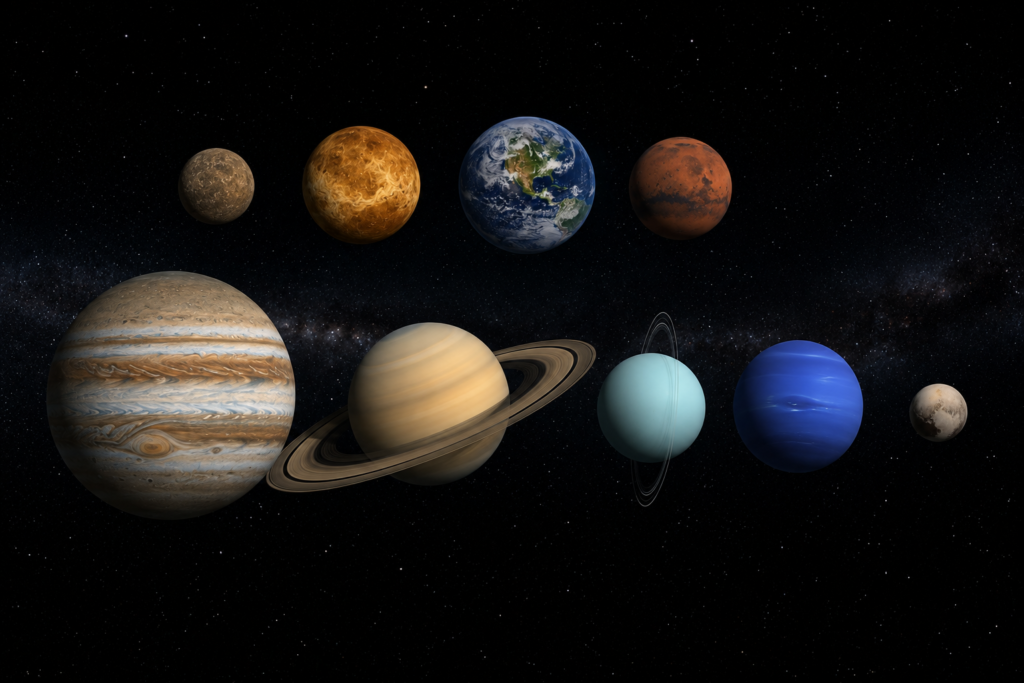
The situation changed as astronomers discovered more Pluto-like objects beyond Neptune. The discovery of Eris in particular raised a difficult question: if Pluto was a planet, should similar objects also be counted as planets?
In 2006, the IAU adopted a formal definition of a planet in our Solar System. Under that definition, an object must orbit the Sun, be massive enough for its own gravity to make it nearly round, and have cleared the neighbourhood around its orbit. Pluto satisfies the first two conditions but not the third, so the IAU placed it in the dwarf-planet category.
The three rules that define a planet
The IAU’s definition can be understood through three basic requirements:
It must orbit the Sun.
It must have enough mass for its own gravity to make it nearly round.
It must have cleared the neighbourhood around its orbit.
Pluto’s problem is the third requirement. It travels through the distant Kuiper Belt, a region containing many icy bodies and other trans-Neptunian objects. Pluto has not gravitationally dominated and cleared its orbital neighbourhood in the way the IAU definition requires for a planet.
Why do some scientists disagree with the definition?
Supporters of changing Pluto’s classification argue that orbital dominance should not be the only way to define a planet. They point to Pluto’s rounded shape, complex geology and active surface as evidence that it is much more than an ordinary small piece of rock or ice.
One alternative approach discussed in planetary science is to focus more heavily on an object’s intrinsic properties—such as whether it is massive enough to become spherical and whether it has complex planetary geology. Under broader definitions of this kind, Pluto could qualify, but the consequences would extend far beyond Pluto.
Would making Pluto a planet mean more planets?
This is one of the biggest scientific complications. If the rules are changed to make Pluto a planet because it is round and geologically complex, other worlds could also become candidates.
That could include several dwarf planets and, depending on the exact definition used, potentially other large planetary bodies. So the debate is not simply about restoring one familiar name to the school textbook. It is really about deciding what the word “planet” should mean.
New Horizons showed that Pluto is far more complex than expected
NASA’s New Horizons spacecraft flew past Pluto in July 2015 and transformed our understanding of the distant world. The mission revealed mountains, glaciers, a thin atmosphere, complex surface features and evidence of ongoing geological activity.
One of Pluto’s most recognisable features is its large heart-shaped region, Tombaugh Regio. Within it lies Sputnik Planitia, a vast nitrogen-ice plain with evidence of active surface processes.
Pluto also has five known moons: Charon, Styx, Nix, Kerberos and Hydra. The New Horizons mission showed that the Pluto system is a surprisingly dynamic and scientifically rich environment.
A 2026 discovery makes Pluto even more interesting
The scientific story has continued after New Horizons. In August 2026, NASA reported a new analysis of New Horizons imagery that provides evidence that liquid nitrogen may recently have reached Pluto’s surface through cracks near the northern edge of Sputnik Planitia. The finding adds another example of how active and unusual Pluto can be.
However, interesting geology does not automatically change an object’s formal classification. Planetary status depends on the definition being used, not simply on how geologically fascinating an object is.
Does NASA control Pluto’s classification?
No. NASA can conduct missions, publish research and support scientific discussion, but it does not unilaterally decide the official classification of Solar System bodies. The IAU is the internationally recognised organisation responsible for astronomical nomenclature and adopted the 2006 planet definition.
That is why Isaacman’s statement is best understood as support for reopening the scientific debate, not as an announcement that Pluto has already been promoted.
So, is Pluto a planet right now?
No. Under the IAU’s current definition, Pluto is a dwarf planet. That classification has not been officially changed.
The important development in 2026 is that NASA’s administrator has publicly supported reconsidering the issue. Whether that leads to a new definition or a change in Pluto’s status is a separate question that would require broader scientific discussion and an appropriate formal process.
The real Pluto debate is bigger than Pluto
At first glance, the argument sounds simple: Pluto was a planet, people loved it, and now some scientists want it back. The deeper issue is much more interesting. Astronomy is constantly discovering new worlds, and classifications have to keep pace with those discoveries.
The Pluto debate therefore asks a fundamental question: should a planet be defined mainly by its location and gravitational relationship with its orbital neighbourhood, or by its physical and geological characteristics?
For now, the official answer remains unchanged. Pluto is a dwarf planet. But the discussion around how we define planets is clearly alive again—and new observations continue to make Pluto one of the most fascinating worlds at the edge of our Solar System.
Conclusion
Pluto has not officially become a planet again, but NASA Administrator Jared Isaacman’s 2026 comments have brought the issue back into the public conversation. The 2006 IAU decision was based on a specific definition of “planet,” especially the requirement that a planet clear its orbital neighbourhood.
Whether that definition should remain unchanged is a scientific question, not simply a matter of nostalgia. As Pluto research continues to reveal an active and complex world, the debate may tell us as much about how science classifies new discoveries as it does about Pluto itself.
Explore More
Want to understand more about space and science? Explore A1InfoHub for more easy-to-follow explainers on astronomy, technology, and the discoveries shaping our understanding of the world around us.
Sources
International Astronomical Union — 2006 Resolution on the definition of a planet and Pluto’s dwarf-planet classification.
U.S. Senate Committee on Appropriations — April 28, 2026 NASA budget hearing.
NASA — New Horizons mission and Pluto science findings.
NASA Science — August 2026 report on evidence of recent liquid nitrogen activity on Pluto.

