


A proposed railway connection from Russia towards the Indian Ocean and India has drawn attention after Russian Deputy Prime Minister Marat Khusnullin said the idea should be explored. But this is not a completed railway project or a confirmed passenger train service. It is an exploratory proposal aimed mainly at creating another trade route that could reduce dependence on vulnerable maritime chokepoints.
Table of Contents
What Is the Russia-India Direct Rail Link Proposal?
Russia is exploring the possibility of developing a railway route towards the Indian Ocean, with potential connectivity to India. Khusnullin discussed the idea in an August 2026 interview with Russia’s state news agency TASS, saying that alternative routes could reduce risks associated with the Bosphorus and Strait of Hormuz.
The proposed concept should therefore be understood as a strategic freight-corridor idea rather than a ready-to-book Moscow-to-India passenger train. The exact alignment, financing model, construction schedule and participation of India have not been finalized.
Why Is Russia Considering a New Land Route to India?
The main reason is route diversification. Russia’s trade with Asian markets has become increasingly important, while geopolitical tensions and disruptions around major sea routes have highlighted the risks of depending on a small number of maritime chokepoints.
The Bosphorus is an important gateway between the Black Sea and the Mediterranean. The Strait of Hormuz is another major strategic passage for global energy trade. A land-based connection would not eliminate all transport risks, but it could give Russia an additional option when maritime routes face disruption.
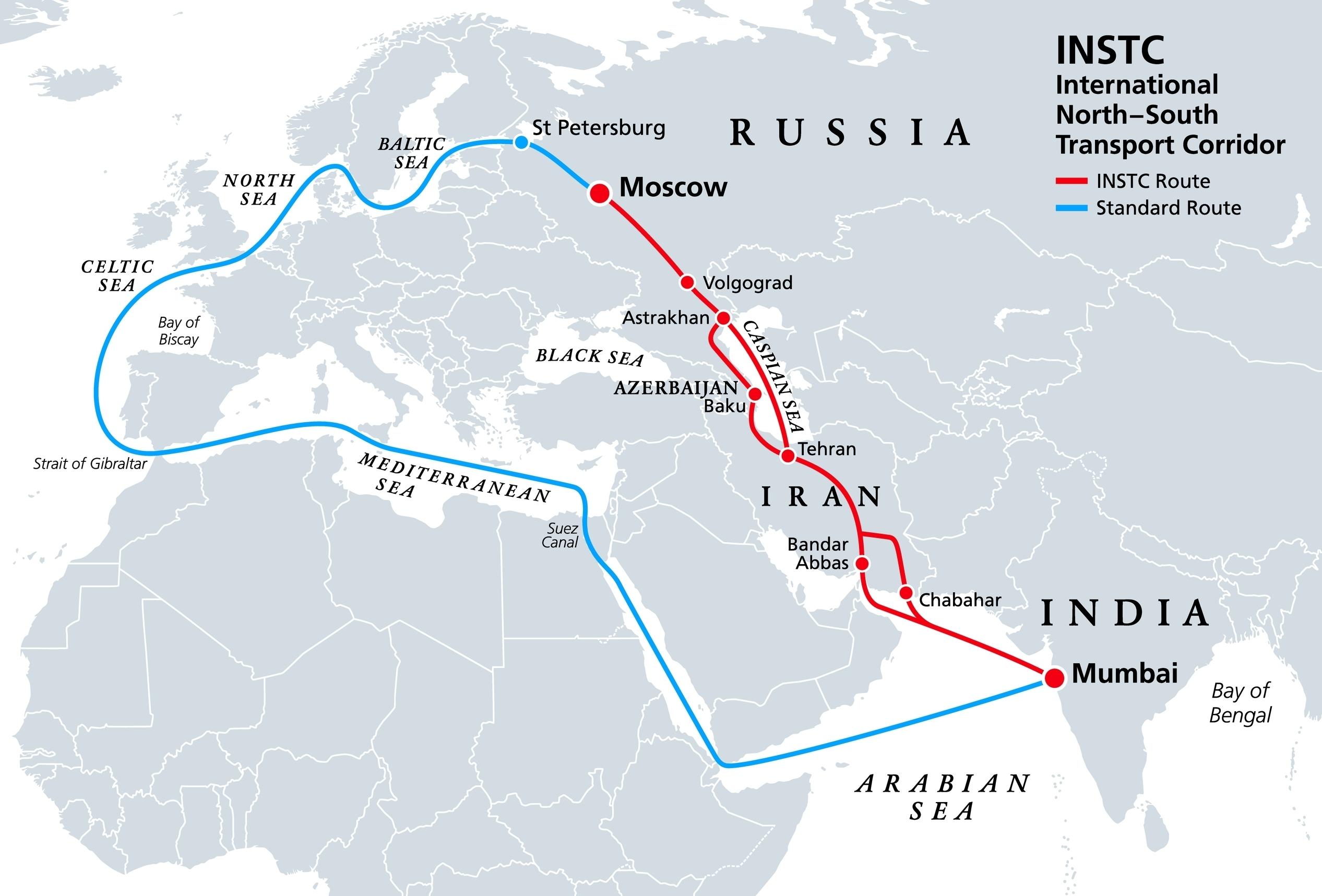
This thinking also fits into the wider push to strengthen the International North-South Transport Corridor (INSTC), a multimodal network involving rail, road and sea links between Russia, Iran and India and other countries. The INSTC is already an important part of the broader connectivity discussion, although it is not the same thing as a single continuous railway from Moscow to an Indian city.
Which Countries Could the Proposed Route Pass Through?
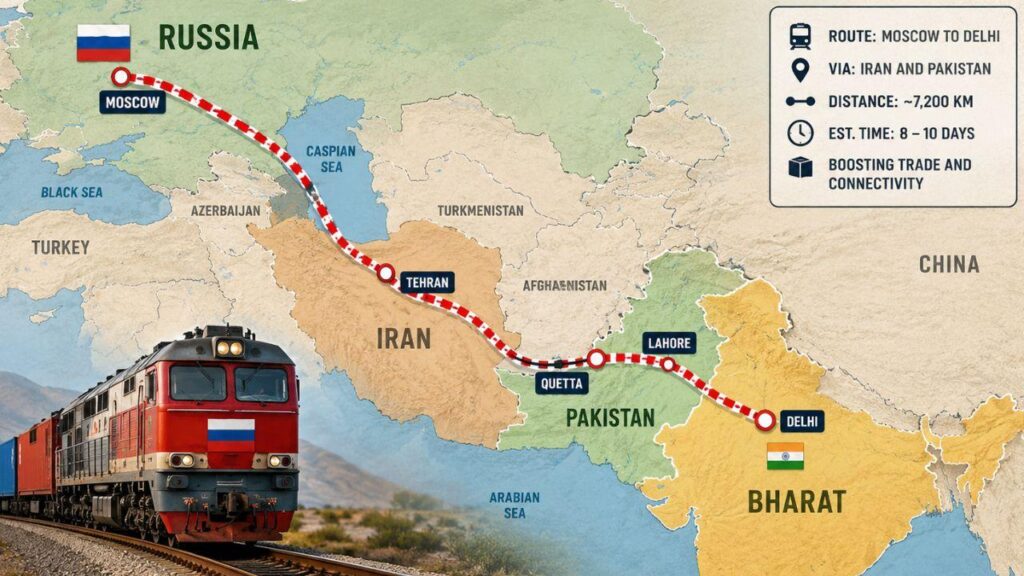
Khusnullin said possible alternatives could pass through Turkmenistan, Iran, Afghanistan and Pakistan, with any option that provides access to India considered. This means there is no single officially finalized route yet.
| Possible country | Potential role | Major consideration |
| Russia | Origin and major freight network | Long-distance connection into Central Asia |
| Turkmenistan | Central Asian transit option | Cross-border infrastructure and coordination |
| Iran | Key bridge toward the Indian Ocean | Rail capacity, sanctions and network integration |
| Afghanistan | Possible overland connection | Security and infrastructure challenges |
| Pakistan | Potential route toward India | Security, political relations and border connectivity |
| India | Destination market | No confirmed commitment to this proposed alignment |
A different and more established connectivity framework is the eastern branch of the INSTC, which uses infrastructure through Russia, Kazakhstan, Turkmenistan and Iran. That route can connect onward to Iranian ports and maritime links toward India. This existing network is important because it shows that parts of the broader Russia-Central Asia-Iran connectivity chain already exist, even though a direct rail line all the way to India does not.
Why Not Simply Use Ships?
Shipping remains the dominant option for moving very large volumes of bulk commodities because ships can carry much more cargo per trip than trains. A new railway would not replace maritime transport for every type of trade.
The strategic argument is different: a railway can act as an additional route when a sea passage becomes unreliable, delayed or politically risky. For selected high-value or time-sensitive cargo, a land corridor can also provide an alternative to longer multimodal shipping routes.
The exact time savings claimed in public discussions should be treated cautiously because transit time depends on border procedures, train capacity, track conditions, gauge changes, customs clearance and the final route.
The Biggest Challenge: Geography
Connecting Russia to India by rail is not simply a matter of drawing a straight line on a map. The route would cross several countries with different railway systems, terrain, regulations and infrastructure standards.
Mountainous areas, especially along parts of a Central and South Asian route, could require major investments in bridges, tunnels, upgraded tracks and supporting infrastructure. Even where construction technology is available, building across multiple sovereign countries makes planning much more complicated than building a railway inside one country.
Different Railway Gauges Add Another Technical Problem
Railway gauge is the distance between the two rails. Different countries use different gauges, and this can complicate international freight movement.
| Railway system | Common gauge |
| Russia and much of the former Soviet rail network | 1,520 mm |
| Iran | 1,435 mm |
| India and Pakistan | 1,676 mm |
These differences do not make international rail freight impossible, but they can require transshipment, bogie or wheelset changes, gauge-changing technology, or specially designed logistics facilities. Any future Russia-India corridor would therefore need a practical solution for seamless or efficient movement across the different rail systems.
Security and Geopolitical Risks Could Be Even Bigger
A railway crossing several countries would be exposed to more than engineering risks. It would depend on long-term political stability, border agreements, security arrangements and cooperation among all participating governments.
Afghanistan and Pakistan are particularly important in the route concept mentioned by the Russian deputy prime minister. Security conditions, internal political developments and the reliability of cross-border infrastructure would have a direct impact on whether investors and freight operators could use such a corridor with confidence.
For India, any route involving Pakistan would also carry obvious geopolitical complications. That is one reason the idea should currently be viewed as a strategic concept rather than a near-term construction project.
Could Russia Use an Existing Corridor Instead?
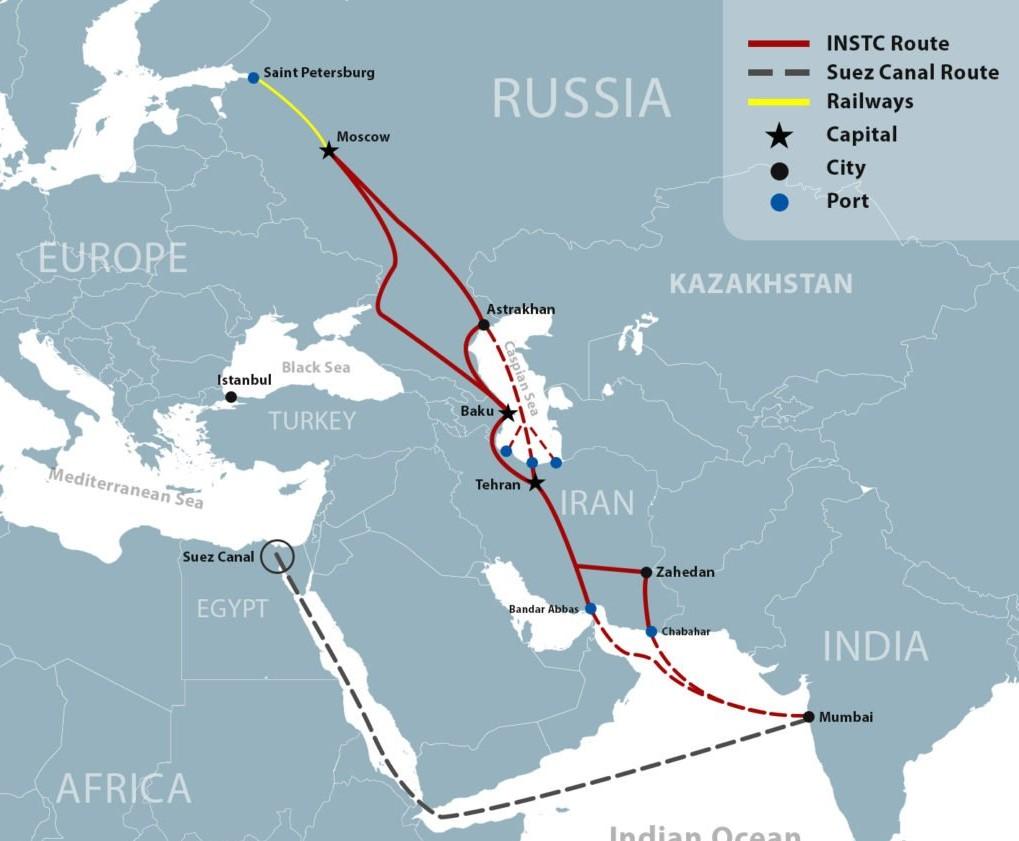
Yes. Russia and India already have a broader connectivity framework through the International North-South Transport Corridor. The INSTC is a multimodal network rather than one continuous railway, and it includes different branches and combinations of rail, road and maritime transport.
One important eastern alignment runs through Russia, Kazakhstan, Turkmenistan and Iran. Another western branch involves Azerbaijan and Iran. The Rasht-Astara railway project in Iran is particularly important for improving the western section of the corridor.
This makes the existing INSTC relevant to the new proposal: Russia may not need to start the entire connectivity system from zero, but extending or integrating existing infrastructure into a more resilient route toward India would still require major investment and international coordination.
How Much Could a Russia-India Rail Corridor Cost?
There is no reliable official cost estimate for a complete new Russia-to-India railway based on the exploratory proposal. Large numbers circulating in discussions should therefore not be presented as an approved project budget.
The final cost would depend on the chosen alignment, how much existing track could be upgraded, the number of new sections required, bridges and tunnels, border infrastructure, security requirements, financing costs and the standards adopted by each participating country.
Would This Be a Passenger Train for Travellers?
Not at this stage. The current proposal is primarily about strategic connectivity and freight access to the Indian Ocean and India. There is no confirmed regular passenger service connecting Moscow and an Indian city under this proposal.
A future railway corridor could theoretically support passenger services if the infrastructure, border agreements and security conditions allowed them, but that would be a separate decision from creating a freight corridor.
What Could a Successful Corridor Change?
If a reliable overland connection were eventually developed, its benefits could extend beyond Russia and India. A functioning corridor could strengthen trade between several countries along the route and encourage investment in logistics hubs, warehouses, border terminals and supporting infrastructure.
Provide Russia with another route toward the Indian market.
Reduce dependence on selected maritime chokepoints for some types of cargo.Improve rail and logistics infrastructure in participating Central and South Asian countries.Create opportunities for regional trade and multimodal freight services.Strengthen economic links between Russia, Central Asia, Iran and South Asia.
Russia-India Rail Link: What Is Confirmed So Far?
The most important point is the distinction between a proposal and a project under construction.
Russian Deputy Prime Minister Marat Khusnullin said a rail link to the Indian Ocean should be explored.
He identified possible routes through Turkmenistan, Iran, Afghanistan and Pakistan.
The stated objective is to create alternatives to maritime routes exposed to risks around the Bosphorus and Strait of Hormuz.
The proposal is still exploratory; there is no confirmed construction schedule for a direct Russia-India railway.
India has not announced a commitment to build the specific route described in the proposal.
Russia-India Direct Rail Link: Final Takeaway
A direct rail connection between Russia and India would be one of the most ambitious international transport projects in Eurasia, but it is far too early to describe it as a railway that is about to begin construction.
For now, the idea is best understood as part of Russia’s wider effort to diversify trade routes and reduce exposure to maritime chokepoints. The existing INSTC already provides an important foundation for Russia-India connectivity, while a new overland route through Central and South Asia would introduce additional technical, financial, security and geopolitical challenges.
Whether the concept moves beyond discussion will depend on route selection, political agreements, financing, infrastructure feasibility and, crucially, the willingness of all countries involved to cooperate over the long term.
Stay Updated with A1InfoHub
Want to understand how major infrastructure projects can change trade and geopolitics? Explore more explainers on world affairs, international connectivity and technology at A1InfoHub.
Also Read:Germany-Russia Drone Attack

