


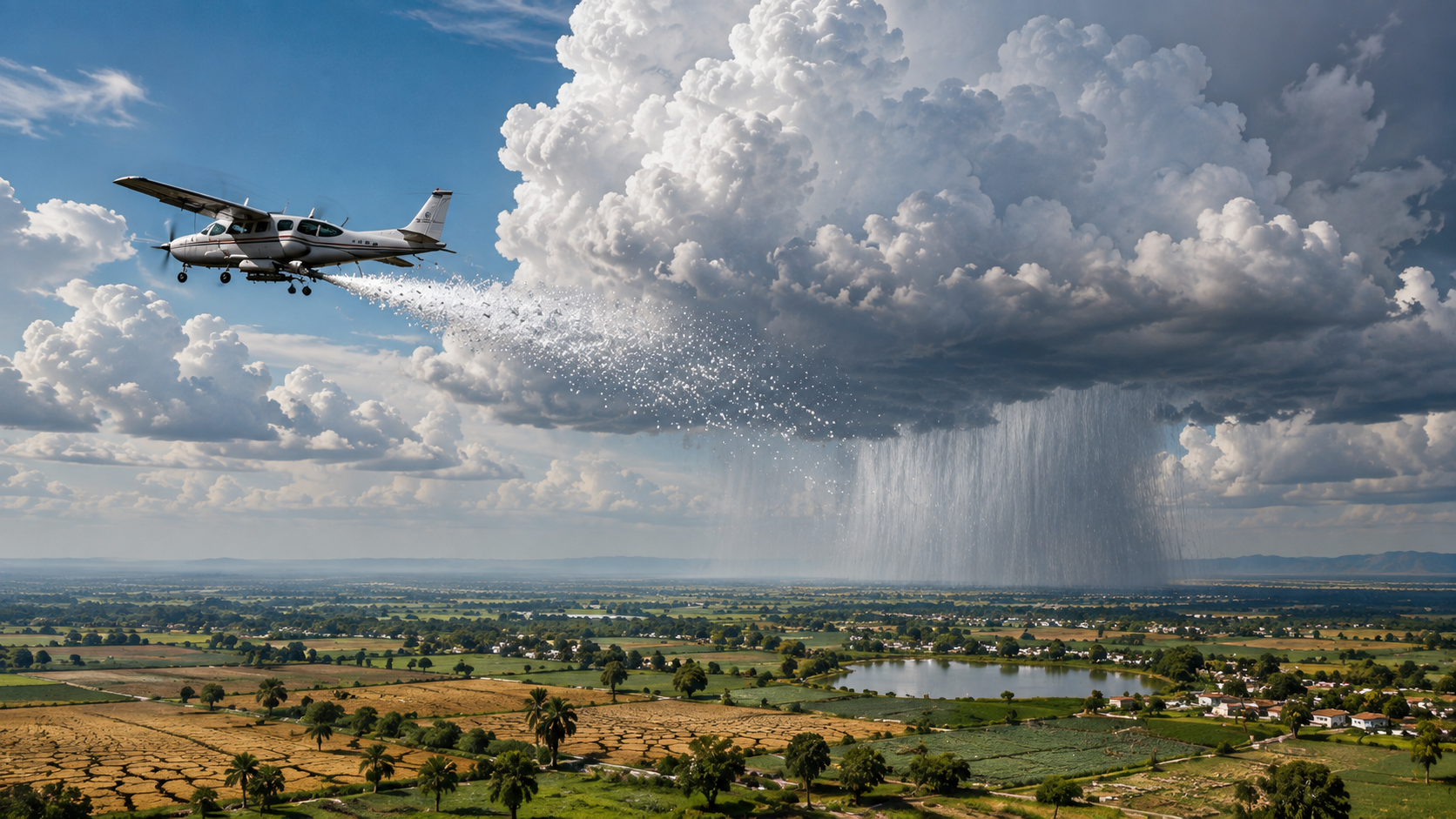
Cloud seeding sounds almost like science fiction: an aircraft enters a suitable cloud, releases tiny particles, and rain may follow. But the process is not about creating water from nothing. It is a form of weather modification that tries to influence precipitation already developing inside suitable clouds. The key question is not simply whether cloud seeding can make rain, but when it can work, how much difference it can make, and why it cannot replace normal water-management measures.
Table of Contents
What Is Cloud Seeding?
Cloud seeding is a weather-modification technique in which particles are introduced into a cloud to influence the formation or growth of water droplets or ice crystals. The World Meteorological Organization (WMO) describes it as a local-to-regional intervention intended to alter precipitation processes, rather than a way to manufacture an entirely new weather system.
There are different approaches. Glaciogenic seeding targets ice formation in cold, supercooled clouds, while hygroscopic seeding uses water-attracting particles to influence liquid droplets in warmer clouds. Silver iodide is one of the best-known materials used for glaciogenic seeding.
How Does Natural Rain Form?
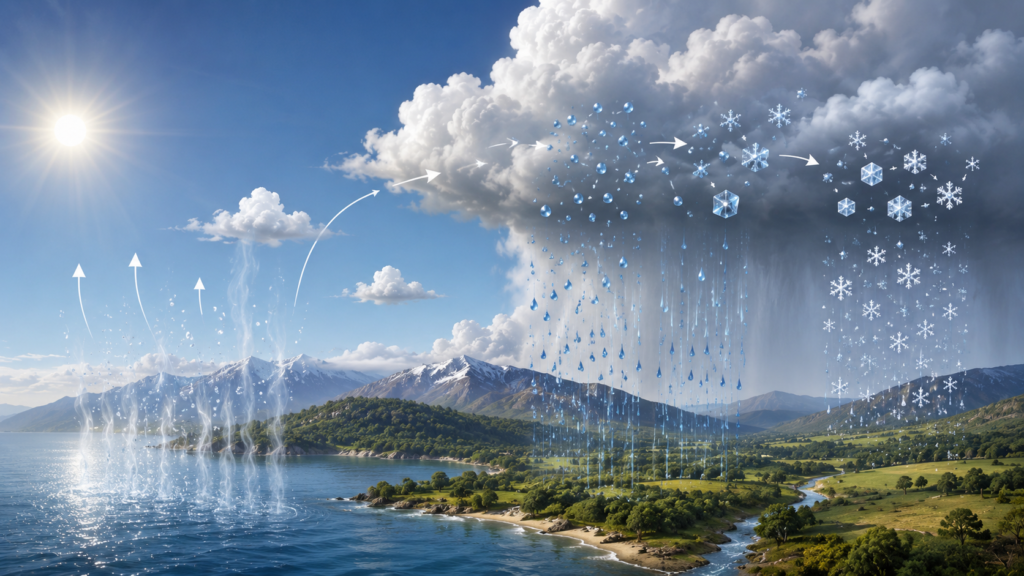
Before understanding cloud seeding, it helps to understand what happens inside a natural cloud. Water evaporates from the Earth’s surface and enters the atmosphere as water vapour. As moist air rises and cools, the vapour condenses around tiny atmospheric particles called cloud condensation nuclei, forming cloud droplets.
In cold or mixed-phase clouds, some droplets can remain liquid even when the temperature is below 0°C. These are called supercooled liquid water droplets. Ice crystals can grow in such clouds, and as they become larger they can eventually fall as snow or melt into rain as they pass through warmer air.
The important point is that clouds can contain a large amount of water without necessarily producing substantial rain at the ground. Cloud seeding attempts to influence the microphysical processes that turn cloud water into precipitation.
How Cloud Seeding Works
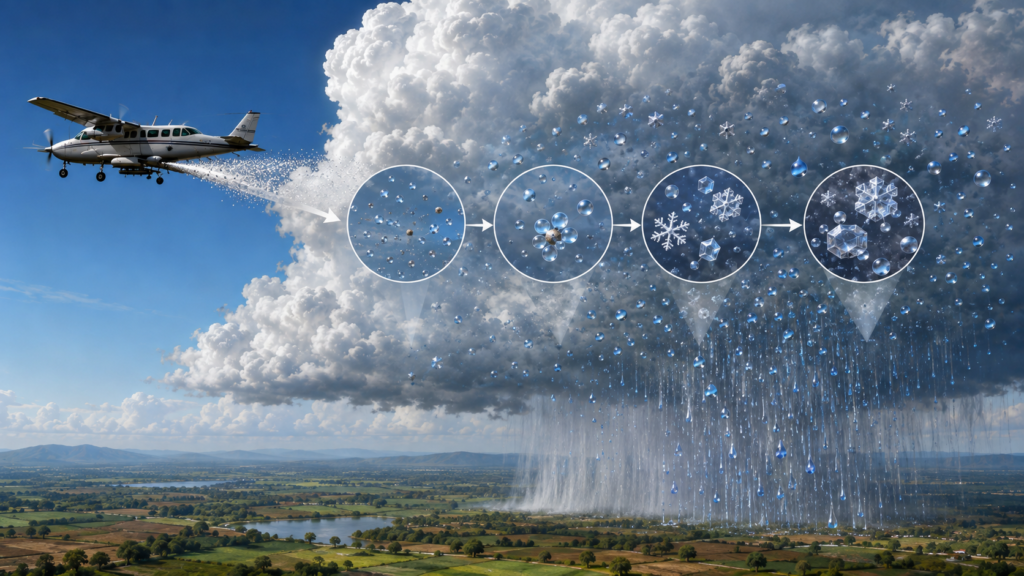
A typical glaciogenic cloud-seeding operation can be understood in four broad stages:
1. Find a suitable cloud
Meteorologists use observations such as radar, satellite data, weather models and in-cloud measurements to identify clouds with characteristics that may respond to seeding. Not every cloud is suitable.
2. Select the seeding method
The material and delivery method depend on the cloud type and the intended objective. Aircraft, ground-based generators, rockets and other systems have been used in different programmes.
3. Introduce the seeding particles
For cold-cloud glaciogenic seeding, silver iodide particles can be released into a suitable part of the cloud. The particles act as ice-nucleating surfaces.
4. Allow precipitation processes to develop
In suitable supercooled clouds, ice formation can grow at the expense of liquid droplets. Larger ice particles can then fall and melt into rain when they pass through warmer air.
Why Is Silver Iodide Used?
Silver iodide (AgI) is widely discussed in cloud-seeding science because its crystalline structure can act as an effective ice nucleus under appropriate conditions. In a supercooled cloud, introducing suitable ice nuclei can encourage freezing and subsequent ice-particle growth.

This is not best described as a simple chemical reaction that turns all cloud water into rain. The process involves cloud microphysics: ice nucleation, deposition and growth, collisions among hydrometeors, and the movement of particles through the cloud.
The 1946 Experiment That Helped Launch Modern Cloud Seeding
The transcript traces modern cloud seeding to Vincent Schaefer’s 1946 experiments at General Electric. Historical accounts from NOAA describe how dry ice was used to cool a cloud and produce ice formation. The work helped establish the idea that changing cloud microphysics could influence precipitation.
Soon afterward, researchers investigated silver iodide as an artificial ice nucleus. That development became important because silver iodide could be dispersed in very small quantities and used in operational seeding systems.
What Happened in India?
India has experimented with rainmaking and cloud seeding for decades. The Indian Institute of Tropical Meteorology (IITM) records pioneering attempts by Tata firms in the Western Ghats in 1951 using ground-based silver iodide generators. In 1952, S. K. Banerji conducted cloud-seeding experiments using salt and silver iodide delivered by hydrogen-filled balloons.
Cloud-seeding research later expanded through India’s atmospheric and cloud-physics research programmes. Karnataka has also conducted operational experiments. A peer-reviewed study of the 2017 Karnataka Varshadhare programme reported measurable rainfall enhancement under particular atmospheric conditions, while emphasizing that effectiveness depends on the cloud and environmental setup.
Can Cloud Seeding Create Rain Whenever We Want?
No. This is the most important limitation to understand. Cloud seeding does not create clouds, transport moisture into a drought area, or manufacture water from an empty sky.
The WMO states that the energy involved in weather systems is so large that it is not scientifically sound to claim that cloud seeding can create rain-producing cloud systems from nothing or bring water vapour into a region. Successful operations depend on suitable pre-existing clouds and favourable atmospheric conditions.
In simple terms: cloud seeding may help a suitable cloud produce more precipitation, but it cannot guarantee rain simply because an aircraft releases a seeding agent.
Why Cloud Seeding Does Not Permanently Solve Drought
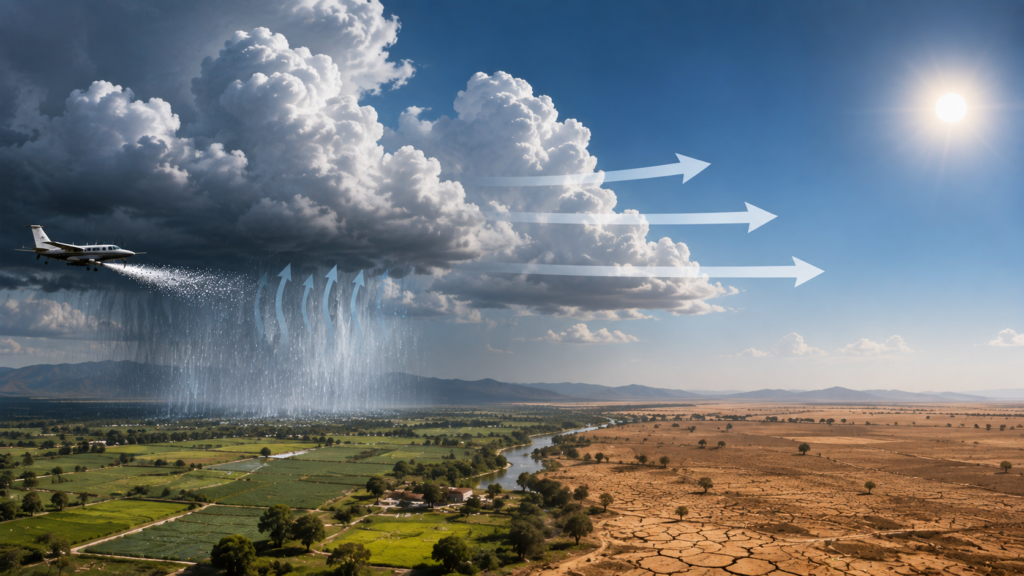
A suitable cloud must already exist.
The cloud must contain the right amount and type of moisture and the right microphysical conditions.
Wind can move clouds away from the intended target area.
Natural rainfall varies greatly, making it difficult to measure the exact effect of seeding.
Operations require aircraft, equipment, meteorological monitoring and trained personnel.
Results vary by cloud type, geography and atmospheric conditions.
Even a successful rainfall-enhancement operation does not create a permanent water supply.
How Effective Is Cloud Seeding?
The scientific answer is more nuanced than either ‘it always works’ or ‘it never works.’ Some experiments have reported increased precipitation, but the effect is highly dependent on the cloud system and on the quality of the experimental design.
The WMO notes that recent research has produced stronger evidence for some specific situations, including certain wintertime orographic clouds, while results in more dynamically complex clouds can be difficult to separate from natural variability. The U.S. Government Accountability Office likewise describes cloud-seeding benefits as uncertain and highlights the difficulty of obtaining reliable effectiveness data.
For Karnataka, a peer-reviewed assessment of the 2017 Varshadhare programme reported an average rainfall enhancement of about 27.9% above estimated natural rainfall across 618 analysed cases. That result should not be interpreted as a universal success rate: the study itself tied effectiveness to particular atmospheric and thermodynamic conditions.
Can Cloud Seeding Make a City Have Clear Skies for an Event?
Weather-modification programmes have also attempted to influence precipitation timing or location around major events. China used cloud-seeding and other weather-modification measures around the 2008 Beijing Olympics, including efforts intended to reduce the risk of rain at the opening ceremony.
However, such examples should not be interpreted as proof that scientists can precisely control weather. Forecast uncertainty, cloud movement and the natural variability of precipitation make outcomes difficult to attribute to seeding alone.
Cloud Seeding Has Also Been Used for Military Purposes
Weather modification has a controversial military history. U.S. government historical documents describe Project Popeye, which began as a weather-modification programme along routes in North Vietnam and southern Laos during the Vietnam War. The objective was to increase rainfall and interfere with movement along infiltration routes.
The history of such programmes is one reason weather modification is often discussed not only as a scientific technology but also as a matter of policy and international concern.
Is Silver Iodide Safe?
At the quantities used in past cloud-seeding operations, published studies have generally not identified significant human-health or environmental impacts from silver iodide. The WMO nevertheless recommends evaluating environmental and health effects when substantially larger quantities or new seeding agents are proposed.
The U.S. Environmental Protection Agency also notes that current evidence suggests silver iodide does not pose a health or environmental concern at current levels, while uncertainty remains about the effects of much wider use. This is a reason to treat environmental monitoring as part of responsible weather-modification programmes.
What Cloud Seeding Can and Cannot Do
| Cloud seeding can potentially | Cloud seeding cannot reliably |
| Influence precipitation from suitable existing clouds | Create rain from a clear, moisture-free sky |
| Increase precipitation under favourable conditions | Guarantee a specific amount of rain |
| Target certain cloud systems using meteorological data | Control the movement of clouds against strong winds |
| Support water-supply or agricultural objectives in some programmes | Provide a permanent cure for drought |
| Modify precipitation on local-to-regional scales | Control the global climate or weather system |
The Bottom Line
Cloud seeding is real science, but it is not a rain-making switch. The technology works by influencing cloud microphysics in clouds that already have the right ingredients. Silver iodide and other seeding agents can provide particles that encourage particular precipitation processes, but the outcome depends heavily on atmospheric conditions.
For drought-hit regions, cloud seeding can therefore be considered a possible supplementary tool rather than a standalone solution. Water conservation, groundwater management, watershed protection, storage, efficient irrigation and drought planning remain essential because no cloud-seeding operation can guarantee rain whenever it is needed.
A Quick Answer
Cloud seeding does not create rain from nothing. It introduces particles into suitable existing clouds to influence the formation and growth of water droplets or ice crystals. Under favourable conditions, this can increase precipitation, but the effect is variable and cannot permanently solve drought.
Explore More on A1InfoHub
Interested in how science and technology are being used to address real-world problems? Explore more A1InfoHub articles on weather, climate, technology and emerging scientific developments.
Sources and verification
This article was developed from the supplied YouTube transcript and checked against authoritative and scientific sources including the World Meteorological Organization, NOAA, the U.S. Government Accountability Office, the U.S. Environmental Protection Agency, India’s Indian Institute of Tropical Meteorology, and peer-reviewed research on Karnataka’s Varshadhare programme.
c
Cloud seeding sounds almost like science fiction: an aircraft enters a suitable cloud, releases tiny particles, and rain may follow. But the process is not about creating water from nothing. It is a form of weather modification that tries to influence precipitation already developing inside suitable clouds. The key question is not simply whether cloud seeding can make rain, but when it can work, how much difference it can make, and why it cannot replace normal water-management measures.
What Is Cloud Seeding?
Cloud seeding is a weather-modification technique in which particles are introduced into a cloud to influence the formation or growth of water droplets or ice crystals. The World Meteorological Organization (WMO) describes it as a local-to-regional intervention intended to alter precipitation processes, rather than a way to manufacture an entirely new weather system.
There are different approaches. Glaciogenic seeding targets ice formation in cold, supercooled clouds, while hygroscopic seeding uses water-attracting particles to influence liquid droplets in warmer clouds. Silver iodide is one of the best-known materials used for glaciogenic seeding.
How Does Natural Rain Form?
Before understanding cloud seeding, it helps to understand what happens inside a natural cloud. Water evaporates from the Earth’s surface and enters the atmosphere as water vapour. As moist air rises and cools, the vapour condenses around tiny atmospheric particles called cloud condensation nuclei, forming cloud droplets.
In cold or mixed-phase clouds, some droplets can remain liquid even when the temperature is below 0°C. These are called supercooled liquid water droplets. Ice crystals can grow in such clouds, and as they become larger they can eventually fall as snow or melt into rain as they pass through warmer air.
The important point is that clouds can contain a large amount of water without necessarily producing substantial rain at the ground. Cloud seeding attempts to influence the microphysical processes that turn cloud water into precipitation.
How Cloud Seeding Works
A typical glaciogenic cloud-seeding operation can be understood in four broad stages:
1. Find a suitable cloud
Meteorologists use observations such as radar, satellite data, weather models and in-cloud measurements to identify clouds with characteristics that may respond to seeding. Not every cloud is suitable.
2. Select the seeding method
The material and delivery method depend on the cloud type and the intended objective. Aircraft, ground-based generators, rockets and other systems have been used in different programmes.
3. Introduce the seeding particles
For cold-cloud glaciogenic seeding, silver iodide particles can be released into a suitable part of the cloud. The particles act as ice-nucleating surfaces.
4. Allow precipitation processes to develop
In suitable supercooled clouds, ice formation can grow at the expense of liquid droplets. Larger ice particles can then fall and melt into rain when they pass through warmer air.
Why Is Silver Iodide Used?
Silver iodide (AgI) is widely discussed in cloud-seeding science because its crystalline structure can act as an effective ice nucleus under appropriate conditions. In a supercooled cloud, introducing suitable ice nuclei can encourage freezing and subsequent ice-particle growth.
This is not best described as a simple chemical reaction that turns all cloud water into rain. The process involves cloud microphysics: ice nucleation, deposition and growth, collisions among hydrometeors, and the movement of particles through the cloud.
The 1946 Experiment That Helped Launch Modern Cloud Seeding
The transcript traces modern cloud seeding to Vincent Schaefer’s 1946 experiments at General Electric. Historical accounts from NOAA describe how dry ice was used to cool a cloud and produce ice formation. The work helped establish the idea that changing cloud microphysics could influence precipitation.
Soon afterward, researchers investigated silver iodide as an artificial ice nucleus. That development became important because silver iodide could be dispersed in very small quantities and used in operational seeding systems.
What Happened in India?
India has experimented with rainmaking and cloud seeding for decades. The Indian Institute of Tropical Meteorology (IITM) records pioneering attempts by Tata firms in the Western Ghats in 1951 using ground-based silver iodide generators. In 1952, S. K. Banerji conducted cloud-seeding experiments using salt and silver iodide delivered by hydrogen-filled balloons.
Cloud-seeding research later expanded through India’s atmospheric and cloud-physics research programmes. Karnataka has also conducted operational experiments. A peer-reviewed study of the 2017 Karnataka Varshadhare programme reported measurable rainfall enhancement under particular atmospheric conditions, while emphasizing that effectiveness depends on the cloud and environmental setup.
Can Cloud Seeding Create Rain Whenever We Want?
No. This is the most important limitation to understand. Cloud seeding does not create clouds, transport moisture into a drought area, or manufacture water from an empty sky.
The WMO states that the energy involved in weather systems is so large that it is not scientifically sound to claim that cloud seeding can create rain-producing cloud systems from nothing or bring water vapour into a region. Successful operations depend on suitable pre-existing clouds and favourable atmospheric conditions.
In simple terms: cloud seeding may help a suitable cloud produce more precipitation, but it cannot guarantee rain simply because an aircraft releases a seeding agent.
Why Cloud Seeding Does Not Permanently Solve Drought
1.A suitable cloud must already exist.
2.The cloud must contain the right amount and type of moisture and the right microphysical conditions.
3.Wind can move clouds away from the intended target area.
4.Natural rainfall varies greatly, making it difficult to measure the exact effect of seeding.
5.Operations require aircraft, equipment, meteorological monitoring and trained personnel.
6.Results vary by cloud type, geography and atmospheric conditions.
7.Even a successful rainfall-enhancement operation does not create a permanent water supply.
How Effective Is Cloud Seeding?
The scientific answer is more nuanced than either ‘it always works’ or ‘it never works.’ Some experiments have reported increased precipitation, but the effect is highly dependent on the cloud system and on the quality of the experimental design.
The WMO notes that recent research has produced stronger evidence for some specific situations, including certain wintertime orographic clouds, while results in more dynamically complex clouds can be difficult to separate from natural variability. The U.S. Government Accountability Office likewise describes cloud-seeding benefits as uncertain and highlights the difficulty of obtaining reliable effectiveness data.
For Karnataka, a peer-reviewed assessment of the 2017 Varshadhare programme reported an average rainfall enhancement of about 27.9% above estimated natural rainfall across 618 analysed cases. That result should not be interpreted as a universal success rate: the study itself tied effectiveness to particular atmospheric and thermodynamic conditions.
Can Cloud Seeding Make a City Have Clear Skies for an Event?
Weather-modification programmes have also attempted to influence precipitation timing or location around major events. China used cloud-seeding and other weather-modification measures around the 2008 Beijing Olympics, including efforts intended to reduce the risk of rain at the opening ceremony.
However, such examples should not be interpreted as proof that scientists can precisely control weather. Forecast uncertainty, cloud movement and the natural variability of precipitation make outcomes difficult to attribute to seeding alone.
Cloud Seeding Has Also Been Used for Military Purposes
Weather modification has a controversial military history. U.S. government historical documents describe Project Popeye, which began as a weather-modification programme along routes in North Vietnam and southern Laos during the Vietnam War. The objective was to increase rainfall and interfere with movement along infiltration routes.
The history of such programmes is one reason weather modification is often discussed not only as a scientific technology but also as a matter of policy and international concern.
Is Silver Iodide Safe?
At the quantities used in past cloud-seeding operations, published studies have generally not identified significant human-health or environmental impacts from silver iodide. The WMO nevertheless recommends evaluating environmental and health effects when substantially larger quantities or new seeding agents are proposed.
The U.S. Environmental Protection Agency also notes that current evidence suggests silver iodide does not pose a health or environmental concern at current levels, while uncertainty remains about the effects of much wider use. This is a reason to treat environmental monitoring as part of responsible weather-modification programmes.
What Cloud Seeding Can and Cannot Do
| Cloud seeding can potentially | Cloud seeding cannot reliably |
| Influence precipitation from suitable existing clouds | Create rain from a clear, moisture-free sky |
| Increase precipitation under favourable conditions | Guarantee a specific amount of rain |
| Target certain cloud systems using meteorological data | Control the movement of clouds against strong winds |
| Support water-supply or agricultural objectives in some programmes | Provide a permanent cure for drought |
| Modify precipitation on local-to-regional scales | Control the global climate or weather system |
The Bottom Line
Cloud seeding is real science, but it is not a rain-making switch. The technology works by influencing cloud microphysics in clouds that already have the right ingredients. Silver iodide and other seeding agents can provide particles that encourage particular precipitation processes, but the outcome depends heavily on atmospheric conditions.
For drought-hit regions, cloud seeding can therefore be considered a possible supplementary tool rather than a standalone solution. Water conservation, groundwater management, watershed protection, storage, efficient irrigation and drought planning remain essential because no cloud-seeding operation can guarantee rain whenever it is needed.
A Quick Answer
Cloud seeding does not create rain from nothing. It introduces particles into suitable existing clouds to influence the formation and growth of water droplets or ice crystals. Under favourable conditions, this can increase precipitation, but the effect is variable and cannot permanently solve drought.
Explore More on A1InfoHub
Also Read: Geothermal Energy in India
Interested in how science and technology are being used to address real-world problems? Explore more A1InfoHub articles on weather, climate, technology and emerging scientific developments.

