


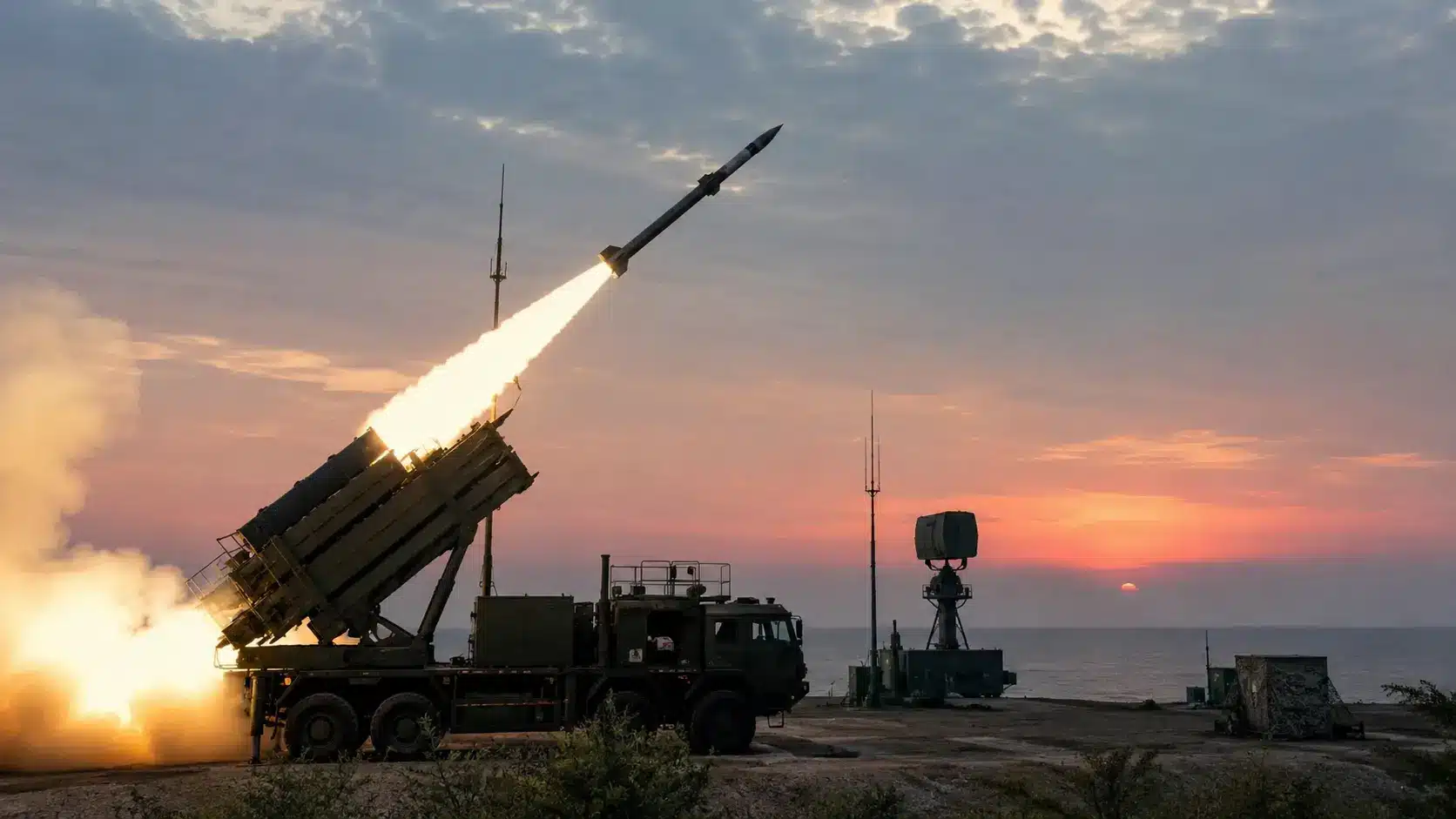
India just took a major step toward building its own long-range air defence shield — and it didn’t need to buy it from anyone else.
On 23 July 2026, the Defence Research and Development Organisation (DRDO) carried out the first flight test of Project Kusha, an indigenous long-range surface-to-air missile system, from the Integrated Test Range on Dr. APJ Abdul Kalam Island off the Odisha coast. The missile locked onto a high-speed electronic target simulating an aerial threat and destroyed it in mid-air. DRDO called the trial a complete success, and Defence Minister Rajnath Singh described it as a major milestone for Indian defence research.
If that sounds familiar, it’s because India already flies the Russian S-400 Triumf, one of the most capable air defence systems in the world. So why build another one? The short answer: control, speed of production, and independence from foreign supply chains. Here’s what Project Kusha actually is, how it works, and why it matters.
What Is Project Kusha?
Project Kusha is India’s fully indigenous long-range air defence missile programme, developed by DRDO with Indian defence manufacturers Bharat Electronics Limited (BEL) and Bharat Dynamics Limited (BDL). The goal is to build a system capable of detecting and destroying enemy aircraft, drones, and missiles at long range — in the same broad category as Russia’s S-400 or Israel’s Iron Dome, but designed, built, and controlled entirely within India.
The Cabinet Committee on Security cleared the project around 2022–23, with a total outlay of roughly ₹21,700 crore. The plan includes five missile squadrons for the Indian Air Force, with DRDO handling the overall system design while BEL builds the radars and BDL manufactures the missiles.
Project Kusha is a core piece of a much bigger plan: Mission Sudarshan Chakra, an ambitious effort announced in 2025 to build a layered, nationwide air defence network across India by 2035.
A Three-Layer Shield, Not a Single Missile
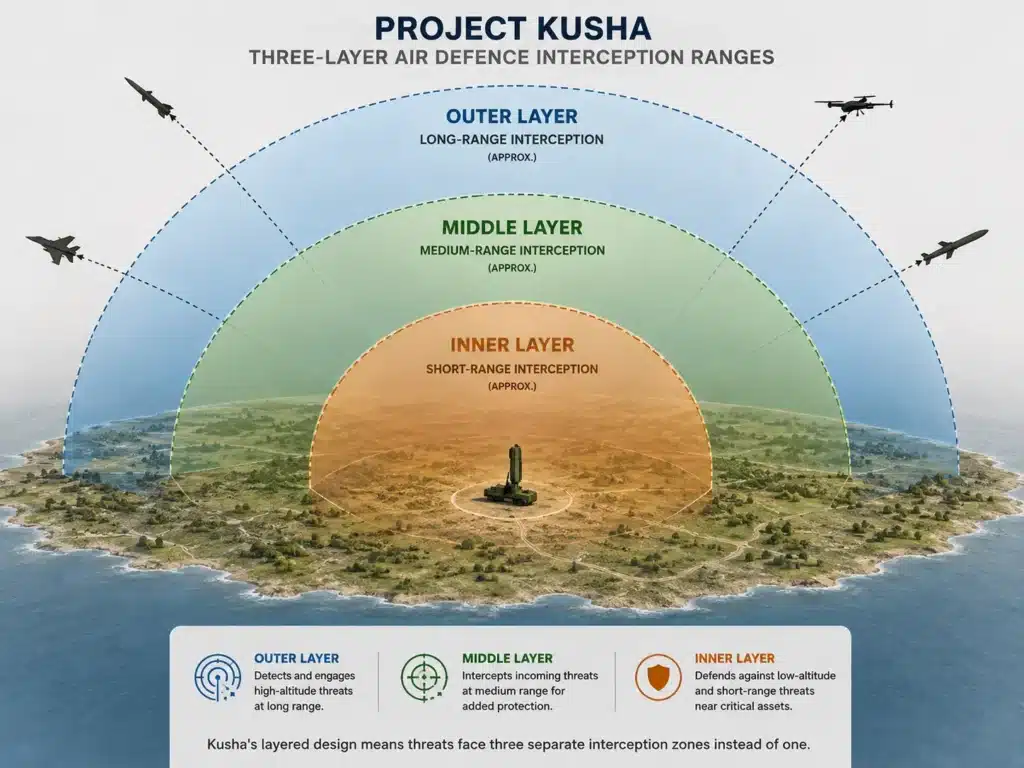
The real strength of Project Kusha isn’t one missile — it’s the layered structure behind it. Most air defence systems protect a fixed radius. Kusha is designed to intercept threats at three different distances, so that whatever gets through one layer runs into the next.
Based on DRDO’s public description of the system, the three interceptor tiers work roughly like this:
| Layer | Approximate Range | Role |
|---|---|---|
| Long-range interceptor | Up to roughly 350–400 km | Strikes high-value targets — enemy AWACS aircraft, aerial refuelling tankers, and command aircraft — before they even approach Indian airspace |
| Medium-range interceptor | Around 250 km | Engages fighter aircraft and other aerial threats that come closer |
| Short-range interceptor | Roughly 120–150 km | Handles fast, close-in threats like cruise missiles, drones, and kamikaze drones that slip past the outer layers |
The idea is simple: if an adversary launches a large-scale air operation, Kusha doesn’t wait for the threat to get close. The outer layer can, in theory, strike targets while they’re still hundreds of kilometres away — for example, a system positioned near the Punjab border could threaten targets deep inside neighbouring airspace before those aircraft ever take off in anger.
A note on naming: Different official and media sources describe the three interceptor variants (often labelled M1, M2 and M3) somewhat differently, and DRDO has not published a single authoritative range chart. The ranges above reflect the general three-tier structure described by DRDO and Indian defence commentary, but readers should treat the exact range attached to each individual missile variant as approximate rather than officially confirmed.
How Fast Is It?
Speed is where Kusha is meant to have a real edge. Indian defence sources describe the interceptor missiles as capable of speeds around Mach 5.5 — more than five times the speed of sound, or roughly 1.9 kilometres per second. At that speed, even stealth aircraft have very little room to manoeuvre once they’ve been detected and locked onto.
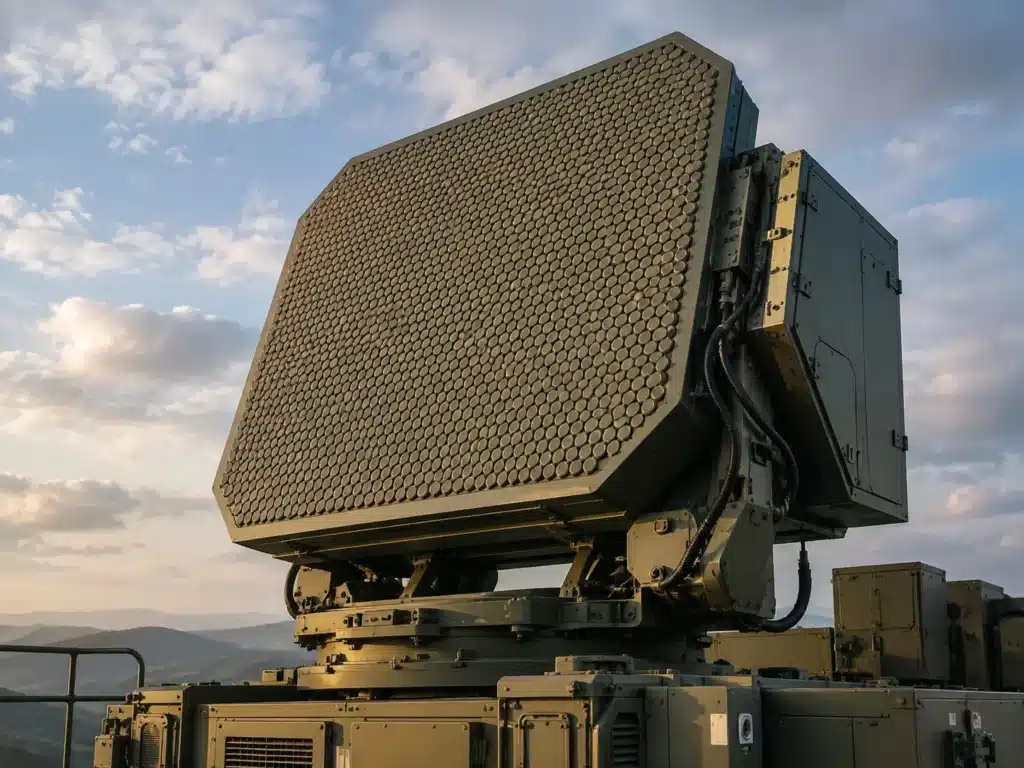
That speed is backed by the system’s sensors. Kusha relies on Active Electronically Scanned Array (AESA) radar technology, including a long-range battle management radar reported to detect targets from more than 500 km away. DRDO has also used gallium nitride (GaN) semiconductor technology in its radar systems, which is known for improving the detection of small, low-signature targets such as stealth aircraft and drones. The system is also designed to track and engage multiple incoming targets at once, and to operate in any weather, from Rajasthan’s desert heat to the high-altitude cold of Arunachal Pradesh.
Kusha is built to plug directly into the Indian Air Force’s Integrated Air Command and Control System (IACCS), so it doesn’t operate as a standalone unit — it shares data with the rest of India’s air defence network in real time.
Why Build This When India Already Has the S-400?
This is the question most people ask first, and it’s a fair one. India already operates multiple S-400 squadrons, with more on order from Russia. So why spend thousands of crores on a domestic alternative?
The answer comes down to a few practical realities:
- Full control over the technology. With an imported system like the S-400 or the American Patriot, India does not own the source code or the core control technology. Training, upgrades, and modifications depend on the supplying country. With Kusha, DRDO and the Indian armed forces control the software, radar frequencies, and upgrade path entirely in-house.
- Faster, more flexible production. Buying additional S-400 batches from Russia reportedly takes around five years per order. Because Kusha is built domestically, India can scale up manufacturing and deployment on its own timeline, without waiting on a foreign production queue.
- Easier future upgrades. Since India owns the underlying technology, extending the missile’s range, upgrading the radars, or adapting the system to new threats can be done without seeking permission or assistance from another country.
- Strategic depth, not replacement. Kusha is not meant to replace the S-400. It’s designed to work alongside it, adding another independent layer to India’s air defence network rather than depending on a single imported system.
This approach fits into India’s broader Atmanirbhar Bharat (self-reliance) push in defence manufacturing, where the priority is reducing dependence on imported weapons systems over time.
What Happens Next
The July 2026 test was the first flight trial of the system, not the final word. Project Kusha is expected to go through further rounds of testing before it’s formally inducted into the Indian Air Force, with induction currently expected around 2028. It follows another round of good news for India’s air defence programme — two successful tests of India’s multi-layered Ballistic Missile Defence (BMD) system in June 2026 — suggesting DRDO is stacking up wins across multiple air defence projects at once.
Zoomed out, Project Kusha reflects a broader shift in how India is approaching national defence: building the capability to design, produce, and upgrade its own weapons systems, rather than depending entirely on imports even from close defence partners.
The Bottom Line
Project Kusha is India’s attempt to build an S-400-class air defence system entirely on its own terms — layered across three interception ranges, built around indigenous radar and missile technology, and fully under Indian control from design to deployment. It won’t replace the S-400 anytime soon, but as more tests are completed over the next couple of years, it’s set to become a significant, independently controlled layer in India’s air defence network.
Want to understand more about how India’s defence technology is evolving? Explore more defence and technology explainers on A1InfoHub.

