


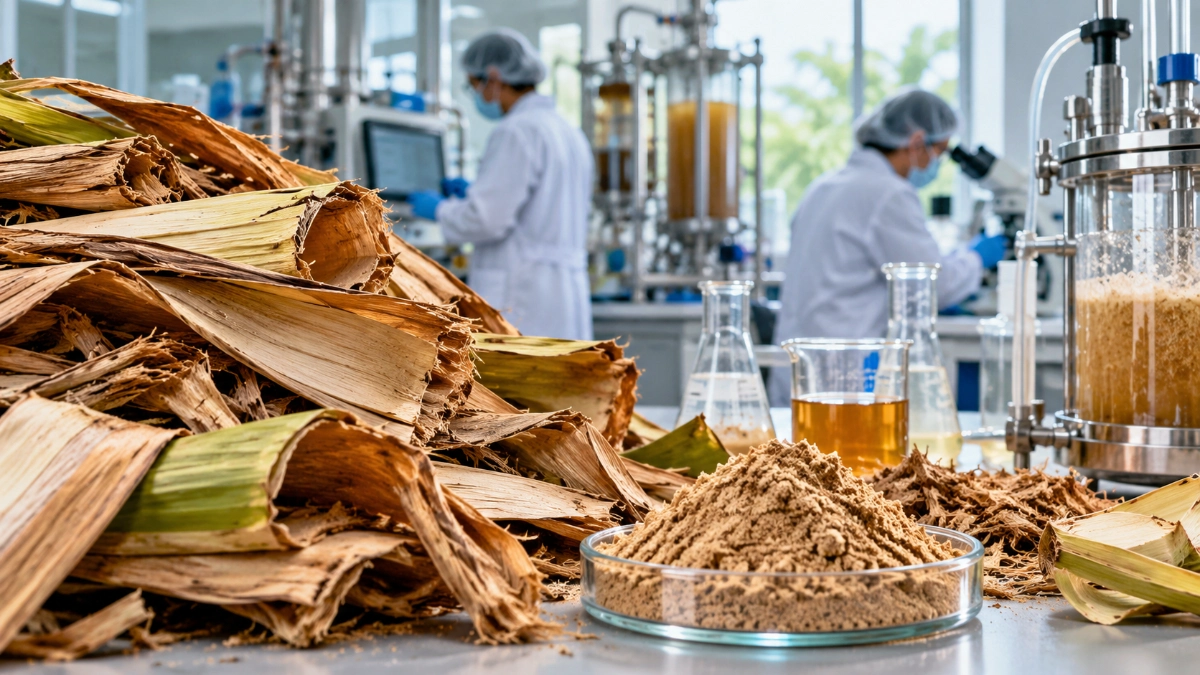
Can ethanol be produced from areca nut waste? A recent laboratory experiment in Karnataka suggests that the answer may be yes. Researchers have demonstrated the possibility of producing bioethanol from waste generated after areca leaf sheaths are used to make plates, although the process still needs further research before it can be considered commercially viable at industrial scale.
The development is attracting attention because areca leaf waste is generally treated as a by-product, while converting part of that waste into a fuel-related product could create an additional value stream for the areca sector. The reported Karnataka work was carried out as a student project under the guidance of researchers associated with the University of Mysore and JSS Academy of Higher Education and Research.
Table of Contents
What the Karnataka Experiment Found
The Karnataka research described in the September 2026 report used waste left after areca leaf sheaths were processed into plates. The waste was powdered and used as the feedstock for laboratory experiments aimed at producing bioethanol.
According to the report, the work was carried out under the guidance of Dr. Gopal Marathe, a retired University of Mysore professor and scientific adviser to Agrileaf, and Dr. Shiva S of JSS Academy of Higher Education and Research.
The reported result demonstrates laboratory-scale feasibility, rather than a commercially established production process.
How Can Ethanol Be Produced from Areca Nut Waste?
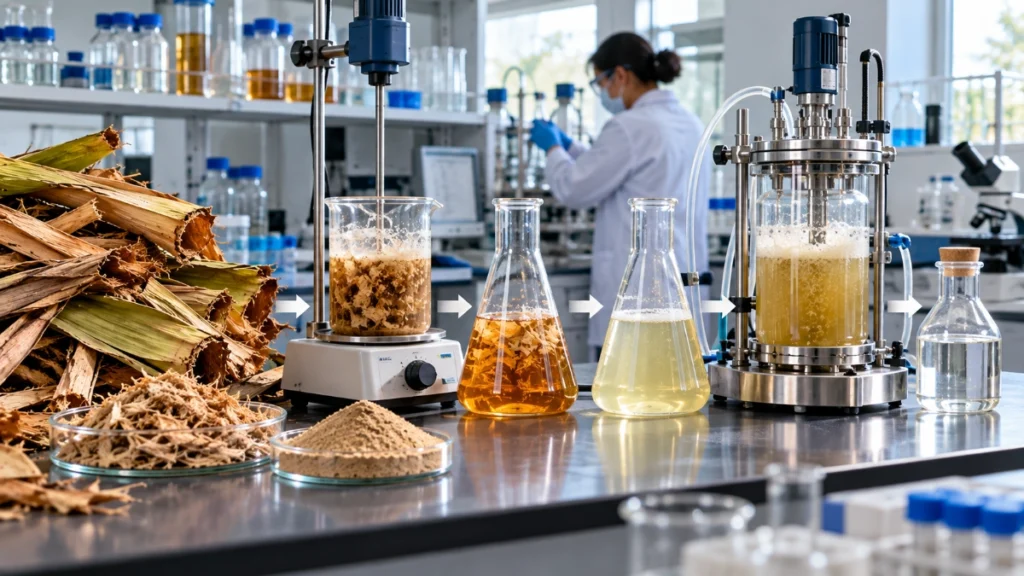
The basic idea is similar to other lignocellulosic bioethanol processes. Plant residues contain structural carbohydrates such as cellulose and hemicellulose, together with lignin. The carbohydrates have to be made accessible before they can be converted into fermentable sugars.
The Karnataka report describes a pretreatment stage in which chemical solutions are used to separate lignin from the material. The cellulose and hemicellulose are then processed so that fermentable sugars, including glucose, can be obtained. The resulting sugars can then be fermented to produce bioethanol.
A separate peer-reviewed 2025 study from researchers at Hasanuddin University also investigated areca leaf sheath fibre for bioethanol production. That study used acid and alkaline pretreatment, enzymatic hydrolysis and fermentation, and reported measurable bioethanol formation.
Also Read: research on bioethanol production from areca leaf sheath
However, that was a different experiment under different conditions, so its numerical results should not be presented as measurements from the Karnataka research.
Why Areca Leaf Waste Could Be Useful for Bioethanol
Areca leaf sheath is a lignocellulosic agricultural biomass. Its cellulose-rich structure makes it technically interesting as a potential source of fermentable sugars after suitable pretreatment.
Published research shows that the exact chemical composition of areca leaf sheath can vary substantially depending on the material and analytical method. One 2025 bioethanol study reported high cellulose content in its tested material, while other research has reported different cellulose, hemicellulose and lignin proportions.
Therefore, a single percentage should not be presented as a universal composition for all areca leaf waste.
The more important point is that the material contains carbohydrates that can potentially be released and converted into sugars, giving waste from areca-based products another possible use.
Could This Become an Additional Income Source for Areca Farmers?
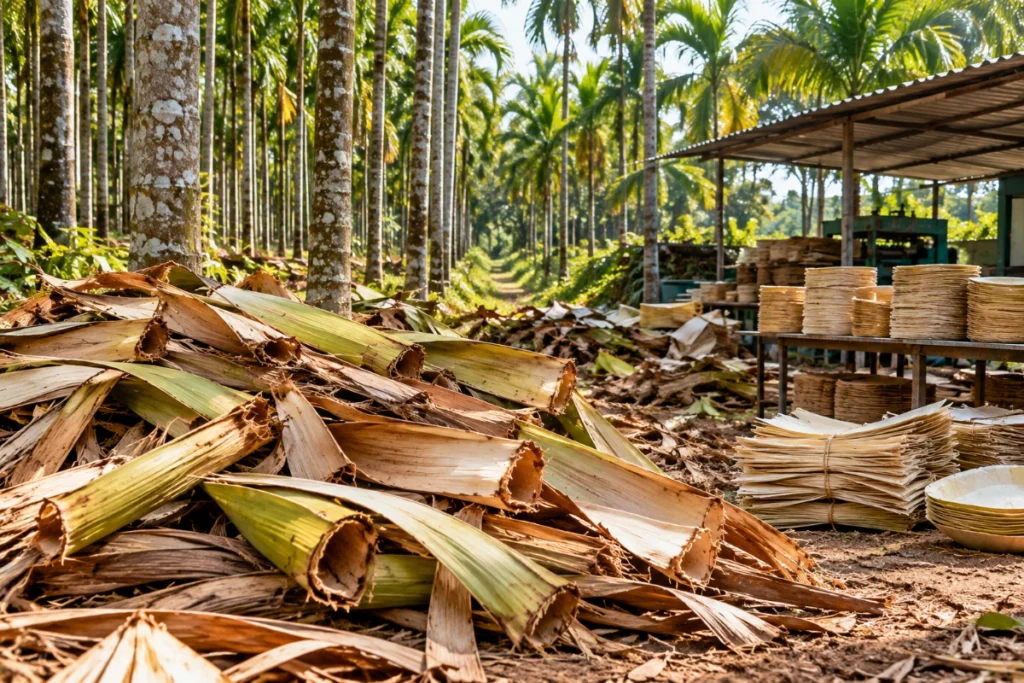
Potentially, but it is too early to describe it as a confirmed new income source.
The Karnataka report says further work is being considered to examine the process at a larger or industrial scale. That means several important questions still need to be answered before the technology can become a commercial opportunity.
For farmers and processors, the economic question is not only whether ethanol can be produced in a laboratory. A commercial process would also need to establish:
- Reliable collection of areca leaf waste
- Transportation and storage costs
- Pretreatment costs
- Enzyme or fermentation requirements
- Energy consumption
- Ethanol yield
- Waste handling
- Processing-plant investment
- Market value of the final product
If these factors can be made economically viable at scale, converting a waste stream into a saleable product could add value to the areca-leaf supply chain.
That possibility is the main reason the research is attracting interest.
What Happens Next?
The next important stage is scale-up.
Laboratory results need to be reproduced with larger quantities of consistent feedstock and under controlled process conditions. Researchers would also need to evaluate ethanol yield, process efficiency, operating costs, environmental performance and the reliability of the process over repeated production cycles.
A successful laboratory demonstration should therefore be viewed as an early research milestone, not as evidence that commercial areca-waste ethanol plants are already ready for widespread deployment.
The 2025 peer-reviewed study also shows that areca leaf sheath can be experimentally processed through pretreatment, hydrolysis and fermentation for bioethanol production, providing independent scientific context for the broader concept.
What About the Reported U.S. Market Issue for Areca Leaf Plates?
The Karnataka report also discusses concerns around the U.S. market for areca leaf plates and describes this as one reason alternative uses for the material are receiving attention.
However, the claim that the United States has completely stopped importing Indian areca leaf plates should not be presented as a general current fact without a specific official trade or regulatory source.
Current U.S. government information shows that plant and plant-derived products can be subject to commodity-specific import requirements.
The U.S. FDA has also published a 2025 memorandum concerning the regulatory safety status of Areca catechu leaf-sheath food-contact articles. The FDA memorandum specifically discusses available safety information concerning the use of this material in food-contact articles. U.S. Food and Drug Administration
These regulatory matters are separate from the technical question of whether areca waste can be converted into ethanol.
FAQs
Can ethanol be produced from areca nut waste?
Yes. Laboratory research has demonstrated that areca leaf-sheath waste can be processed into fermentable sugars and used to produce bioethanol. The Karnataka project described in the source material is an early-stage laboratory demonstration, and industrial-scale feasibility still requires further research.
What part of the areca plant is being used for ethanol production?
The reported Karnataka experiment used waste left after areca leaf sheaths were processed into plates. This material was powdered and used as the feedstock for the experiment.
How is areca leaf waste converted into ethanol?
The reported process involves pretreatment to make the plant structure more accessible, separation or reduction of lignin, hydrolysis of structural carbohydrates to produce fermentable sugars such as glucose, and fermentation to produce ethanol.
Is areca-waste ethanol already being produced commercially in Karnataka?
The available source describes laboratory-scale research and says further work is being considered for industrial-scale development. It does not establish that commercial-scale production is already operating in Karnataka.
Can this technology give areca farmers additional income?
It could create an additional value stream if an industrial process proves technically reliable and economically viable. At present, that should be treated as a potential opportunity rather than a confirmed income source.
Conclusion
The answer to the question “Can ethanol be produced from areca nut waste?” is yes at the laboratory-research level. The Karnataka experiment adds to a growing body of research showing that areca leaf-sheath biomass can be investigated as a feedstock for bioethanol.
The more difficult question is whether the process can be scaled economically.
If further research demonstrates consistent yields, manageable processing costs and a viable supply chain, areca-leaf waste could gain a new value beyond its existing uses. Until those conditions are demonstrated, the development is best understood as a promising research opportunity rather than a commercially proven solution.
Also Read:How to Manage Money Like the 1%: 4 Smart Money Rules

