


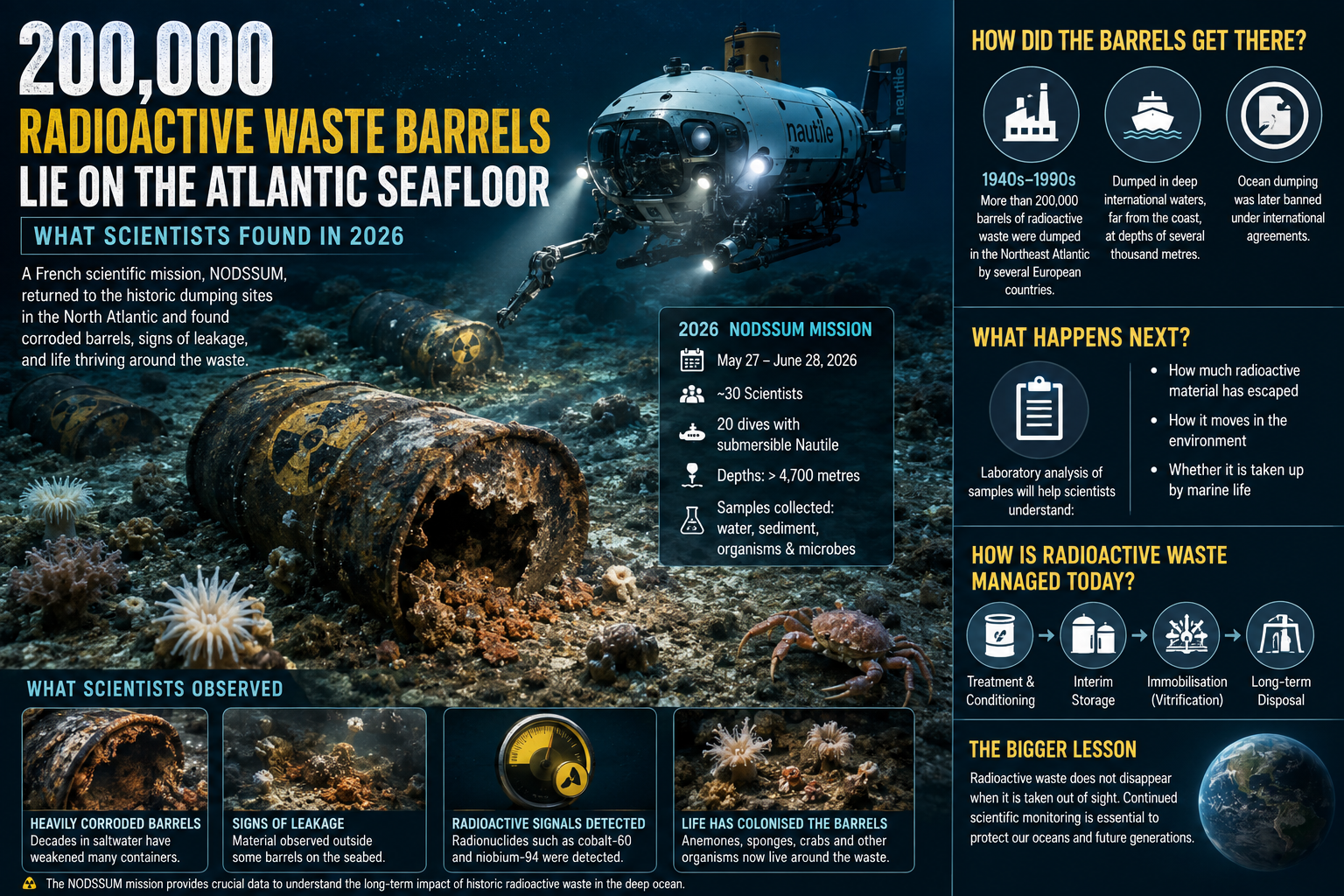
More than 200,000 barrels containing radioactive waste were dumped in the Northeast Atlantic decades ago. Now, a French-led scientific mission has returned to the deep ocean to find out what happened to them.
In 2025 and 2026, researchers working under the NODSSUM project used autonomous underwater technology and the crewed submersible Nautile to locate and inspect the historic dumping sites. During the 2026 expedition, scientists saw barrels in advanced stages of corrosion, and some showed signs of material escaping onto the surrounding seabed.
The findings do not mean that the entire Atlantic is experiencing a large-scale radioactive contamination event. Instead, they provide important new evidence about the condition of individual waste containers and raise questions about how radioactive material may interact with deep-sea ecosystems over the long term.
Here is what scientists discovered, how the barrels got there, and what happens next.
What Is Happening to the Radioactive Waste in the Atlantic?
Between May 27 and June 28, 2026, around 30 scientists took part in the second NODSSUM research campaign aboard the French research vessel Pourquoi Pas?
The team used the crewed deep-sea submersible Nautile to carry out 20 dives to depths exceeding 4,700 metres.
The mission was not simply to locate radioactive waste. Scientists wanted to understand what condition the dumped containers are in and how the waste may interact with the surrounding deep-sea environment.
During the dives, researchers directly observed several barrels. Some were heavily corroded, while particularly degraded containers showed material apparently spilling onto the seabed.
Scientists also collected sediment, water, organisms and microbial samples around selected barrels. These samples will help researchers determine which radionuclides are present and whether radioactive material has moved from the containers into the surrounding environment.
This distinction is important: scientists have documented degraded and damaged barrels, but the research is still determining the scale and environmental significance of any radioactive releases.
How Did More Than 200,000 Radioactive Waste Barrels End Up in the Ocean?
The story goes back to the era when nuclear science and the nuclear industry were expanding rapidly.
During the middle of the 20th century, several European countries generated radioactive waste from nuclear research, industrial activities and the development of nuclear technologies.
At the time, ocean dumping was considered an acceptable disposal method for certain categories of low-level radioactive waste. Governments believed that the enormous volume of the ocean and the great depth of the seabed could help isolate or dilute contaminants.
More than 200,000 barrels of radioactive waste were eventually dumped in the Northeast Atlantic. The material was placed in deep-ocean areas, with some containers lying at depths of several thousand metres.
According to the NODSSUM researchers, the barrels were dumped by several European countries during the historical period of ocean disposal.
Today, such dumping is no longer considered an acceptable way to manage radioactive waste.
Why Did Countries Think Dumping Waste in the Ocean Was Safe?
The idea may seem shocking today, but attitudes toward radioactive waste were very different in the middle of the 20th century.
The deep ocean was poorly understood compared with today. Scientists had limited information about deep-sea ecosystems, ocean circulation and how contaminants could behave over very long periods.
The ocean also appeared enormous and capable of diluting substances to extremely low concentrations.
This led to the assumption that putting waste into deep international waters would isolate it from human populations.
The problem was that the deep sea was not an empty or lifeless environment.
Modern research has shown that deep-ocean ecosystems contain a wide range of organisms and complex biological communities. The NODSSUM mission itself found organisms living on and around some of the old barrels.
That makes the condition of the containers important—not simply because the barrels are radioactive, but because they have become part of a living marine environment.
When Was Radioactive Waste Dumping in the Ocean Stopped?
Ocean dumping of radioactive waste was gradually restricted through international agreements.
The London Convention and subsequent international measures placed increasingly strict controls on dumping at sea. Ocean dumping of radioactive waste was ultimately prohibited under international arrangements.
The historical barrels, however, remain on the seafloor.
Stopping the practice prevented new waste from being dumped, but it did not remove the material that had already been deposited decades earlier.
That is why missions such as NODSSUM are important: scientists need to understand what is happening to these old containers as they age.
Inside the NODSSUM Mission
NODSSUM stands for Nuclear Ocean Dump Site Survey Monitoring.
The project is led by French researchers and involves scientists from several institutions and countries. Its goal is to map the historic dumping site and study the behaviour of radioactive waste and radionuclides in the deep ocean.
The project has involved two major research campaigns.
The 2025 Campaign
The first campaign, conducted from June 15 to July 11, 2025, focused heavily on mapping the dumping area and locating containers.
Researchers used the autonomous underwater vehicle UlyX to survey sections of the seabed and identify barrels.
This was an important first step because scientists needed a better understanding of where the old containers were located before they could carry out detailed inspections.
The 2026 Campaign
The second campaign took place from May 27 to June 28, 2026.
This time, researchers used the manned submersible Nautile to get much closer to the barrels.
The team conducted 20 dives to depths exceeding 4,700 metres and directly observed several containers and their surrounding environment.
The researchers also collected environmental samples for laboratory analysis.
What Did Scientists See on the Seafloor?
The most striking discovery was the condition of some of the barrels.
Decades of exposure to seawater have caused significant corrosion in some containers.
Researchers observed barrels at different stages of degradation. Some remained recognisable as containers, while others were heavily damaged.
In some cases, researchers observed material outside the containers and on the surrounding seabed.
This does not mean every barrel is leaking.
Instead, the observations show that at least some containers have deteriorated enough for their contents to be exposed or released onto the seafloor.
That is one of the key findings of the 2026 expedition.
Did Scientists Detect Radioactive Material?
Yes.
Researchers used field instruments to look for radionuclides associated with the historic radioactive waste.
The NODSSUM team reported significant signals from radionuclides including cobalt-60 and niobium-94, which can be associated with the dumped radioactive material. Researchers also detected cesium-137 and americium-241.
However, cesium-137 and americium-241 can also be associated with historical atmospheric nuclear weapons testing and nuclear accidents.
That is why scientists cannot simply look at the presence of an isotope and automatically conclude that every detected atom came from a particular barrel.
Laboratory analysis of the sediment, water and biological samples is important for determining the source, distribution and behaviour of the radionuclides more precisely.
The Deep-Sea Ecosystem Has Grown Around the Barrels
One of the unexpected observations from the expedition was the amount of life around the old containers.
Researchers observed organisms including anemones, sponges and crabs living on or around some barrels.
The barrels have effectively introduced hard surfaces into an environment where much of the surrounding seabed consists of soft sediment.
For marine organisms, those hard surfaces can provide places to attach or shelter.
This creates an unusual situation: containers that were originally dumped as waste have now become physical structures within a deep-sea ecosystem.
Scientists are therefore interested not only in the barrels themselves but also in the biological communities that have developed around them.
Could Radioactive Material Enter the Food Chain?
This is one of the questions scientists are investigating, but it is important not to confuse a possible pathway with a confirmed human health impact.
Radioactive substances can potentially move through marine ecosystems if they are released into seawater or sediment and subsequently taken up by organisms.
For example, researchers may investigate whether radionuclides are present in organisms living directly on or near the containers.
If radioactive material enters organisms, scientists can study how it is distributed through the local ecosystem.
However, the 2026 NODSSUM expedition does not establish that radioactive material from these barrels has already moved through the marine food chain and reached humans.
The researchers collected organisms, sediment and water specifically so that these questions can be studied in the laboratory.
The results will help determine whether measurable contamination is occurring, how extensive it is, and what ecological significance it may have.
Is This a Major Radioactive Pollution Event?
There is currently no evidence from the NODSSUM findings that the entire Northeast Atlantic has suddenly become dangerously radioactive.
The discovery is better understood as evidence of long-term deterioration of individual historical waste containers and the need to understand their environmental interactions.
The researchers themselves are studying the scale and significance of any releases.
The fact that some barrels are damaged does not automatically mean that a large quantity of radioactive material has entered the wider ocean.
That distinction is important because headlines about “200,000 leaking barrels” can give the impression that every container is actively releasing dangerous quantities of radioactive material.
The scientific evidence is more specific: more than 200,000 barrels were historically dumped, several have been found in advanced states of degradation, and some show evidence of material outside the containers.
Why Can’t Scientists Simply Remove the Barrels?
At first glance, retrieving the barrels might seem like the obvious solution.
In reality, recovering thousands of old containers from depths of around 4,000 to 4,700 metres would be an extremely difficult operation.
The containers have been underwater for decades. Some are heavily corroded, and moving them could potentially disturb their contents.
A large-scale recovery project would require specialised deep-sea equipment, careful radiological assessment, transportation systems and a secure destination for the recovered material.
It would also create the question of what to do with the waste after it reached the surface.
For these reasons, the current scientific focus is on mapping, monitoring, sampling and understanding the condition of the site, rather than attempting to recover all of the historical barrels.
What Happens as the Barrels Continue to Age?
The biggest long-term question is what will happen as more containers deteriorate.
Steel exposed to seawater does not remain intact forever.
As corrosion progresses, individual barrels can lose their structural integrity. What happens after that depends on the type of waste inside the container, the chemical form of the radionuclides, the surrounding sediment and the movement of seawater.
Some radionuclides may remain strongly associated with sediment, while others can behave differently in the marine environment.
This is why scientists need actual measurements rather than assumptions.
The NODSSUM project is designed to provide those measurements.
What Happens Next With the Atlantic Waste?
The 2026 expedition collected a large amount of environmental information.
Researchers obtained samples of:
- Seawater
- Sediment
- Marine organisms
- Microbial communities
- Material surrounding selected barrels
These samples can now be analysed in laboratories to determine the concentration and distribution of different radionuclides.
The results will help researchers answer several important questions:
- How much radioactive material has escaped from individual containers?
- How far has it moved through the surrounding sediment?
- Are marine organisms absorbing measurable amounts of radionuclides?
- Which radionuclides are most important at the site?
- How might the situation change as more barrels corrode?
- What monitoring should be carried out in the future?
The answers will be important not only for this particular dumping site but also for understanding the long-term consequences of historic radioactive-waste disposal in the ocean.
What About Radioactive Waste Management in India?
India’s approach to radioactive-waste management is different from the historical ocean-dumping practices investigated by NODSSUM.
According to the Bhabha Atomic Research Centre (BARC), India follows a closed nuclear fuel cycle in which spent nuclear fuel can be reprocessed to recover useful nuclear materials.
BARC says radioactive waste is treated, conditioned, stored and disposed of according to its type and radioactivity. High-level radioactive waste generated during reprocessing is immobilised in a glass matrix through a process known as vitrification, followed by interim storage and eventual disposal in a geological disposal facility.
India’s first spent-fuel reprocessing facility at Trombay began operating in 1964, and additional reprocessing capabilities were later developed at sites including Tarapur and Kalpakkam.
This does not mean India has no radioactive waste. Nuclear power generation, research, medicine and other activities all generate radioactive materials that require controlled management.
The important difference is that India’s current nuclear policy and infrastructure use treatment, conditioning, reprocessing and controlled disposal rather than historical ocean dumping.
How Is Radioactive Waste Managed Today?
Modern radioactive-waste management depends on the type and level of waste.
There is no single storage method for every radioactive material.
1. Treatment and Conditioning
Radioactive waste may first be processed to reduce its volume and convert it into a more stable form.
Depending on the waste, techniques can include filtration, evaporation, ion exchange, chemical treatment or other processes.
2. Interim Storage
Some radioactive materials need to be stored while their heat and radioactivity decrease.
Spent nuclear fuel, for example, can initially be stored in specially designed water pools and may later be transferred to dry storage systems depending on the country’s nuclear-waste strategy.
3. Immobilisation
High-level radioactive waste can be immobilised so that radioactive materials are trapped within a stable material.
India uses vitrification, in which high-level liquid waste is incorporated into a glass matrix.
4. Long-Term Disposal
For radioactive materials requiring very long-term isolation, deep geological disposal is one of the principal approaches being developed internationally.
The basic idea is to place suitably conditioned waste deep underground in stable geological formations and use multiple engineered and natural barriers to limit the movement of radionuclides.
Why the NODSSUM Discovery Matters
The significance of NODSSUM goes beyond the 200,000 barrels themselves.
The project gives scientists a rare opportunity to study what happens when radioactive waste remains on the deep-ocean floor for decades.
It also demonstrates how much the deep sea has changed in our scientific understanding.
Decades ago, the deep ocean was often viewed as an enormous space where unwanted material could be hidden from human activity.
Today, scientists know that the deep sea contains complex ecosystems and plays an important role in the Earth’s environment.
The old barrels therefore represent more than a historical waste-disposal decision. They are also a long-term experiment—one that scientists never intended to conduct, but now have the opportunity to study.
The Bigger Lesson
The radioactive waste barrels at the bottom of the Atlantic were placed there under very different scientific and regulatory conditions.
At the time, ocean dumping appeared to offer a practical solution to a difficult waste problem.
Decades later, scientists are returning to see what that decision actually produced.
The early findings from NODSSUM show that some containers have deteriorated significantly and that deep-sea organisms have colonised the structures. Researchers have also detected radionuclide signals associated with the historical waste and are now analysing environmental samples to understand the scale of any release.
The most important conclusion is not that the Atlantic is facing an immediate radioactive disaster.
It is that radioactive waste does not simply disappear when it is taken out of sight.
The condition of these old barrels will continue to matter for decades, and continued scientific monitoring will be necessary to understand their long-term environmental impact.
Frequently Asked Questions
How many radioactive waste barrels are in the Atlantic Ocean?
More than 200,000 barrels containing radioactive waste were historically dumped in the Northeast Atlantic. NODSSUM researchers have identified thousands of the containers during their 2025 and 2026 surveys.
Are the radioactive barrels in the Atlantic leaking?
Some barrels observed during the 2026 NODSSUM expedition were severely corroded, and researchers observed material outside some containers on the surrounding seabed. This does not mean that all 200,000 barrels are leaking or that a large-scale radioactive pollution event has been confirmed.
How deep are the radioactive waste barrels?
The barrels are located in deep-ocean areas several thousand metres below the surface. During the 2026 NODSSUM mission, Nautile conducted dives to depths exceeding 4,700 metres.
What is NODSSUM?
NODSSUM stands for Nuclear Ocean Dump Site Survey Monitoring. It is a scientific project studying historic radioactive-waste dumping sites in the Northeast Atlantic, including the condition of the containers and their interaction with the deep-sea environment.
What did scientists find during the 2026 NODSSUM mission?
Researchers directly observed several radioactive-waste barrels, including heavily corroded containers. Some showed material outside the barrels. Scientists also collected sediment, water and biological samples for further analysis.
Did scientists find radioactive contamination?
Field instruments detected radionuclides associated with the historic waste, including cobalt-60 and niobium-94. Researchers also detected cesium-137 and americium-241. Laboratory analysis is needed to determine the full extent and environmental significance of the detected radionuclides.
Could radioactive material enter the marine food chain?
It is a question scientists are investigating. Researchers collected marine organisms and environmental samples around the barrels to determine whether radionuclides are being taken up by organisms. The current findings do not establish that radioactive material from the barrels has reached humans through the food chain.
Why did countries dump radioactive waste into the ocean?
During the mid-20th century, ocean dumping was considered an acceptable disposal method for certain radioactive wastes. The deep ocean was poorly understood, and governments believed its enormous volume and depth could help isolate or dilute the waste.
Can scientists remove the radioactive barrels?
Large-scale recovery would be technically difficult because the containers are thousands of metres underwater, some are severely corroded, and moving them could disturb their contents. Current research therefore focuses primarily on mapping, monitoring and studying the site.
Did India dump radioactive waste into the Atlantic Ocean?
The NODSSUM research concerns historical dumping in the Northeast Atlantic by European countries. India currently manages radioactive waste through controlled treatment, conditioning, storage, reprocessing and disposal systems. BARC describes India’s nuclear programme as following a closed fuel cycle with reprocessing and vitrification of high-level waste.
How is radioactive waste managed today?
Management depends on the type of waste. Methods can include treatment, conditioning, interim storage, reprocessing, immobilisation and long-term disposal. High-level waste in India is immobilised through vitrification and stored before eventual geological disposal.
Is the Atlantic Ocean dangerous because of these barrels?
The NODSSUM findings do not establish that the Northeast Atlantic is experiencing a widespread dangerous radiation event. They show that some historical waste containers have deteriorated and that scientists need to study the resulting environmental interactions carefully.

