


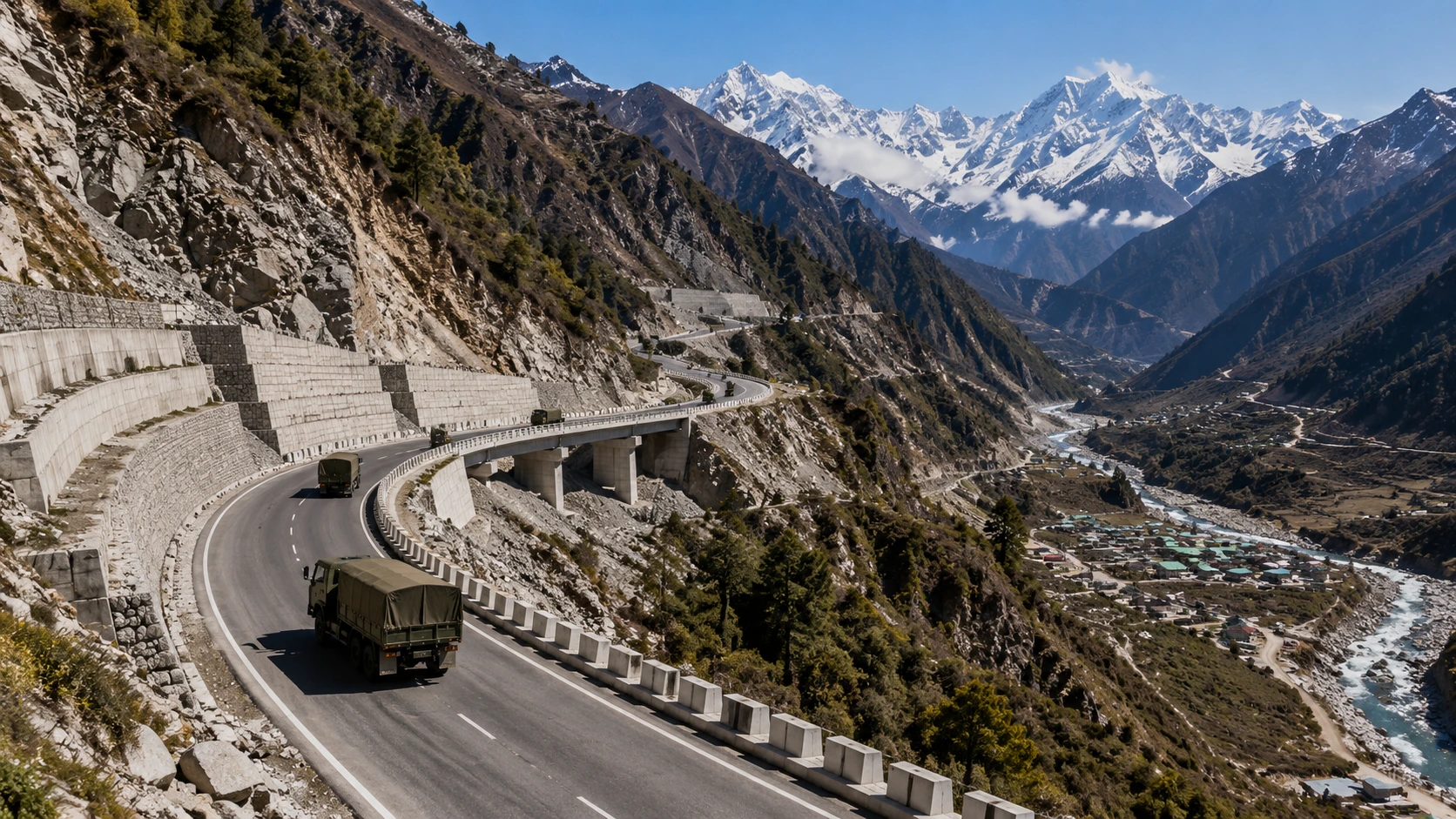
Border highways in India are becoming a major focus of the country’s infrastructure and strategic planning. Recent reports say India is planning more than 5,000 km of highways in border regions over the next three to five years, at a potential investment of over ₹2 trillion. The proposed expansion is intended to improve strategic mobility while also connecting remote communities to markets and essential services.
This reported plan is separate from the official figures for border-area National Highway projects already awarded. Official data shows that 3,318 km of border-connectivity projects were awarded over the last five years, and that is the firmer measure of work already sanctioned.
Table of Contents
What Is the 5,000-km Border Highways in India Plan?
The reported 5,000-km programme is a proposed expansion of highway infrastructure along sensitive frontier regions. Reports say the plan could cover strategic stretches along India’s borders with China, Pakistan, Nepal, Bhutan and Myanmar.
The objective of border highways in India is broader than adding kilometres of road. In difficult border terrain, the location and reliability of a road can determine how quickly personnel, equipment, fuel, food and other supplies can reach forward areas. Better civilian connectivity can also reduce the isolation of villages that have historically had limited access to markets and essential services.
The distinction between a reported future plan and an officially sanctioned project matters. The 5,000-km figure should be treated as a reported programme proposal, not as a completed or fully sanctioned national highway network.
What the Government Has Officially Confirmed So Far
Official Ministry of Road Transport and Highways data gives a clearer picture of work already awarded and under construction. Reports citing the ministry say that National Highway projects covering 3,318 km were awarded over the past five years to improve connectivity in border areas, and that 1,301 km of that length has been completed.
The same reporting says 1,191 National Highway projects covering about 25,917 km, with a total cost of ₹7.15 lakh crore, are under construction across India, including around 3,100 km of highway development in border areas.
This means the 5,000-km reported plan and the 3,318-km awarded pipeline should not be treated as the same number. One describes a proposed future push; the other is an official measure of projects already awarded.
Where Are the Major Border Highway Projects?
Border highways in India are spread across both the northern and northeastern regions. The official list covers Arunachal Pradesh, Jammu and Kashmir, Uttarakhand, West Bengal, Manipur, Nagaland, Mizoram, Meghalaya, Tripura, Punjab, Rajasthan, Sikkim, Himachal Pradesh and Ladakh. Arunachal Pradesh has the largest share of the awarded border projects.
The mix reflects the fact that India’s strategic frontier is not limited to the India-China boundary. Road connectivity is also being improved along other international borders and sensitive approaches.
Why Road Connectivity Matters for National Security
In border operations, the last usable road is strategically important because it affects how quickly forces and supplies can move closer to forward areas. Analysts commonly describe the difference between road-head positions on each side of a frontier as the “road-head differential.”
The concept is simple: if one side can move vehicles closer to a frontier while the other side’s motorable road ends much farther back, the first side may have a logistical advantage. This does not decide the outcome of a conflict by itself, but it can influence mobilisation time, sustainment and flexibility.
Border highways in India are central to how the country has been working to reduce this infrastructure gap, alongside bridges, tunnels and other dual-use facilities. The Border Roads Organisation is a major part of this effort, and the Arunachal Frontier Highway, also known as NH-913, is one of the clearest examples of strategic road-building along the India-Tibet-Myanmar frontier. Project lengths for that highway have changed across government documents, so check the latest package-level information before quoting a fixed figure.
Roads Are Also About Border-Village Development
Border roads have a dual-use character. A road built for strategic mobility can also become the main connection for a village, allowing farmers and small businesses to reach markets more easily and making it practical to deliver healthcare, education and public services.
This matters most in remote Himalayan and northeastern regions, where terrain, weather and distance make everyday travel difficult. Better connectivity can support tourism and local entrepreneurship, although the benefits depend on reliable maintenance, local participation and complementary infrastructure such as power, telecommunications, healthcare and logistics.
How Railways and Multimodal Connectivity Fit In
Roads are only one part of the wider border-connectivity push. Recent reporting also describes a possible programme of railway upgrades along borders with China, Pakistan and Bangladesh. That figure is a reported plan, not a single notified government scheme, so it should be presented cautiously.
Its significance lies in dual-use potential: civilian rail networks can also help move personnel, equipment and supplies during emergencies. A strong road leading to a railhead can be more useful than either asset operating alone.
PM Gati Shakti and Sagarmala: Connecting the Wider Network
Border infrastructure also fits into broader national connectivity planning. The PM Gati Shakti National Master Plan is used to coordinate infrastructure across ministries and to identify connections between transport modes.
Sagarmala’s port-connectivity programme focuses on linking ports with domestic production and consumption centres through road, rail and logistics parks. It is not a border-road scheme, but its connectivity can complement national logistics by improving links between ports, highways and inland destinations.
The Biggest Challenges Ahead
Building thousands of kilometres of roads in frontier terrain is far harder than building a highway on the plains. Himalayan projects can face steep slopes, landslides, snow, sub-zero temperatures, river crossings and short construction seasons.
Environmental sensitivity is another major consideration. Strategic urgency does not remove the need for proper clearances, slope stabilisation, drainage, disaster resilience and long-term maintenance. A road that is completed but frequently closed by landslides or snow cannot provide dependable strategic mobility.
Execution and coordination are equally important. Large programmes involve several agencies, including the Ministry of Road Transport and Highways, the Border Roads Organisation, NHIDCL, state governments, the railways and defence authorities. Keeping designs, land acquisition, clearances, funding and construction schedules aligned will determine how quickly the planned connectivity becomes usable.
What This Means for India
The strategy for border highways in India is moving toward a more connected model in which highways serve both security and development. The most important change is not simply the number of kilometres announced. It is the attempt to reduce the time and distance involved in reaching remote frontier areas.
If the reported 5,000-km programme is fully sanctioned and implemented, it would be a significant expansion. Official data already confirms substantial work: 3,318 km of border-connectivity National Highway projects were awarded in the last five years, and 1,301 km of that has been completed.
For readers, the key point about border highways in India is that the country is not relying on a single “border highway.” It is building a network of roads and other transport links across several frontier regions. The eventual impact will depend on execution, all-weather reliability and how well these corridors connect defence logistics with the economic needs of border communities.
Conclusion
The proposed 5,000-km programme for border highways in India could be an important next phase of India’s frontier connectivity strategy. For now, the number is a reported plan. The officially documented 3,318 km of awarded border-connectivity projects is the firmer measure of work already sanctioned and underway.
If the expansion is implemented successfully, its benefits could go beyond faster military logistics. Better roads, rail links and multimodal connections can also make remote border regions more accessible for residents, businesses, tourism and emergency services.
Also read: North Korea South Korea Border Facts

