


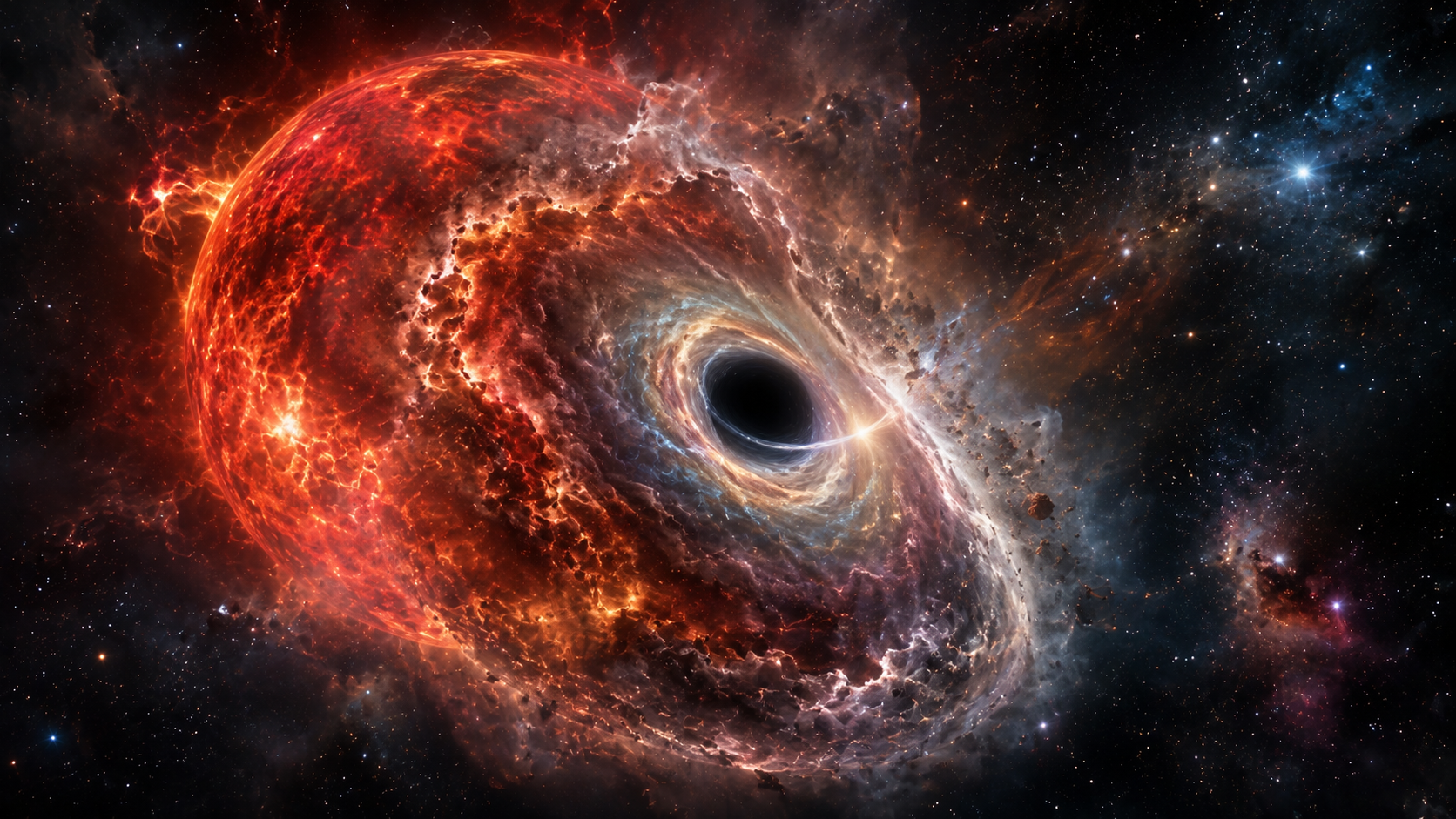
How Do Black Holes Form? Understanding Stellar Black Holes
Black holes are among the most extreme objects in the universe. Their gravity can become so strong that, once matter and light pass a boundary called the event horizon, they cannot escape. But how does an ordinary star end up becoming a black hole? The answer begins with a long battle between gravity and the energy produced inside a massive star.
A black hole is not simply an empty hole in space. It is an extremely compact object formed when a large amount of matter collapses under gravity. The type discussed most directly in the source material is the stellar-mass black hole, which is associated with the final stages of massive stars.
Table of Contents
What Is a Black Hole?
A black hole is a region of spacetime where gravity is so strong that the escape speed is greater than the speed of light. The boundary marking this point of no return is called the event horizon. Because light cannot escape from inside the event horizon, a black hole cannot normally be seen directly by the light it emits.
Astronomers instead detect black holes through their effects on nearby matter and light, including hot gas orbiting the black hole and the motion of nearby stars. Gravitational waves from black-hole mergers provide another way to study them.
How Does a Massive Star Stay Stable?
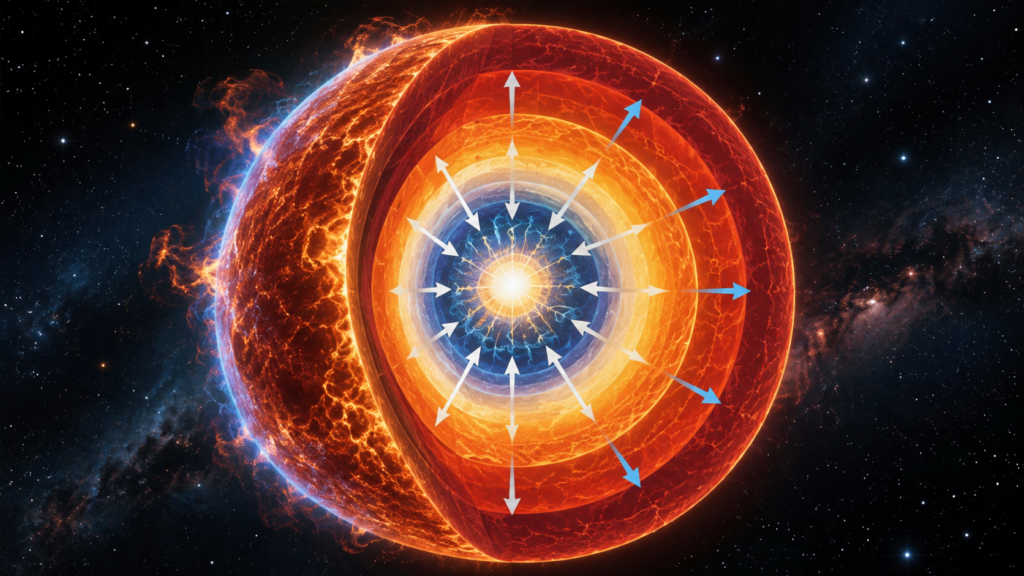
For most of its life, a star is held in a delicate balance. Gravity constantly pulls the star’s material inward, while energy produced by nuclear fusion in the core provides pressure that helps support the star.
In a Sun-like star, hydrogen fusion produces helium. More massive stars can continue through additional stages of nuclear burning and build heavier elements in their cores. As long as the star can generate enough internal pressure to resist gravitational collapse, it remains comparatively stable.
What Happens When a Massive Star Runs Out of Fuel?
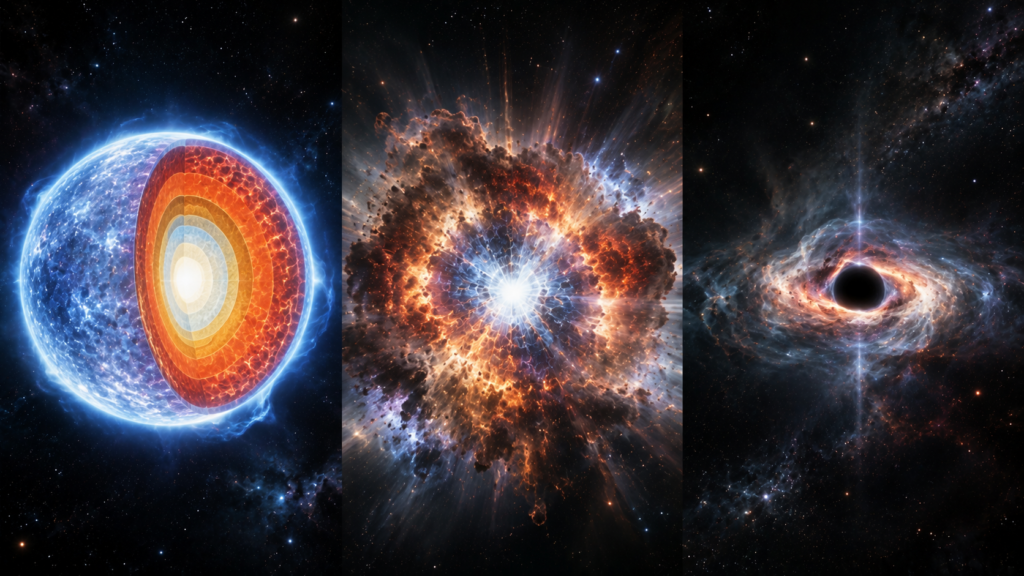
The situation changes when a massive star can no longer produce enough energy through its core reactions. The outward support weakens, while gravity continues pulling the material inward.
In very massive stars, the core can collapse extremely rapidly. The outer layers may be expelled in a supernova explosion, while the remaining core becomes a compact remnant. Depending on the mass and physical state of that remnant, it can become a neutron star or collapse further into a black hole.
The exact mass boundaries are more complicated than a single number because stellar evolution, mass loss, composition, rotation and the details of the collapse all matter. Therefore, it is better not to treat one starting stellar mass as a universal black-hole threshold.
Where Does the Chandrasekhar Limit Fit In?
The Chandrasekhar limit is important to the story of stellar remnants, but it is often misunderstood. It is approximately 1.4 times the mass of the Sun and describes the maximum mass that an ideal white dwarf can support through electron degeneracy pressure.
It is not the direct mass limit that says, ‘above this value, a star becomes a black hole.’ A stellar core that exceeds the white-dwarf support limit can continue evolving into a neutron star or, if the remaining core is sufficiently massive, a black hole.
Neutron stars have their own maximum sustainable mass, and the precise theoretical limit depends on the physics of ultra-dense matter. Once a collapsing core is too massive for any known pressure support to halt its collapse, a black hole can form.
Why Does Gravity Become So Powerful?
The key is not that a black hole suddenly gains a mysterious new kind of gravity. Instead, an enormous amount of mass becomes concentrated into an extraordinarily small region. The resulting spacetime curvature becomes extreme, and an event horizon can form.
This is why saying that a black hole is simply a ‘star with very strong gravity’ is incomplete. Its defining feature is the formation of a region bounded by an event horizon from which no signal can escape to the outside.
What Is a Stellar-Mass Black Hole?
A stellar-mass black hole is a black hole with a mass comparable to that of stars, generally formed through stellar evolution or related compact-object processes. Many are expected to be several times the mass of the Sun, although the observed population covers a broader range.
When a stellar-mass black hole is in a binary system, material from its companion can spiral toward it. The infalling gas can become extremely hot and produce X-rays, allowing astronomers to infer the presence of an otherwise dark object.
Are All Black Holes Formed From Stars?
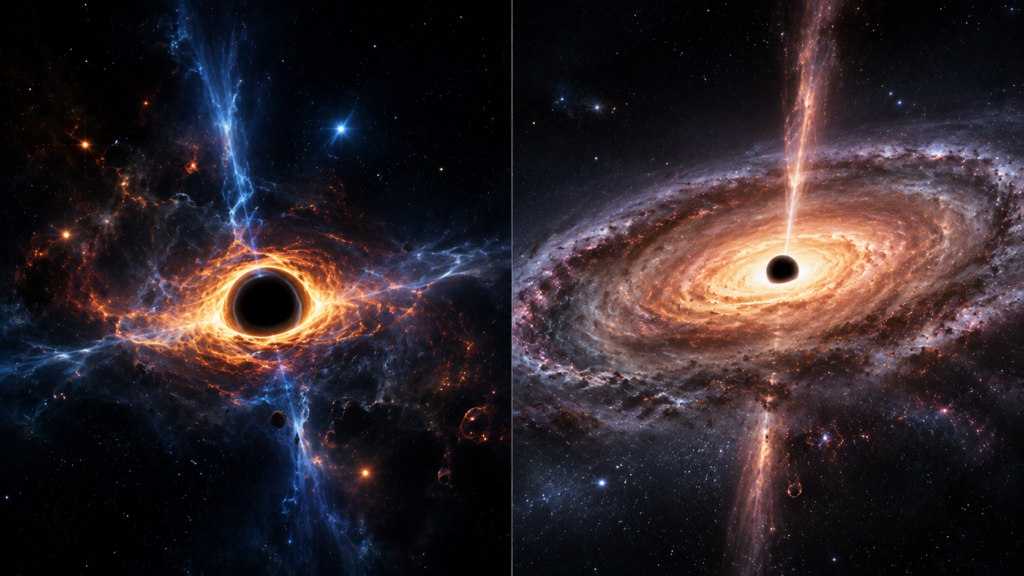
No. Stellar collapse is one important formation pathway, but it is not the only possibility discussed in modern astrophysics. Supermassive black holes, which sit at the centres of many large galaxies, are millions to billions of times more massive than the Sun and have a more complicated origin.
Scientists are also investigating intermediate-mass black holes and the possibility of primordial black holes that could have formed in the early universe. These remain active areas of research, so they should not be presented as settled explanations for every black hole.
Is There a Black Hole at the Centre of the Milky Way?
Yes. The Milky Way contains a supermassive black hole at its centre known as Sagittarius A*. It is very different from a stellar-mass black hole formed by the death of one massive star. Its enormous mass and its location at the centre of the galaxy make it part of a different class of black holes.
The presence of a central black hole does not mean that it is pulling every object in the Milky Way into itself. Stars can orbit the galactic centre at large distances, just as planets orbit the Sun.
What Happens After a Black Hole Forms?
A black hole can grow by accreting matter from its surroundings. Gas, dust and material from a companion star can fall toward it. Some of this material can form a hot accretion disk outside the event horizon and release intense radiation before crossing the point of no return.
Black holes can also merge. When two black holes orbit each other and eventually collide, the event can generate gravitational waves that travel through spacetime. The first direct detection of gravitational waves from a binary black-hole merger was announced in 2016 from the LIGO observation made in 2015.
Black Holes Are Not Cosmic Vacuum Cleaners
A black hole does not automatically pull in everything around it from enormous distances. Gravity depends on mass and distance, just as it does for other objects. If the Sun were somehow replaced by a black hole with exactly the same mass, Earth would continue to orbit at essentially the same distance; the major difference would be the loss of sunlight.
Matter becomes unable to escape once it crosses the event horizon. Outside that boundary, objects can orbit a black hole and, under the right conditions, remain far away from it.
How Scientists Study Something That Does Not Emit Light?
Scientists study black holes indirectly by observing their surroundings and their gravitational effects. Useful evidence includes the motion of nearby stars, X-rays from hot accreting gas, gravitational lensing and gravitational waves produced by mergers.
In 2019, the Event Horizon Telescope collaboration released the first image of a black hole’s shadow-like silhouette, produced by the interaction of the black hole with glowing material around it. This was not a conventional photograph of the black hole’s interior; the event horizon itself remains dark.
Key Takeaways
A black hole forms when matter becomes compressed so strongly that an event horizon can form.
Stellar-mass black holes are commonly associated with the collapse of massive stellar cores.
Nuclear fusion helps support a star against gravity during its active lifetime.
When a massive star can no longer maintain sufficient internal support, its core can collapse.
The Chandrasekhar limit of about 1.4 solar masses applies to white dwarfs, not as a simple universal black-hole threshold.
Black holes can grow by accreting matter and by merging with other black holes.
Supermassive black holes, such as Sagittarius A* at the centre of the Milky Way, have a different and still actively studied origin.
Conclusion
The formation of a stellar black hole is the final stage of an extreme gravitational collapse. A massive star spends its life balancing gravity against the pressure generated by energy-producing processes in its interior. When that support can no longer prevent collapse, the core may become a neutron star or, if sufficiently massive, continue collapsing until an event horizon forms.
Black holes therefore provide a remarkable example of how gravity, nuclear physics and relativity meet in the most extreme environments known in the universe.
Click here to read more A1-InfoHub.com

