


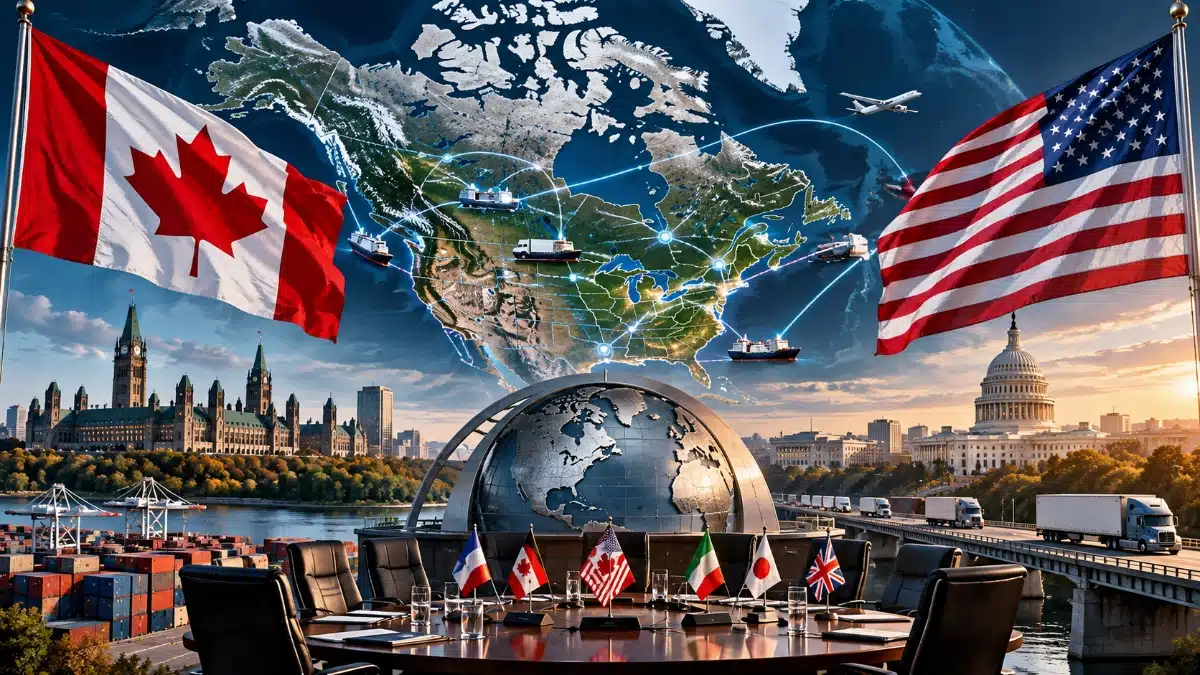
Canada–US Conflict is a hypothetical scenario, not a current military conflict. Canada and the United States remain deeply connected through trade, continental defence, NATO, NORAD and other institutions. But if an armed conflict between the two G7 members ever occurred, the consequences would extend far beyond the battlefield. Canada’s position inside the G7, NATO and the North American security system would create an unusually complicated diplomatic and economic crisis.
Table of Contents
Canada–US Conflict: What Would Happen to Canada’s G7 Position?
Canada would not automatically lose its G7 membership simply because it entered a conflict with another G7 member. The G7 is an informal grouping of seven advanced economies plus the European Union, created as a forum for economic and geopolitical coordination. It is not a mutual-defence alliance and does not operate like NATO.
That means there is no simple rule saying that a war between Canada and the United States would automatically remove Canada from the G7. Instead, the political and diplomatic consequences would be determined by the other G7 governments and by the wider international response.
The situation would also be unprecedented in the modern history of the G7 because Canada and the United States are both members. The other members—France, Germany, Italy, Japan and the United Kingdom—would face a major diplomatic problem: they would have to respond to a conflict between two countries that normally cooperate closely on economic and security issues.
Also Read: Is the United Kingdom Breaking Up?
Would Other G7 Countries Automatically Fight for Canada?
No. G7 membership does not create an automatic military obligation. NATO is different: it is a collective-defence alliance with its own treaty commitments. Canada and the United States are both NATO members, which would make a hypothetical Canada–U.S. war extraordinarily complicated because the two countries would be fighting despite belonging to the same alliance.
The practical response of NATO members would depend on the circumstances, the legal basis of the conflict and decisions taken by the alliance and individual governments. It would therefore be misleading to say that France, Germany, Italy, Japan or the UK would automatically send troops to defend Canada simply because Canada is a G7 member.
Canada’s Defence Relationship With the United States Would Change Completely
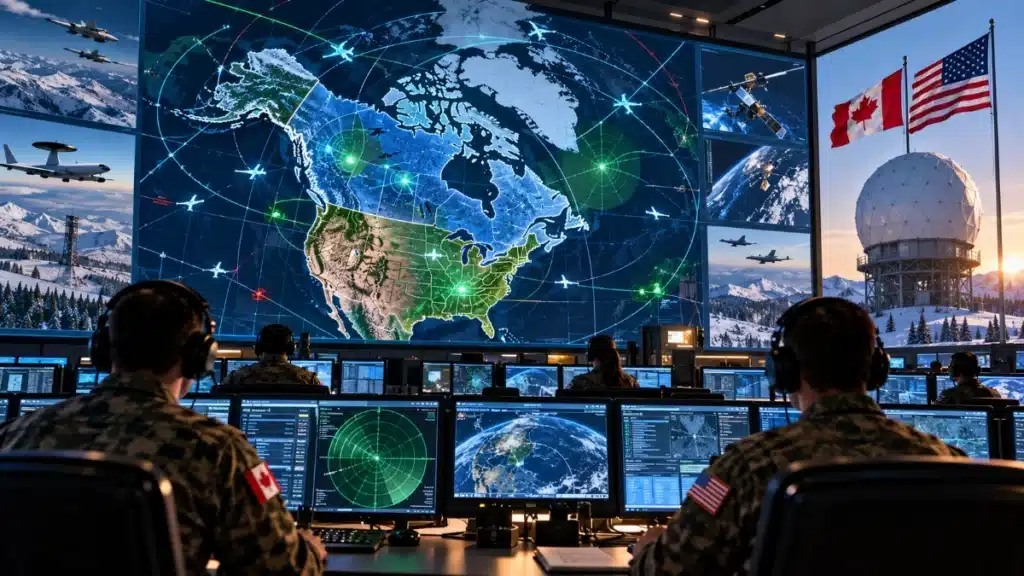
One of the biggest complications would be the collapse of the defence arrangements that currently connect the two countries. NORAD is a binational command responsible for aerospace warning, aerospace control and maritime warning for North America. Canada’s NORAD region identifies and tracks aircraft entering Canadian airspace, while Canadian and U.S. forces routinely train and operate together.
Canada’s defence establishment currently describes the United States relationship as central to North American security. In 2026, Canadian defence officials said Canada was continuing to modernize its contribution to NORAD while maintaining dialogue, exercises and cooperation with the United States.
In a war scenario, those arrangements could no longer function normally between the two combatants. Command structures, intelligence sharing, military exchanges, logistics and defence supply chains would all become major national-security issues. Exactly how they would be reorganized would depend on the circumstances of the conflict; the available sources do not establish a specific wartime plan.
Also Read:Canada-US trade relationship
The Economic Shock Could Be Immediate
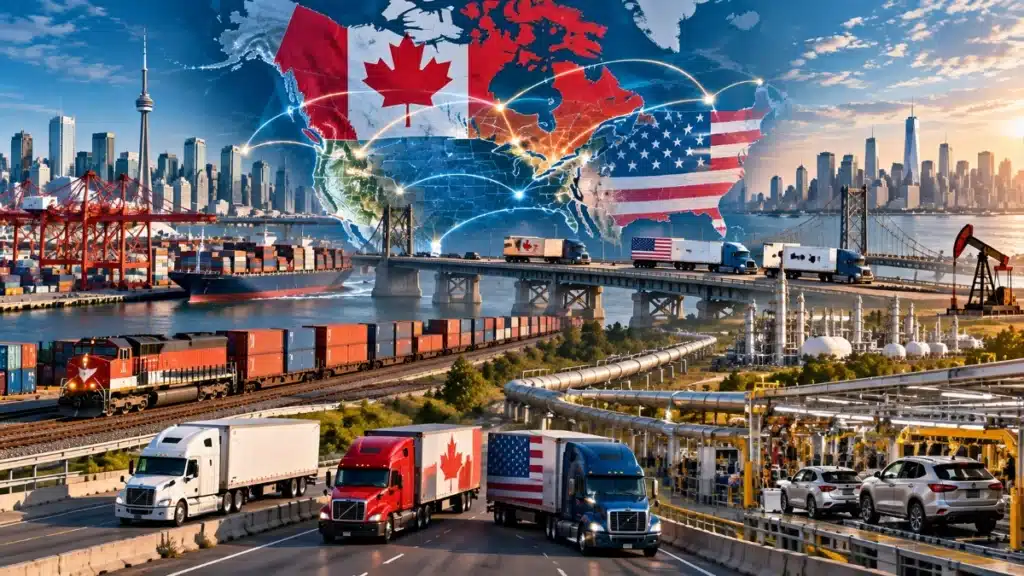
The economic consequences could be particularly severe because Canada and the United States have one of the world’s most integrated trading relationships. Canadian government trade material says more than 75% of Canada’s exports have gone to the United States in recent years, while a large share of those exports feeds into U.S. supply chains. The relationship is especially important in automotive manufacturing, energy, agriculture, defence and other industries.
A military conflict would therefore threaten factories, transportation networks, energy flows, financial markets and cross-border supply chains on both sides. Canada is also an open economy in which trade is roughly two-thirds of GDP, according to the Bank of Canada.
The impact would not be limited to Canada. The United States also relies on Canadian energy, raw materials, manufactured inputs and other goods. Recent trade data show the scale of the relationship: U.S. imports from Canada were about $454 billion in 2025, while U.S. exports to Canada were about $426 billion.
What About Canada’s Military Strength?
Canada has a modern military and is expanding defence capabilities, but its force is much smaller than that of the United States. Current Canadian defence figures show an authorized Regular Force strength of 71,500 and a Primary Reserve target of 30,000; as of March 31, 2026, actual strength was approximately 67,800 Regular Force personnel and 25,100 paid Primary Reserve personnel.
There have also been reports about plans to expand Canada’s reserve capacity substantially. However, a reported mobilization target should not be described as 400,000 fully trained soldiers already available for combat. The figure has been reported as a proposed expansion of different reserve categories, while current official force-strength figures remain far lower.
This distinction matters when discussing the Canada US war scenario. A larger reserve structure could improve Canada’s ability to mobilize people over time, but it would not instantly transform the Canadian Armed Forces into a force equivalent to the U.S. military.
Where Does the Guerrilla-Warfare Story Come From?
The source material behind this article describes reports and commentary about Canadians considering how a smaller country might resist a much larger military, including discussion of guerrilla warfare. The underlying idea is that conventional military strength is not the only factor in a prolonged conflict.
However, the available evidence does not support presenting a specific Canadian government guerrilla-warfare plan as an established operational policy. Public reporting has included individual Canadian veterans discussing guerrilla resistance, but that is different from an official national military doctrine.
For that reason, claims that Canada has officially adopted a Taliban-style strategy should be treated cautiously. A war-game, military discussion or individual proposal should not automatically be presented as a government decision or confirmed battle plan.
The Historical Connection: War Plan Red
There is a real historical reason the Canada US war topic sometimes refers to an old U.S. invasion plan. In the interwar period, U.S. military planners developed War Plan Red, a contingency plan for a hypothetical war with the British Empire. Canada was designated as part of the potential theatre because it was then part of the British Empire. The U.S. National Archives describes the 1930 plan as a scenario for invading Canada if the United States went to war with Great Britain.
The existence of War Plan Red does not mean the United States had a modern plan to invade Canada, nor does it demonstrate that a contemporary war is inevitable. It was a historical contingency plan created under very different geopolitical conditions. The plan was declassified decades later and is useful mainly for understanding how military planners once considered worst-case scenarios involving North America.
Why Would the G7 Matter During Such a Crisis?
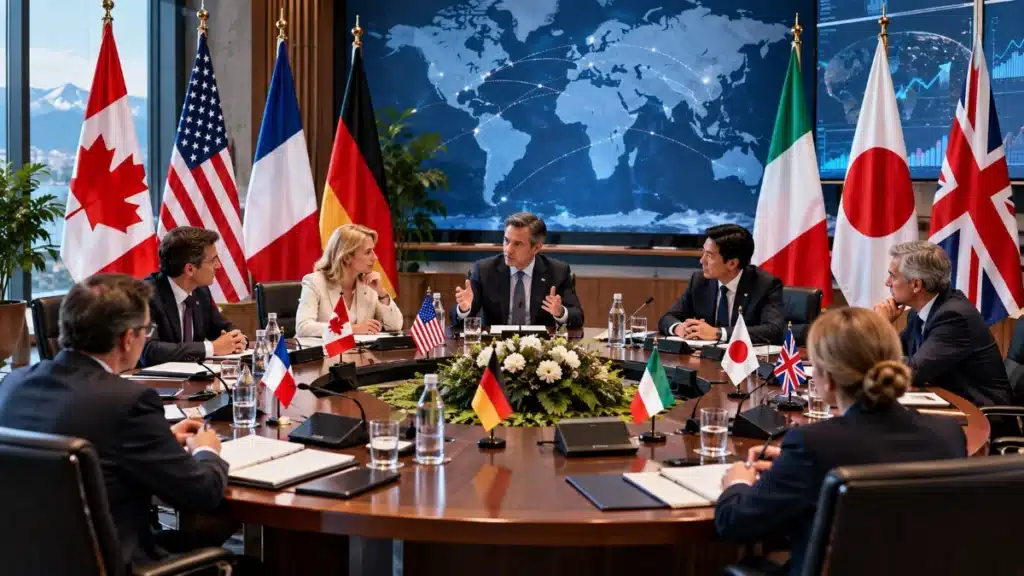
The G7 would matter because it provides a high-level forum for the world’s major advanced economies to coordinate responses to economic and geopolitical crises. Its members regularly discuss financial stability, trade, security, energy and other international issues.
If two G7 members entered a war, the group would face a severe internal crisis. Meetings could become a channel for diplomacy, pressure and economic coordination, while the other members could use separate national or multilateral institutions to respond. But the G7 itself does not function as a military command, so its response would be political and economic rather than an automatic military intervention.
Canada’s diplomatic position would also depend on its relationships outside the G7. Canada is a NATO member and participates in other international partnerships, including Five Eyes intelligence cooperation. Canadian defence policy identifies NORAD, NATO and Five Eyes as important parts of the country’s security relationships.
Would Canada Lose Its International Influence?
A conflict would almost certainly create a major diplomatic shock, but the exact effect on Canada’s international position cannot be predicted with certainty. Canada would remain a sovereign state unless its legal status changed through some separate political process. Its G7 membership would not automatically disappear simply because the United States was at war with it.
The larger question would be how Canada and its partners maintained international cooperation during the crisis. European G7 countries and other allies could face pressure to balance economic interests, security commitments and relations with Washington and Ottawa. The outcome would depend heavily on the cause of the conflict, the conduct of the parties and decisions made by other governments.
Could a Canada US War Actually Happen?
The source material focuses on a hypothetical conflict rather than an ongoing war. Current official Canadian sources continue to describe active cooperation with the United States through NORAD and other defence arrangements.
Political rhetoric about Canada’s future relationship with the United States can generate concern, but rhetoric, contingency planning and military simulations are not the same thing as a decision to start a war. A responsible analysis therefore needs to separate documented developments from hypothetical scenarios.
Frequently Asked Questions
Would Canada remain a G7 country during a Canada US war?
There is no automatic G7 rule that would expel Canada simply because it entered a conflict with another G7 member. The G7 is an informal political and economic grouping, not a military alliance. The other members could respond politically, but the exact institutional outcome would depend on the circumstances.
Would the other G7 countries send troops to Canada?
Not automatically. G7 membership does not create a collective-defence obligation. Any military assistance would depend on separate treaties, national decisions and the circumstances of the conflict.
Would NATO defend Canada against the United States?
Canada and the United States are both NATO members, which makes a hypothetical conflict between them legally and politically complex. NATO’s collective-defence framework would not translate into a simple rule that automatically makes the alliance fight one member on behalf of another.
How important is the United States to Canada’s economy?
Extremely important. Canadian government sources report that more than 75% of Canadian exports have gone to the United States in recent years, while Canadian and U.S. production networks are deeply integrated.
Does Canada already have 400,000 reserve soldiers ready for war?
No. Reports about a proposed 400,000-person reserve structure should not be confused with 400,000 trained troops currently ready for combat. Official Canadian figures for March 31, 2026 put the Primary Reserve at about 25,100 paid personnel, with an authorized target of 30,000.
Was there really a U.S. plan to invade Canada?
Yes, historically. War Plan Red was a U.S. contingency plan for a hypothetical war with Great Britain, and Canada was considered a major theatre because of its position within the British Empire. The plan was completed in 1930 and was later declassified.
Conclusion
A Canada US war would be far more than a bilateral military confrontation. It would challenge the economic system connecting North America, disrupt the defence architecture built around NORAD and NATO, and create an extraordinary crisis inside the G7 because both countries are members.
Canada would not automatically cease to be a G7 country, and the other G7 members would not automatically enter the war. The precise response would depend on the circumstances and on political decisions made by Canada, the United States and their international partners.
What can be established today is that the two countries remain deeply integrated economically and militarily, making an actual war a fundamentally different scenario from the hypothetical preparations and historical plans discussed in the source material.
Also Read:US Deploys Space Weapons for First Time in Orbit: What the 2026 Disclosure Means


[…] Canada US War: What Happe… […]
[…] Canada US War: What Happe… […]