


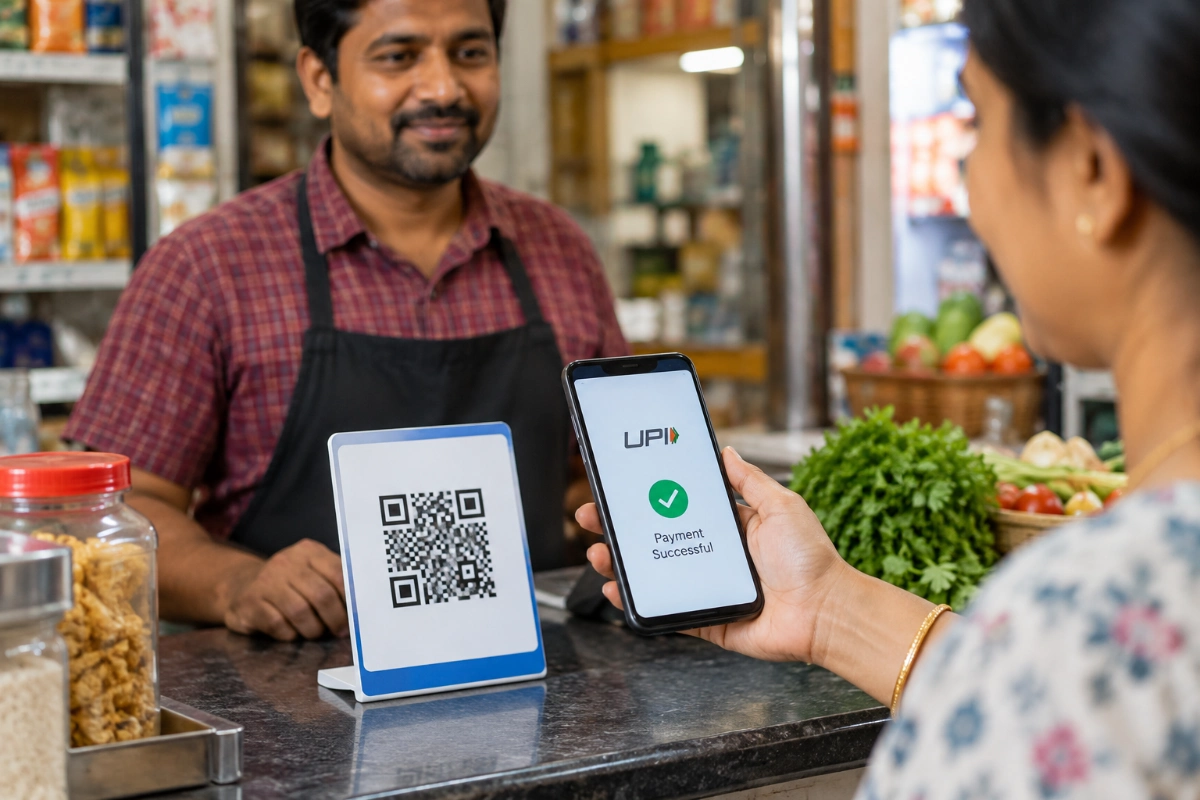
UPI Payment Charges From October 15, 2026: India’s Unified Payments Interface (UPI) is set to introduce a revised Merchant Discount Rate (MDR) framework from October 15, 2026. The change will affect selected person-to-merchant payments above ₹2,000, while ordinary person-to-person transfers and most small-value merchant payments will remain free.
The Ministry of Finance has clarified that the new MDR is not a tax collected by the government or NPCI. Instead, it is a charge distributed among participants in the payment ecosystem, including banks and payment application providers, to support the continued operation and expansion of UPI.
Table of Contents
Will customers have to pay UPI charges?
According to the Ministry of Finance, customers will not be directly charged MDR when making UPI payments. The revised framework applies to specified merchant transactions, not to ordinary transfers between individuals.
The following transactions will remain free:
- Person-to-person UPI transfers, regardless of the amount.
- Merchant payments of ₹2,000 or less.
- Payments received by eligible small merchants covered under the zero-MDR framework.
- Ordinary UPI usage without a monthly quota or tiered fee structure.
The government has stated that approximately 96% of person-to-merchant transactions will remain unaffected.
What is the new MDR rate for merchant payments?
From October 15, 2026, a 0.4% MDR will apply to specified person-to-merchant UPI payments above ₹2,000.
For transactions of ₹75,000 or more, the MDR will be capped at ₹300 per transaction. The charge is intended to be paid within the merchant payment ecosystem rather than directly by the customer.
Examples of the standard MDR
| Payment amount | 0.4% MDR | Applicable cap |
|---|---|---|
| ₹3,000 | ₹12 | ₹300 |
| ₹10,000 | ₹40 | ₹300 |
| ₹50,000 | ₹200 | ₹300 |
| ₹75,000 | ₹300 | ₹300 |
| ₹1,00,000 | ₹400 | ₹300 |
These examples show the standard rate before applying the maximum transaction-level cap.
Which sectors will have a flat ₹5 MDR?
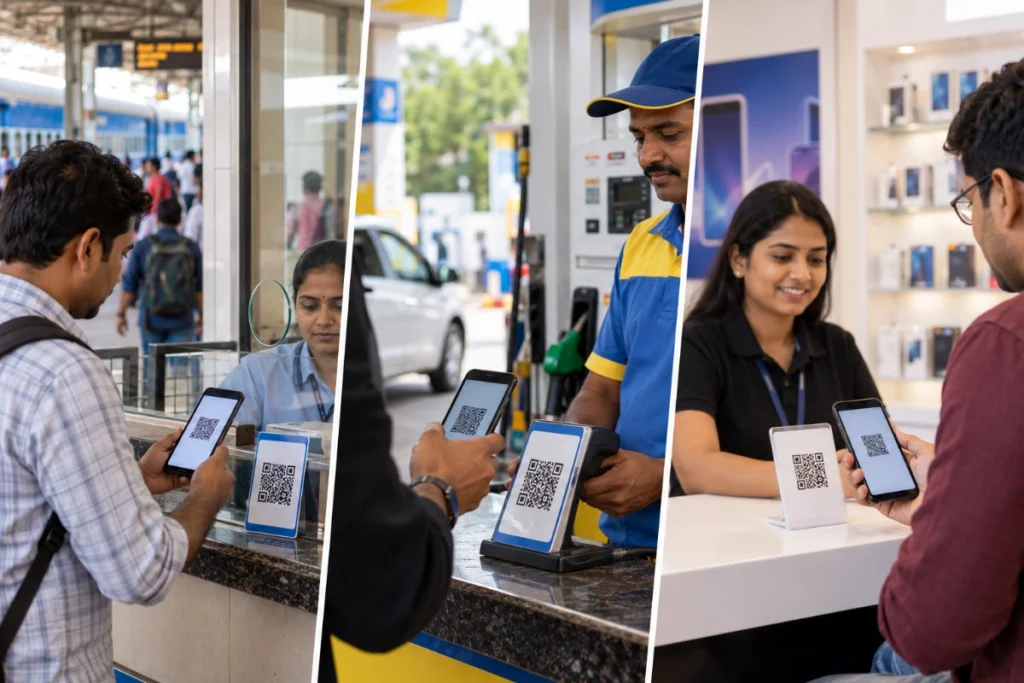
Certain essential and thin-margin sectors will use a flat MDR of ₹5 per transaction for eligible payments above ₹2,000.
The sectors identified by the Ministry of Finance include:
- Railway payments
- Telecommunications
- Insurance
- Fuel and petrol payments
- Agricultural inputs
The flat rate is intended to provide more predictable costs for businesses and public services operating with narrow margins.
What about mutual funds, shares and stockbroker payments?
Payments connected with capital-market services will attract a lower MDR of 0.02%, with a maximum cap of ₹300 per transaction.
This category includes payments relating to:
- Mutual funds
- Securities
- Stockbrokers
- Dealers
- Other eligible investment-related services
The lower rate is intended to support continued participation in formal financial markets.
Will small merchants be affected?
Eligible small merchants receiving up to ₹1 lakh per month through UPI QR codes under the Person-to-Person-Merchant, or P2PM, category will continue to receive zero-MDR treatment.
This provision is designed to protect:
- Street vendors
- Small neighbourhood shops
- Micro-enterprises
- Other eligible small businesses
However, the exemption depends on the merchant’s classification under the applicable framework. Not every merchant should assume that the exemption applies automatically.
Will UPI payments to friends and family remain free?

Yes. Person-to-person UPI transfers will remain free, even when the amount is above ₹2,000.
For example, sending ₹5,000 to a friend or transferring ₹20,000 to a family member will not attract the new MDR. The framework applies to specified merchant payments, not ordinary individual-to-individual transfers.
Can merchants pass the MDR cost to customers?
The Ministry of Finance has said that banks should ensure merchants do not pass MDR charges on to customers. UPI application providers are also prohibited from imposing platform fees or hidden charges under the clarified framework.
Even so, merchants may consider payment-processing costs when setting prices in the wider market. Whether any business changes its prices will depend on its own costs, margins and commercial decisions. The official framework itself does not authorise a separate MDR charge to be collected directly from customers.
Why is UPI introducing MDR?

The government has described the framework as a measure to support the long-term sustainability of UPI.
UPI processes very large transaction volumes and requires continued investment in:
- Cybersecurity
- Fraud prevention
- Payment infrastructure
- Customer support
- Rural and semi-urban expansion
- Wider acceptance among small businesses
The government has also said that MDR revenue will be distributed among payment ecosystem participants, including banks, payment service providers and UPI application providers. A dedicated fund equivalent to 5% of total MDR collections is planned to support UPI adoption among small merchants. <Cite refs={[“turn0search3″,”turn0search1”]} />
What remains unclear?
Although the broad framework has been announced, some operational details may depend on implementation instructions and the final arrangements between ecosystem participants.
Users and merchants should pay attention to:
- The exact classification of a transaction.
- Whether a merchant qualifies for the small-merchant exemption.
- Whether a payment is treated as a standard merchant payment, essential-sector payment or capital-market payment.
- The way banks and payment providers display transaction information.
- Any official updates issued by NPCI, the RBI or the Ministry of Finance.
The official guidance states that users should rely on verified announcements rather than forwarded messages or social-media claims.
Frequently Asked Questions
Is UPI becoming chargeable from October 15, 2026?
Selected merchant payments above ₹2,000 will attract MDR under the revised framework. UPI will not become universally chargeable, and person-to-person transfers will remain free.
Will I pay ₹300 for every UPI payment above ₹2,000?
No. The standard MDR is 0.4%, capped at ₹300 for transactions of ₹75,000 or more. The maximum does not apply to every payment.
Is the ₹5 charge applicable to all UPI payments?
No. The flat ₹5 MDR applies to specified eligible transactions in sectors such as railways, telecommunications, insurance, fuel and agricultural inputs.
Will sending money to another person attract MDR?
No. Person-to-person UPI transfers remain free regardless of the amount transferred.
Will small shops have to pay MDR?
Eligible small merchants receiving up to ₹1 lakh per month through qualifying P2PM arrangements will continue to receive zero-MDR treatment.
Is MDR a government tax?
No. The Ministry of Finance has clarified that MDR is neither a tax nor a charge collected by the government or NPCI. It is distributed among participants in the payment ecosystem.
Will UPI apps charge an additional platform fee?
Under the clarified framework, UPI application providers are not permitted to impose platform fees or hidden charges on customers for these transactions.
Conclusion
The revised UPI payment charges framework from October 15, 2026, is focused on selected merchant payments above ₹2,000 rather than ordinary users’ daily transfers. The standard MDR is 0.4%, with a ₹300 cap, while certain essential services and capital-market payments will follow separate rates.
Person-to-person transfers, payments up to ₹2,000 and eligible small-merchant transactions will remain free. Customers should still check official updates from NPCI, the RBI and the Ministry of Finance as implementation details become clearer.
Read more in our website:General Info – A1-InfoHub

